Oklahoma Math 6.N.2.5
The Standard
- 6.N.2
- Read, write, and model whole number and integer operations to solve problems.
Factor whole numbers and express prime and composite numbers as a product of prime factors with exponents.
Oklahoma Academic Standards for Mathematics (2022)
Teacher's field guide
What This Standard Means
What Students Need to Do
- Students find factor pairs and decide whether a number is prime or composite. They break numbers into prime factors and use exponents to show repeated factors.
What Mastery Looks Like
- A student can list all the factor pairs of 36 without repeats. They write its prime factorization as 2² × 3² and check by multiplying. They know that a prime number has only itself as a prime factor.
Common Misconceptions
- Some students stop at 4 × 9 when factoring 36, even though 4 and 9 are composite. Others read 3² as 3 × 2 or call 1 prime.
How to Assess It
- Exit ticket: List the factor pairs of 18, label it prime or composite, and write its prime factorization with an exponent. Multiply the prime factors to check.
Lesson moves
Ways to Teach It
Arrange 36 counters in rectangular arrays, list the factor pairs, then make a factor tree and write 36 as 2² × 3².
Draw two different factor trees for 36 and explain why both end with the same prime factors.
Play a matching game with number cards 12, 18, 20, and 45 and cards showing their prime factorizations.
Plan equal-size boxes for 48 pencils: list possible pencils per box, then write 48 as a product of prime powers.
Free download
Printable 6.N.2.5 Worksheet
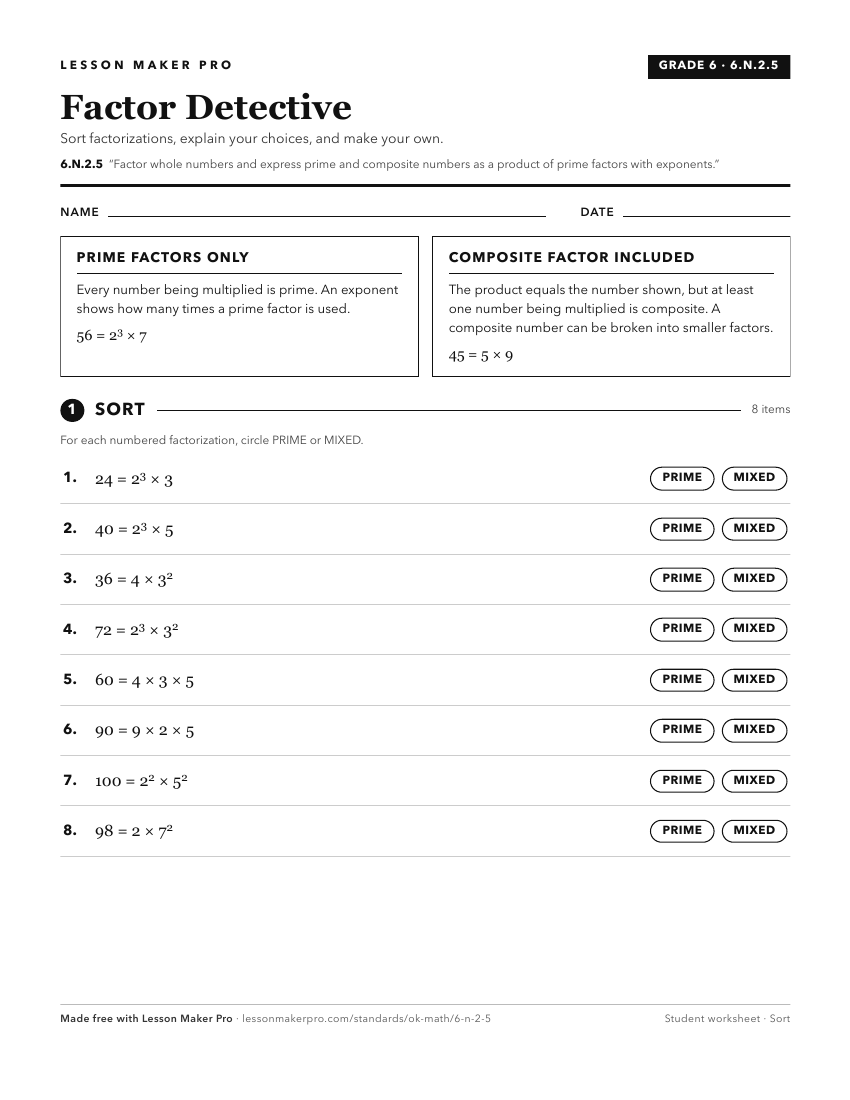
A ready-to-print activity worksheet aligned to 6.N.2.5, with an answer key for the teacher on its own page. No account needed.
PDF, US Letter, prints cleanly in black and white.
Download the worksheetKeep exploring
Related Standards
- A1.A.3.3
Factor common monomial factors from polynomial expressions and factor quadratic expressions with a leading coefficient of 1.
- A2.A.2.1
Factor polynomial expressions including, but not limited to, trinomials, differences of squares, sum and difference of cubes, and factoring by grouping, using a...
- 6.N.2.4
Identify and represent patterns with whole-number exponents and perfect squares. Evaluate powers with whole-number bases and exponents.
- 7.N.2.4
Raise rational numbers (integers, fractions, and decimals) to positive integer exponents.
Turn this exact standard into a lesson
Grade, subject, topic, and the complete standard are prefilled. Create one free, no account needed.
Also for this standard:Make a WorksheetMake a QuizMake a Sub Lesson