Oklahoma Math 6.N.2.6
The Standard
- 6.N.2
- Read, write, and model whole number and integer operations to solve problems.
Determine the greatest common factors and least common multiples. Use common factors and multiples to calculate with fractions, find equivalent fractions, and express the sum of two-digit numbers with a common factor using the distributive property.
Oklahoma Academic Standards for Mathematics (2022)
Teacher's field guide
What This Standard Means
What Students Need to Do
- Find the greatest common factor and least common multiple of two numbers. Use common factors to simplify fractions and common multiples to make equivalent fractions and add fractions. Factor a shared number out of sums such as 24 + 36 = 12(2 + 3).
What Mastery Looks Like
- For 18 and 24, a student finds a greatest common factor of 6 and a least common multiple of 72. They simplify 18/24 to 3/4 and add 1/6 + 1/8 to get 7/24. They rewrite 24 + 36 as 12(2 + 3) and check that both sides equal 60.
Common Misconceptions
- Students may call 12 a common multiple of 6 and 8, even though 8 does not divide into 12. They may add denominators, writing 1/6 + 1/8 = 2/14, or divide only the numerator when simplifying. Some write 24 + 36 = 12(24 + 36) instead of dividing both addends by 12.
How to Assess It
- Exit ticket: Find the greatest common factor and least common multiple of 12 and 18. Use them to simplify 12/18, add 1/12 + 1/18, and rewrite 12 + 18 using a common factor.
Lesson moves
Ways to Teach It
Give pairs 24 red and 36 blue counters; ask for the greatest number of identical groups, then write 24 + 36 = 12(2 + 3).
Ask: Why does 1/6 + 1/8 need a common denominator, and why does 24 work while 14 does not?
Play a card round: draw 18 and 24, race to find their greatest common factor and least common multiple, then simplify 18/24.
Post a bus schedule with routes every 6 and 8 minutes, both arriving at 9:00; ask when they next arrive together.
Free download
Printable 6.N.2.6 Worksheet
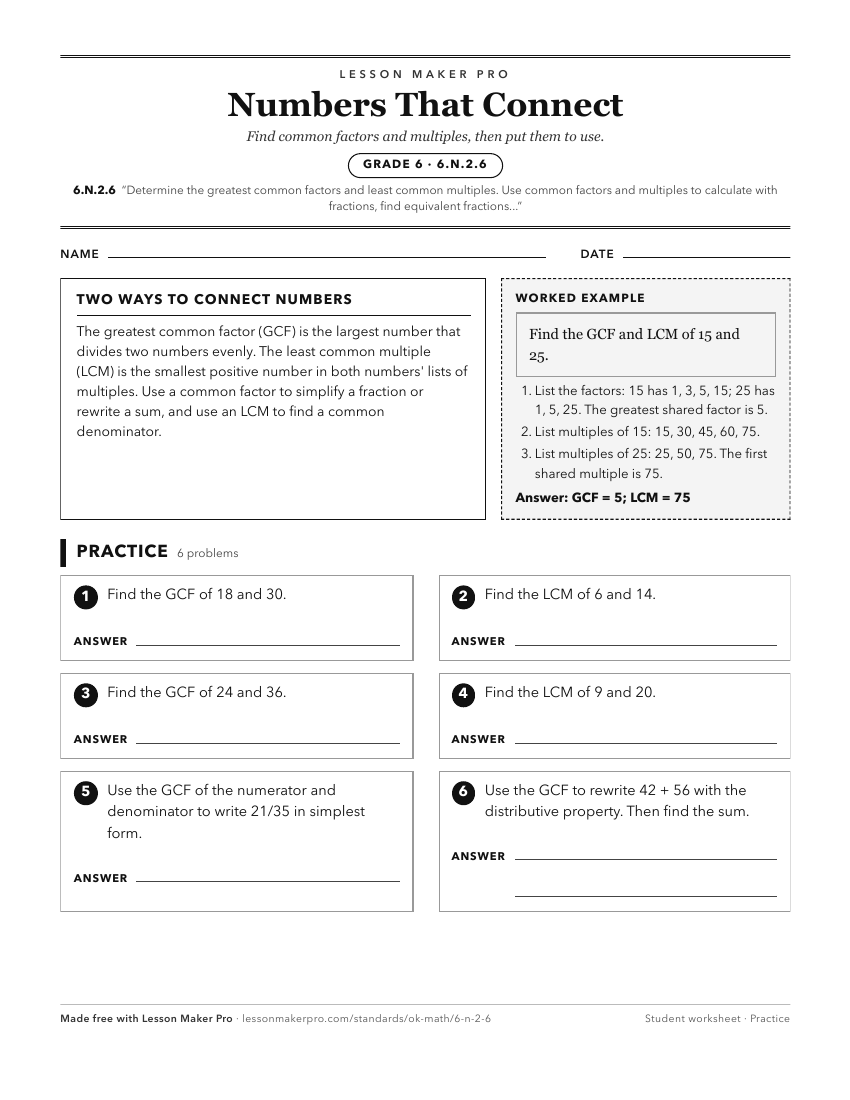
A ready-to-print activity worksheet aligned to 6.N.2.6, with an answer key for the teacher on its own page. No account needed.
PDF, US Letter, prints cleanly in black and white.
Download the worksheetKeep exploring
Related Standards
- 4.N.2.3
Estimate products of 3-digit by 1-digit and 2-digit by 2-digit whole number factors using a variety of strategies (e.g., rounding, front end estimation, adjusti...
- 3.N.2.8
Use various strategies (e.g., base ten blocks, area models, arrays, repeated addition, algorithms) based on knowledge of place value, equality, and properties o...
- 4.N.2.5
Use strategies and algorithms (e.g., mental strategies, standard algorithms, partial quotients, repeated subtraction, the commutative, associative, and distribu...
- 4.N.2.2
Multiply 3-digit by 1-digit and 2-digit by 2-digit whole numbers, using various strategies, including but not limited to standard algorithms.
Turn this exact standard into a lesson
Grade, subject, topic, and the complete standard are prefilled. Create one free, no account needed.
Also for this standard:Make a WorksheetMake a QuizMake a Sub Lesson