Oklahoma Math 3.GM.2
Standard Cluster
Understand measurable attributes of real-world and mathematical objects using various tools. Find the perimeter of a polygon, given whole number lengths of the sides, using a variety of models. Analyze why length and width are multiplied to find the area of a rectangle by decomposing the rectangle into one unit by one unit squares and viewing these as rows and columns to determine the area. Count cubes systematically to identify the number of cubes needed to pack the whole or half of a three-dimensional structure. Find the area of two-dimensional figures by counting the total number of same-size unit squares that fill the shape without gaps or overlaps. Choose an appropriate measurement instrument and measure the length of objects to the nearest whole centimeter or whole meter. Choose an appropriate measurement instrument and measure the length of objects to the nearest whole yard, whole foot, or half inch. Use an analog thermometer to determine temperature to the nearest degree in Fahrenheit and Celsius.
Oklahoma Academic Standards for Mathematics (2022)
Cluster contents
Standards in This Cluster
3.GM.2 is a cluster heading. These are the individual standards under it.
- 3.GM.2.1
Find the perimeter of a polygon, given whole number lengths of the sides, using a variety of models.
- 3.GM.2.2
Analyze why length and width are multiplied to find the area of a rectangle by decomposing the rectangle into one unit by one unit squares and viewing these as ...
- 3.GM.2.3
Count cubes systematically to identify the number of cubes needed to pack the whole or half of a three-dimensional structure.
- 3.GM.2.5
Choose an appropriate measurement instrument and measure the length of objects to the nearest whole centimeter or whole meter.
- 3.GM.2.6
Choose an appropriate measurement instrument and measure the length of objects to the nearest whole yard, whole foot, or half inch.
- 3.GM.2.7
Use an analog thermometer to determine temperature to the nearest degree in Fahrenheit and Celsius.
Teacher's field guide
What This Cluster Means
What Students Need to Do
- Students choose a ruler or tape to measure to the nearest whole centimeter, meter, yard, or foot, or nearest half inch. They add polygon sides for perimeter, count unit squares for area, and explain rectangle area using rows and columns. They count cubes in a whole or half structure and read analog thermometers to the nearest degree in Fahrenheit and Celsius.
What Mastery Looks Like
- A student counts the squares in a stepped shape and shows why a rectangle with 3 rows of 4 squares has an area of 12 square units. They add every side for perimeter and count cubes layer by layer in a whole block and one half of it. They choose a suitable measuring tool, round lengths as asked, and read both thermometer scales.
Common Misconceptions
- Students may add only two sides for perimeter or use perimeter to name an area. They may count grid lines instead of squares or miss cubes hidden behind others. They may round half inches to whole inches or read the wrong thermometer scale.
How to Assess It
- Show a 3-by-4 tiled rectangle with its side lengths labeled. Ask, "What are its area and perimeter? Show why multiplying the rows and columns gives the area."
Lesson moves
Ways to Teach It
Tile a 3-by-4 rectangle with 1-centimeter squares, count its area, then trace and add its four side lengths for perimeter.
Ask, "Why does 3 times 4 count every square in this tiled rectangle?" Have partners sketch rows and columns before answering.
Race to build a 2-by-3-by-2 cube block, remove its top layer, and count cubes in the whole block and half left.
Choose tools to measure pencils in centimeters and half inches, hallways in meters and yards, desks in feet; read analog Fahrenheit and Celsius thermometers.
Free download
Printable 3.GM.2 Worksheet
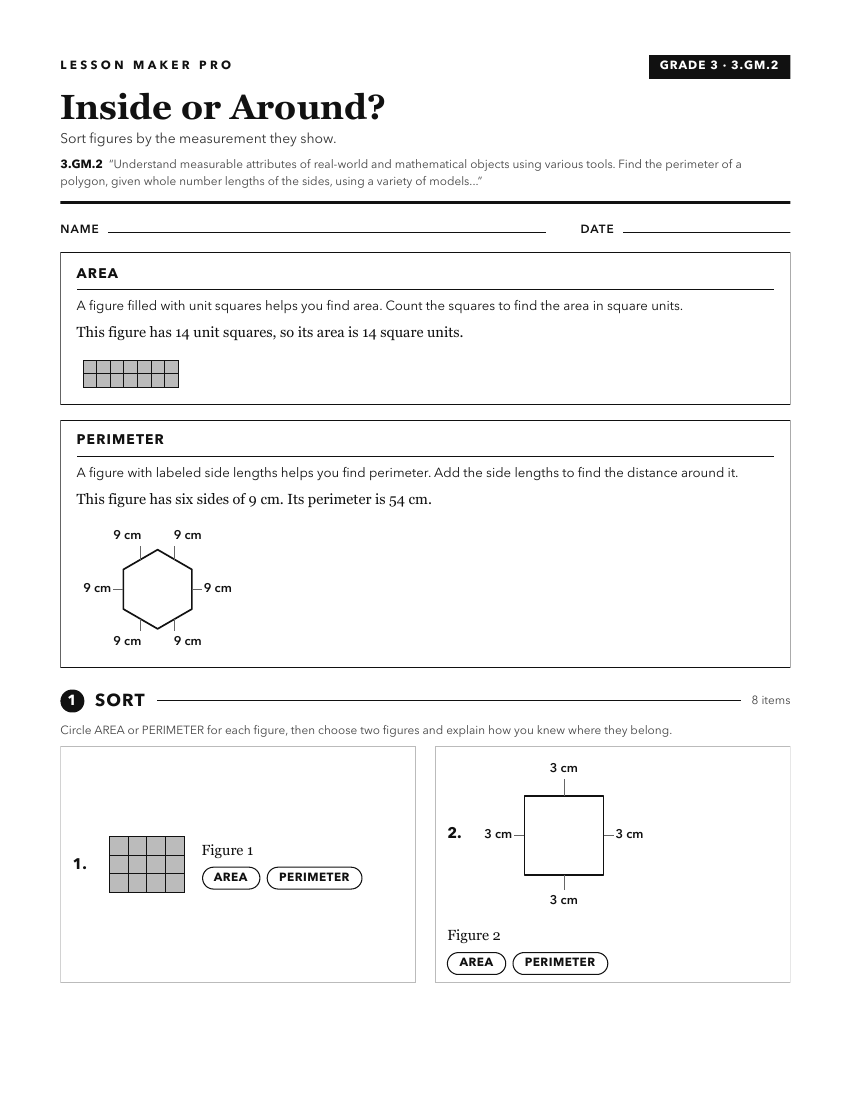
A ready-to-print activity worksheet aligned to 3.GM.2, with an answer key for the teacher on its own page. No account needed.
PDF, US Letter, prints cleanly in black and white.
Download the worksheetKeep exploring
Related Standards
- 4.GM.2
Recognize and measure attributes in real-world and mathematical situations using various tools.
- 5.GM.3
Understand angle, length, weight, and capacity as measurable attributes of real-world and mathematical objects, using various tools to measure them. Solve real-...
- 6.A.1
Recognize and represent relationships between varying quantities; translate from one representation to another; use patterns, tables, graphs, and rules to model...
- 1.A.1
Identify patterns found in real-world and mathematical problems.
Turn this cluster into a lesson
Grade, subject, topic, and the complete cluster are prefilled. Create one free, no account needed.
Also for this cluster:Make a WorksheetMake a QuizMake a Sub Lesson