Oklahoma Math 6.A.1
Standard Cluster
Recognize and represent relationships between varying quantities; translate from one representation to another; use patterns, tables, graphs, and rules to model and solve mathematical problems. Plot integer- and rational-valued (limited to halves and fourths) ordered-pairs as coordinates in all four quadrants and recognize the reflective relationships among coordinates that differ only by their signs. Represent relationships between two varying positive quantities involving no more than two operations with rules, graphs, and tables; translate between any two of these representations. Use and evaluate variables in expressions, equations, and inequalities that arise from various contexts, including determining when or if, for a given value of the variable, an equation or inequality involving a variable is true or false.
Oklahoma Academic Standards for Mathematics (2022)
Cluster contents
Standards in This Cluster
6.A.1 is a cluster heading. These are the individual standards under it.
- 6.A.1.1
Plot integer- and rational-valued (limited to halves and fourths) ordered-pairs as coordinates in all four quadrants and recognize the reflective relationships ...
- 6.A.1.2
Represent relationships between two varying positive quantities involving no more than two operations with rules, graphs, and tables; translate between any two ...
- 6.A.1.3
Use and evaluate variables in expressions, equations, and inequalities that arise from various contexts, including determining when or if, for a given value of ...
Teacher's field guide
What This Cluster Means
What Students Need to Do
- Students plot whole-number, half, and fourth coordinates in all four quadrants and spot reflections across the axes. They move between tables, graphs, and simple rules for two changing positive quantities. They use variables in expressions, equations, and inequalities, then test whether statements are true for a given value.
What Mastery Looks Like
- Given a table of hours and cost, a student writes a rule such as c = 2h + 3 and graphs matching points. They plot (1/2, -3/4) and (-1/2, -3/4) and identify the reflection across the y-axis. They find c when h = 2 and correctly judge whether c > 6 and c = 7.
Common Misconceptions
- Students may reverse x and y or put a negative half on the positive side of an axis. Some think changing one sign reflects a point across both axes. Others read 2h + 3 as 2(h + 3), or assume an inequality with a variable is always true.
How to Assess It
- Exit ticket: For y = 2x + 3, make a table for x = 1 and x = 2, plot both points, and decide whether y > 6 when x = 2. Plot (1/2, -1) and (-1/2, -1), then name the line of reflection.
Lesson moves
Ways to Teach It
Tape a four-quadrant grid on the floor, then have students place cards at (1/2, -1/4) and (-1/2, -1/4).
Ask: A bike rental costs $3 plus $2 per hour. Which table and graph match c = 2h + 3, and why?
Run a true-or-false card sort: at x = 2, check 2x + 3 = 7, 2x + 3 < 6, and 2x + 3 > 6.
Use a takeout menu with a $2 delivery fee and $3 snacks; write a cost rule and graph orders of 1 to 4 snacks.
Free download
Printable 6.A.1 Worksheet
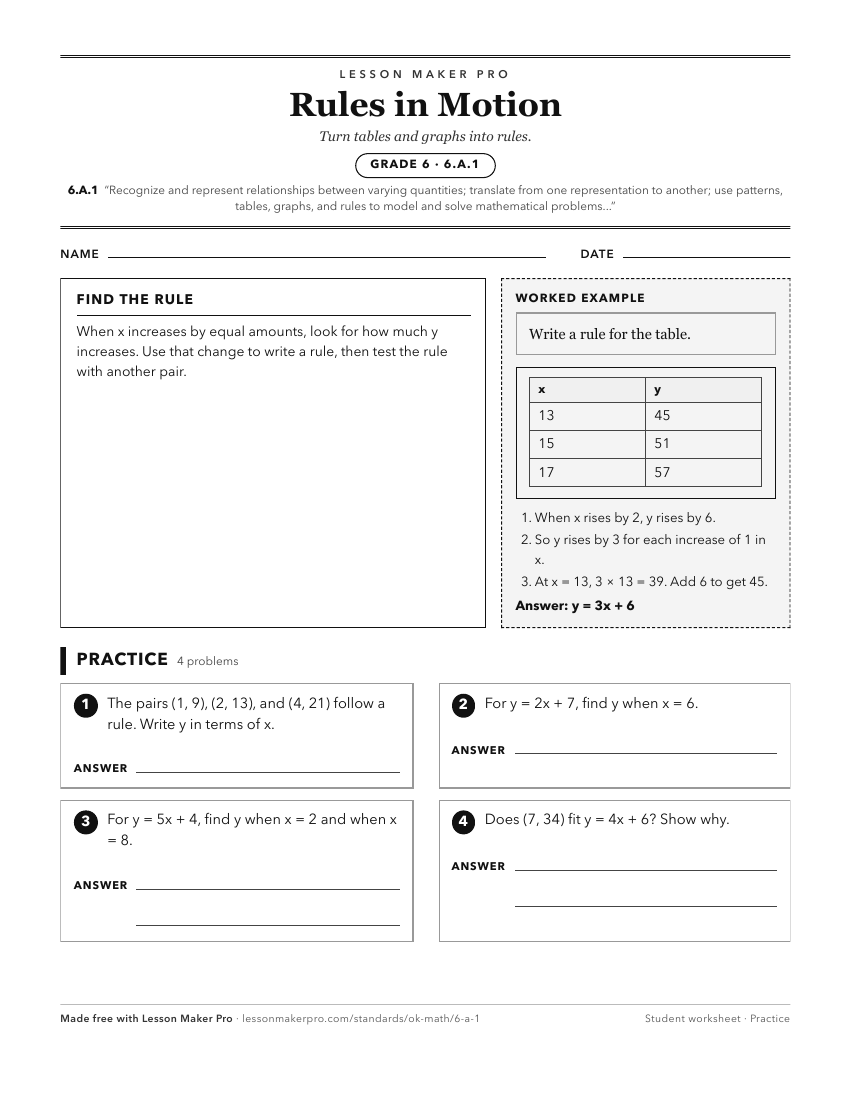
A ready-to-print activity worksheet aligned to 6.A.1, with an answer key for the teacher on its own page. No account needed.
PDF, US Letter, prints cleanly in black and white.
Download the worksheetKeep exploring
Related Standards
- 4.A.1
Describe, create, and analyze multiple representations of patterns to solve real-world and mathematical problems.
- A1.F.3
Represent functions in multiple ways and use the representation to interpret real-world and mathematical problems.
- PA.A.1.2
Use linear functions to represent and model mathematical situations.
Turn this cluster into a lesson
Grade, subject, topic, and the complete cluster are prefilled. Create one free, no account needed.
Also for this cluster:Make a WorksheetMake a QuizMake a Sub Lesson