Oklahoma Math 3.GM.2.2
The Standard
- 3.GM.2
- Understand measurable attributes of real-world and mathematical objects using various tools.
Analyze why length and width are multiplied to find the area of a rectangle by decomposing the rectangle into one unit by one unit squares and viewing these as rows and columns to determine the area.
Oklahoma Academic Standards for Mathematics (2022)
Teacher's field guide
What This Standard Means
What Students Need to Do
- Students split a rectangle into equal-size square units. They count the squares across and the rows down, then multiply to find the total number of squares.
What Mastery Looks Like
- Given a 4-by-6 rectangle on grid paper, a student can show four rows of six squares and write 4 × 6 = 24 square units. They can explain why the product counts every square once.
Common Misconceptions
- Students may count grid lines instead of squares, or add length and width instead of multiplying. Some count the outside edge and call it area.
How to Assess It
- Give students a 3-by-5 rectangle on grid paper. Ask them to label one row and the number of rows, write an area equation, and explain why it works.
Lesson moves
Ways to Teach It
Give pairs square tiles to build a 4-by-3 rectangle, then have them count rows and columns and write an area equation.
Show a 3-by-6 grid and ask, 'Why does 3 × 6 count every square without counting them one by one?'
Roll two dice, draw the matching rectangle on grid paper, and score one point for a correct area equation with square units.
Show a photo of a floor with 4 rows of 5 square tiles and ask how many tiles cover it.
Free download
Printable 3.GM.2.2 Worksheet
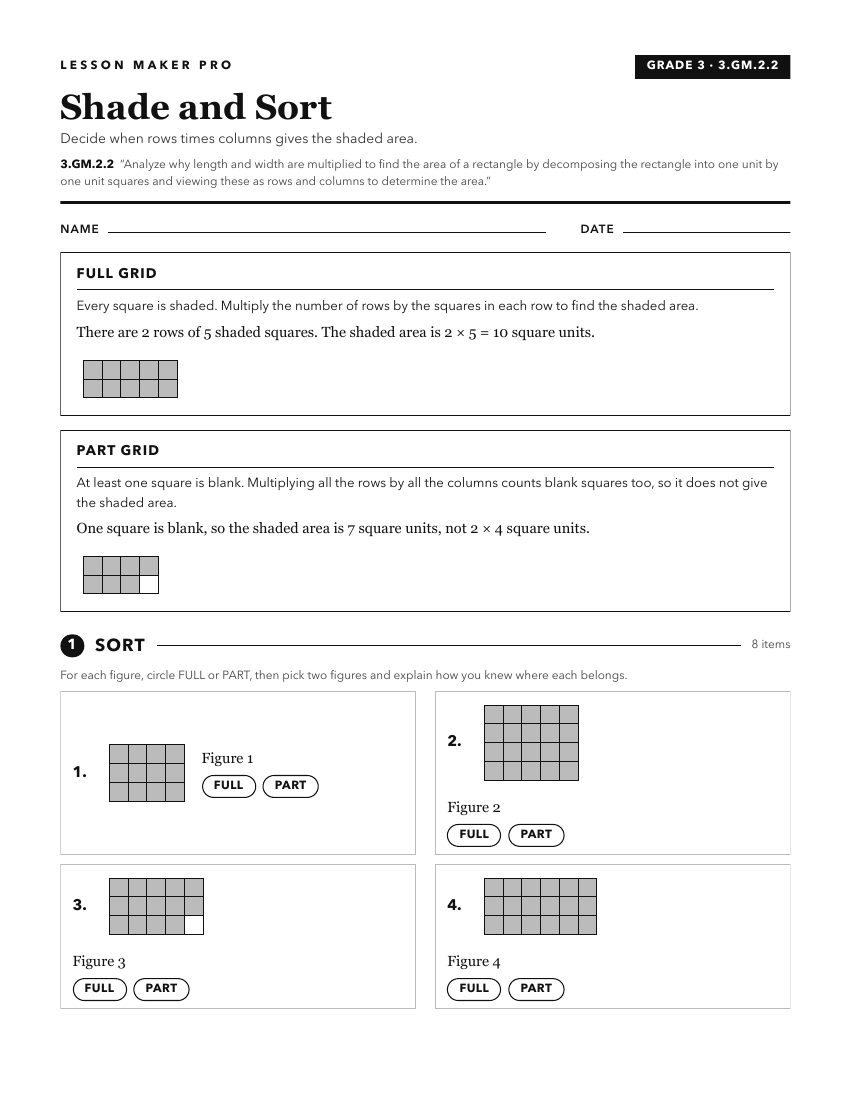
A ready-to-print activity worksheet aligned to 3.GM.2.2, with an answer key for the teacher on its own page. No account needed.
PDF, US Letter, prints cleanly in black and white.
Download the worksheetKeep exploring
Related Standards
- 4.GM.2.2
Find the area of polygons by determining if they can be decomposed into rectangles.
- 7.GM.1.2
Using a variety of tools and strategies, develop the concept that surface area of a rectangular prism can be found by wrapping the figure with same-sized square...
- 6.GM.2
Use mathematical modeling to calculate the area of squares, parallelograms, and triangles to solve problems.
Turn this exact standard into a lesson
Grade, subject, topic, and the complete standard are prefilled. Create one free, no account needed.
Also for this standard:Make a WorksheetMake a QuizMake a Sub Lesson