Oklahoma Math 4.GM.2
Standard Cluster
Recognize and measure attributes in real-world and mathematical situations using various tools. Measure angles in geometric figures and real-world objects with a protractor or angle ruler. Find the area of polygons by determining if they can be decomposed into rectangles. Develop the concept that the volume of rectangular prisms with whole-number edge lengths can be found by counting the total number of same-sized unit cubes that fill a shape without gaps or overlaps. Use a variety of tools and create models to determine the volume using appropriate measurements (e.g., cm³). Choose an appropriate instrument to measure the length of an object to the nearest whole centimeter or quarter inch. Recognize and use the relationship between inches, feet, and yards to measure and compare objects. Recognize and use the relationship between millimeters, centimeters, and meters to measure and compare objects. Determine and justify the best use of customary and metric measurements in a variety of situations (liquid volumes, mass vs. weight, temperatures above 0 (zero) degrees, and length).
Oklahoma Academic Standards for Mathematics (2022)
Cluster contents
Standards in This Cluster
4.GM.2 is a cluster heading. These are the individual standards under it.
- 4.GM.2.1
Measure angles in geometric figures and real-world objects with a protractor or angle ruler.
- 4.GM.2.2
Find the area of polygons by determining if they can be decomposed into rectangles.
- 4.GM.2.3
Develop the concept that the volume of rectangular prisms with whole-number edge lengths can be found by counting the total number of same-sized unit cubes that...
- 4.GM.2.4
Choose an appropriate instrument to measure the length of an object to the nearest whole centimeter or quarter inch.
- 4.GM.2.5
Recognize and use the relationship between inches, feet, and yards to measure and compare objects.
- 4.GM.2.6
Recognize and use the relationship between millimeters, centimeters, and meters to measure and compare objects.
- 4.GM.2.7
Determine and justify the best use of customary and metric measurements in a variety of situations (liquid volumes, mass vs. weight, temperatures above 0 (zero)...
Teacher's field guide
What This Cluster Means
What Students Need to Do
- Students use rulers and protractors to measure lengths and angles. They split polygons into rectangles to find area and count equal cubes to find the volume of a prism. They compare length units and choose sensible units for liquids, mass, weight, and temperatures above zero.
What Mastery Looks Like
- A student centers a protractor on the vertex and reads the correct scale. They find area without counting any part twice, then count cubes in layers and label volume in cubic centimeters. They measure length to the nearest centimeter or quarter inch, convert within customary or metric units, and explain which units fit a situation.
Common Misconceptions
- Students may place the protractor away from the vertex or read the wrong scale. They may count a shared part twice when finding area or count only visible cubes in a prism. They may assume a foot has ten inches or label volume in square centimeters.
How to Assess It
- Print a 60° angle, an L shape made from a 4-by-3 centimeter rectangle with a 2-by-1 corner removed, and a sketch of a 2-by-3-by-2 cube prism. Ask students to measure the angle and find the area and volume, with units.
Lesson moves
Ways to Teach It
Build a 3-by-2-by-2 prism with centimeter cubes, count the cubes by layer, and label its volume in cubic centimeters.
Show a liter carton, a kilogram rice bag, and a 72°F forecast; ask which measurements describe liquid volume, mass, or temperature.
Give pairs angle cards and L-shaped grid figures; have partners measure each angle, split each figure into rectangles, and check answers.
Measure a desk to the nearest centimeter and quarter inch, then convert the results to millimeters, meters, feet, and yards.
Free download
Printable 4.GM.2 Worksheet
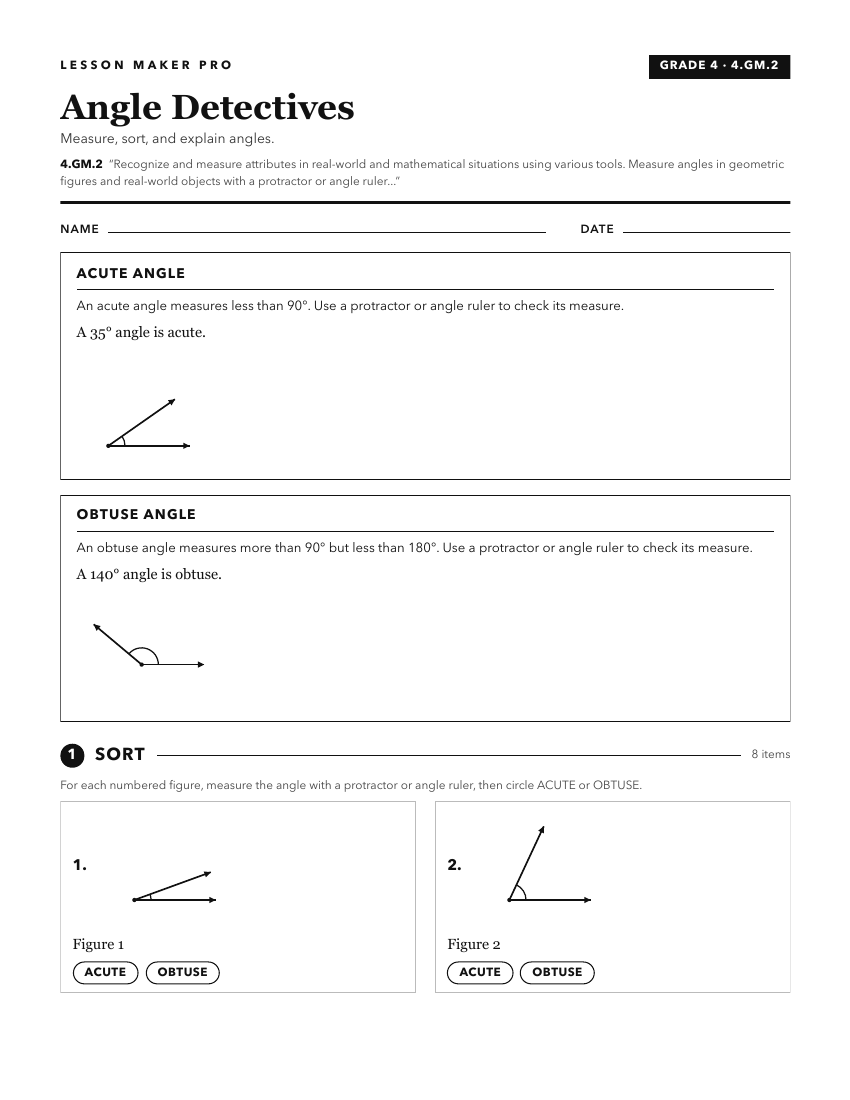
A ready-to-print activity worksheet aligned to 4.GM.2, with an answer key for the teacher on its own page. No account needed.
PDF, US Letter, prints cleanly in black and white.
Download the worksheetKeep exploring
Related Standards
- 3.GM.2
Understand measurable attributes of real-world and mathematical objects using various tools.
- 5.GM.3
Understand angle, length, weight, and capacity as measurable attributes of real-world and mathematical objects, using various tools to measure them. Solve real-...
- 6.A.1
Recognize and represent relationships between varying quantities; translate from one representation to another; use patterns, tables, graphs, and rules to model...
- 1.A.1
Identify patterns found in real-world and mathematical problems.
Turn this cluster into a lesson
Grade, subject, topic, and the complete cluster are prefilled. Create one free, no account needed.
Also for this cluster:Make a WorksheetMake a QuizMake a Sub Lesson