NY Next Generation Math NY-6.SP.7
The Standard
Approximate the probability of a simple event by collecting data on the chance process that produces it and observing its long-run relative frequency, and predict the approximate relative frequency given the probability.
New York State Next Generation Mathematics Learning Standards
Teacher's field guide
What This Standard Means
What Students Need to Do
- Students approximate a simple event’s probability through repeated trials and long-run relative frequency. They use a known probability to predict an approximate frequency.
What Mastery Looks Like
- The student computes observed relative frequency and recognizes that it stabilizes with many trials. The student predicts a reasonable count while allowing normal variation from the exact expectation.
Common Misconceptions
- Students may expect experimental results to match theoretical probability exactly. They may use the number of successes alone instead of successes divided by total trials.
How to Assess It
- A fair number cube is rolled 120 times. Ask students to predict about how often a 5 appears and explain why the result may differ.
Lesson moves
Ways to Teach It
Run repeated spinner trials in groups, combine class data, and track the changing relative frequency.
Ask students why 100 trials usually give a steadier estimate than 10 trials.
Play Prediction Check by comparing expected frequencies with simulated simple-event results.
Estimate defective-item frequency from a known probability and a production total.
Free download
Printable NY-6.SP.7 Worksheet
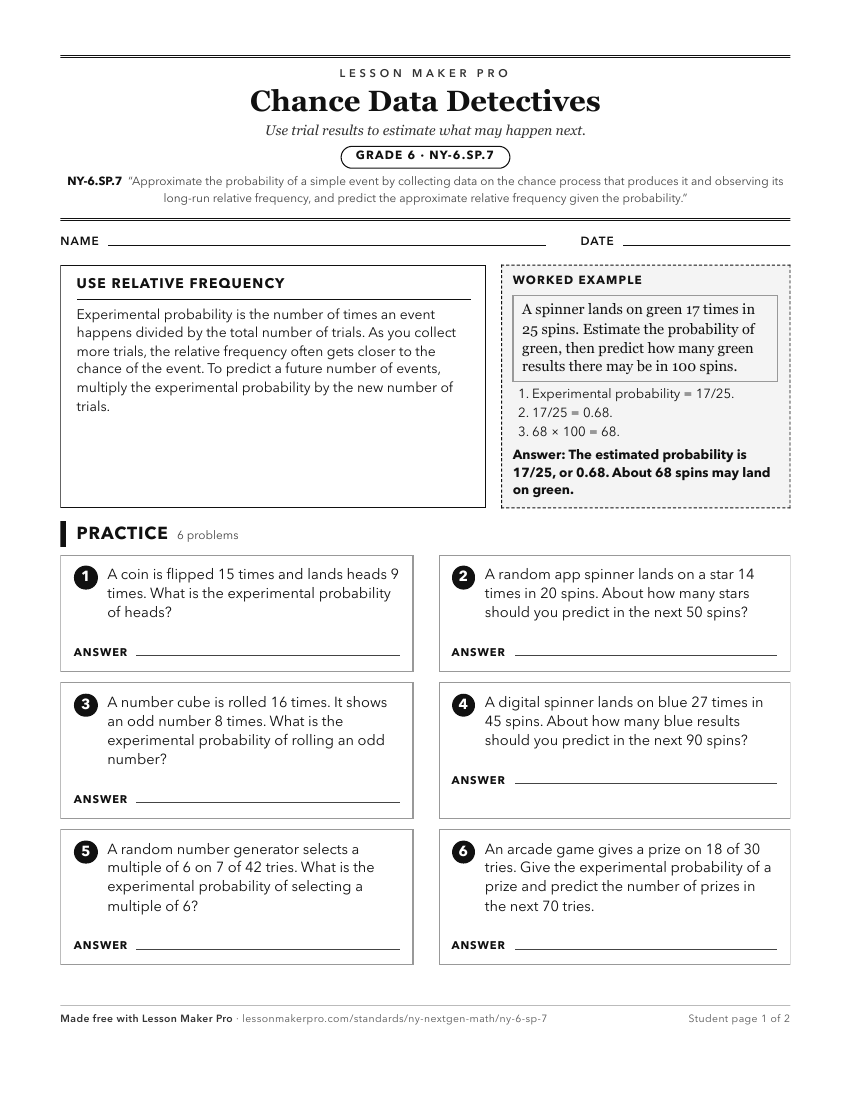
A ready-to-print activity worksheet aligned to NY-6.SP.7, with an answer key for the teacher on its own page. No account needed.
PDF, US Letter, prints cleanly in black and white.
Download the worksheetKeep exploring
Related Standards
- NY-6.SP.8.a
Develop a uniform probability model by assigning equal probability to all outcomes, and use the model to determine probabilities of simple events.
- NY-6.SP.8
Develop a probability model and use it to find probabilities of simple events. Compare probabilities from a model to observed frequencies; if the agreement is n...
- NY-6.SP.8.b
Develop a probability model (which may not be uniform) by observing frequencies in data generated from a chance process
- NY-7.SP.8.a
Understand that, just as with simple events, the probability of a compound event is the fraction of outcomes in the sample space for which the compound event oc...
Turn this exact standard into a lesson
Grade, subject, topic, and the complete standard are prefilled. Create one free, no account needed.
Also for this standard:Make a WorksheetMake a QuizMake a Sub Lesson