NY Next Generation Math NY-6.SP.8.b
The Standard
Develop a probability model (which may not be uniform) by observing frequencies in data generated from a chance process
New York State Next Generation Mathematics Learning Standards
Teacher's field guide
What This Standard Means
What Students Need to Do
- Students develop a probability model from frequencies observed in a chance process that may not be uniform. They use relative frequencies as approximate probabilities.
What Mastery Looks Like
- The student performs or analyzes enough trials, divides each outcome count by total trials, and creates a complete model. Probabilities sum approximately to 1 after rounding.
Common Misconceptions
- Students may force unequal observed outcomes to have equal probabilities. They may use raw frequencies as probabilities or divide by the number of outcome categories.
How to Assess It
- Give results from 80 paper-cup tosses with three landing positions. Ask students to build a probability model and identify whether it appears uniform.
Lesson moves
Ways to Teach It
Toss a paper cup repeatedly, record landing positions, and convert combined frequencies to probabilities.
Ask students why observed data may support a nonuniform model.
Play Frequency-to-Model Match with trial tables and approximate probabilities.
Estimate the probability of a machine producing each package type from observed production counts.
Free download
Printable NY-6.SP.8.b Worksheet
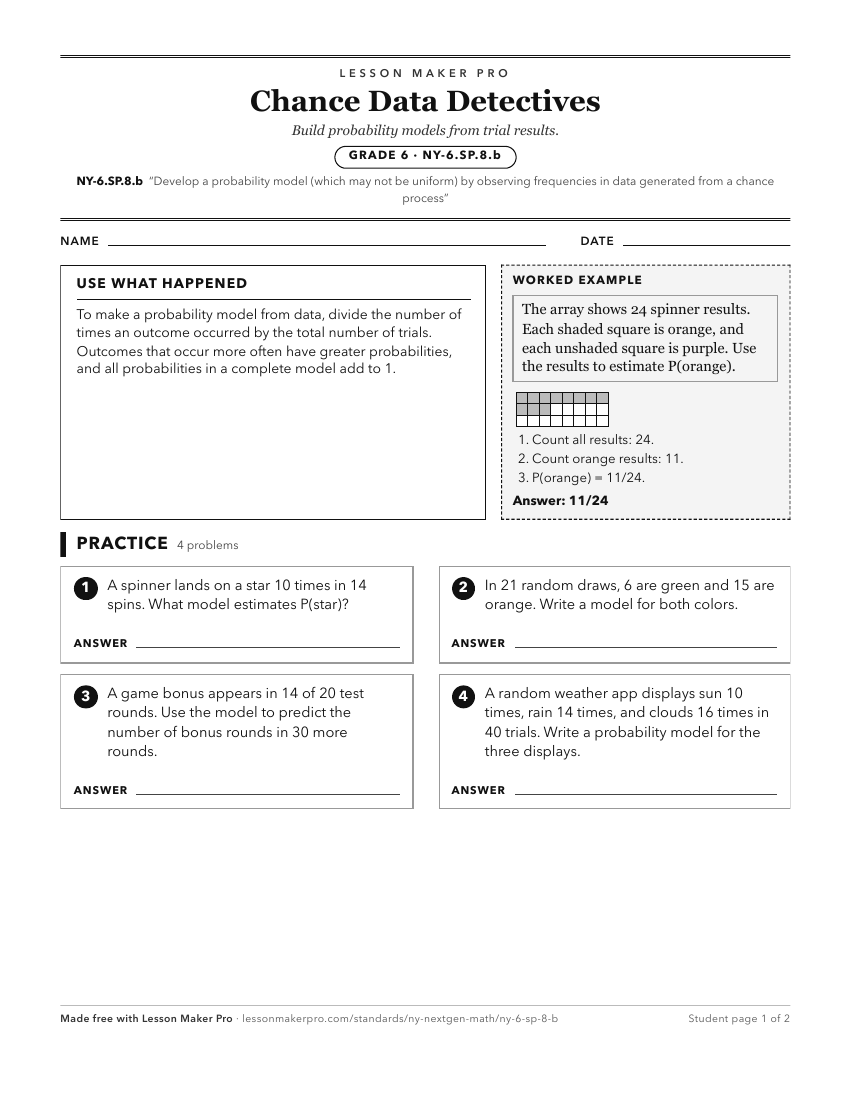
A ready-to-print activity worksheet aligned to NY-6.SP.8.b, with an answer key for the teacher on its own page. No account needed.
PDF, US Letter, prints cleanly in black and white.
Download the worksheetKeep exploring
Related Standards
- NY-6.SP.7
Approximate the probability of a simple event by collecting data on the chance process that produces it and observing its long-run relative frequency, and predi...
- NY-6.SP.8.a
Develop a uniform probability model by assigning equal probability to all outcomes, and use the model to determine probabilities of simple events.
- NY-6.SP.8
Develop a probability model and use it to find probabilities of simple events. Compare probabilities from a model to observed frequencies; if the agreement is n...
Turn this exact standard into a lesson
Grade, subject, topic, and the complete standard are prefilled. Create one free, no account needed.
Also for this standard:Make a WorksheetMake a QuizMake a Sub Lesson