NY Next Generation Math NY-6.SP.8
Standard Cluster
Develop a probability model and use it to find probabilities of simple events. Compare probabilities from a model to observed frequencies; if the agreement is not good, explain possible sources of the discrepancy.
New York State Next Generation Mathematics Learning Standards
Cluster contents
Standards in This Cluster
NY-6.SP.8 is a cluster heading. These are the individual standards under it.
Teacher's field guide
What This Cluster Means
What Students Need to Do
- Students develop uniform or data-based probability models for simple events. They use each model to find probabilities, compare predictions with observed frequencies, and explain discrepancies.
What Mastery Looks Like
- The student assigns equal probabilities when outcomes are equally likely and uses observed frequencies when they are not. The student compares model and experiment with a plausible explanation.
Common Misconceptions
- Students may assume every chance process is uniform. They may rebuild a model from too few trials or call any difference evidence that the model is wrong.
How to Assess It
- Give results from 100 spins of an uneven spinner. Ask students to build a probability model, predict 50 future spins, and explain disagreement with observed counts.
Lesson moves
Ways to Teach It
Test a spinner, record outcome frequencies, and build a probability model from the combined class data.
Ask students when equal outcome probabilities are justified and when observed data are needed.
Play Model Versus Data by matching simple-event models with experimental frequency tables.
Build a quality-control model from observed product outcomes and compare it with a stated uniform assumption.
Free download
Printable NY-6.SP.8 Worksheet
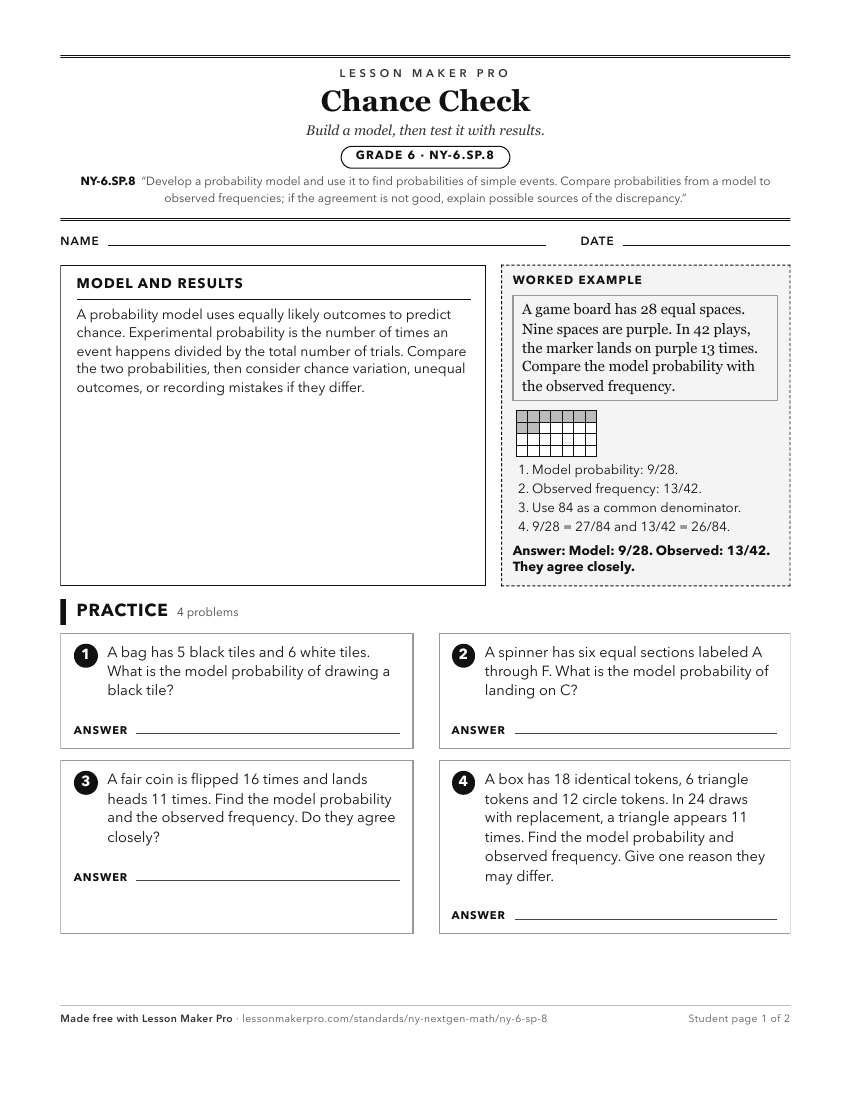
A ready-to-print activity worksheet aligned to NY-6.SP.8, with an answer key for the teacher on its own page. No account needed.
PDF, US Letter, prints cleanly in black and white.
Download the worksheetKeep exploring
Related Standards
Turn this cluster into a lesson
Grade, subject, topic, and the complete cluster are prefilled. Create one free, no account needed.
Also for this cluster:Make a WorksheetMake a QuizMake a Sub Lesson