NY Next Generation Math NY-7.SP.8.a
The Standard
Understand that, just as with simple events, the probability of a compound event is the fraction of outcomes in the sample space for which the compound event occurs.
New York State Next Generation Mathematics Learning Standards
Teacher's field guide
What This Standard Means
What Students Need to Do
- Students calculate a compound event’s probability as the fraction of sample-space outcomes that make the event occur. They identify favorable outcomes within a complete sample space.
What Mastery Looks Like
- The student lists all equally likely outcomes for two simple stages and counts the favorable ones. The resulting fraction uses favorable outcomes as numerator and total outcomes as denominator.
Common Misconceptions
- Students may add stage probabilities without considering combined outcomes. They may count outcomes twice or use only favorable outcomes in the denominator.
How to Assess It
- Ask students to find the probability of rolling an odd number and flipping tails. Require a complete sample space and the favorable-outcomes fraction.
Lesson moves
Ways to Teach It
Use colored tiles and coins to build every compound outcome, then circle outcomes that satisfy an event.
Ask students why the denominator must count the entire sample space.
Play Favorable Fraction with sample-space cards and event descriptions.
Find the chance that two randomly selected lunch choices meet a stated combination.
Free download
Printable NY-7.SP.8.a Worksheet
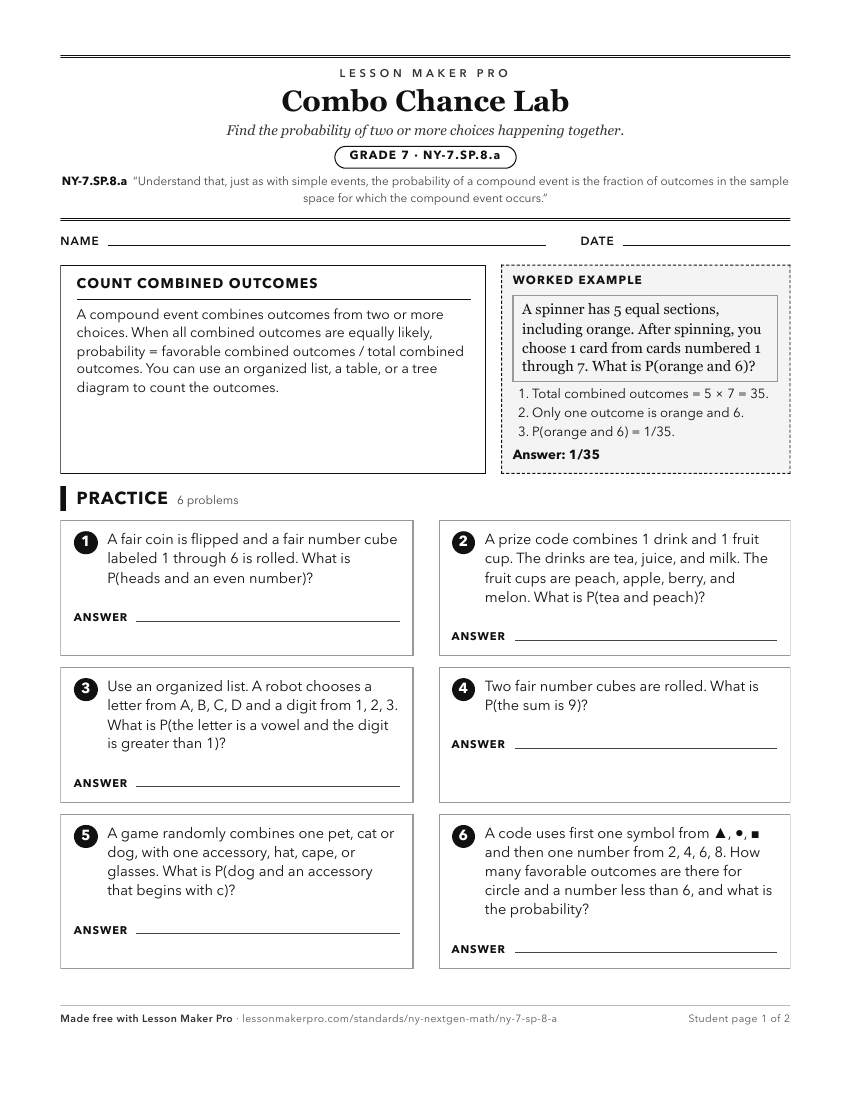
A ready-to-print activity worksheet aligned to NY-7.SP.8.a, with an answer key for the teacher on its own page. No account needed.
PDF, US Letter, prints cleanly in black and white.
Download the worksheetKeep exploring
Related Standards
- NY-6.SP.7
Approximate the probability of a simple event by collecting data on the chance process that produces it and observing its long-run relative frequency, and predi...
- NY-6.SP.8.a
Develop a uniform probability model by assigning equal probability to all outcomes, and use the model to determine probabilities of simple events.
- NY-7.SP.8.b
Represent sample spaces for compound events using methods such as organized lists, sample space tables, and tree diagrams. For an event described in everyday la...
- NY-7.SP.8
Find probabilities of compound events using organized lists, sample space tables, tree diagrams, and simulation.
Turn this exact standard into a lesson
Grade, subject, topic, and the complete standard are prefilled. Create one free, no account needed.
Also for this standard:Make a WorksheetMake a QuizMake a Sub Lesson