NY Next Generation Math NY-6.SP.6
The Standard
Understand that the probability of a chance event is a number between 0 and 1 inclusive, that expresses the likelihood of the event occurring. Larger numbers indicate greater likelihood. A probability near 0 indicates an unlikely event, a probability around ½ indicates an event that is neither unlikely nor likely, and a probability near 1 indicates a likely event.
New York State Next Generation Mathematics Learning Standards
Teacher's field guide
What This Standard Means
What Students Need to Do
- Students interpret probability as a number from 0 through 1 that expresses likelihood. They connect values near 0, one-half, and 1 with unlikely, neither unlikely nor likely, and likely events.
What Mastery Looks Like
- The student places event probabilities correctly on a 0-to-1 scale and compares their likelihoods. The student recognizes 0 as impossible and 1 as certain.
Common Misconceptions
- Students may use probabilities below 0 or above 1. They may think a probability near one-half guarantees alternating outcomes or an exact short-run split.
How to Assess It
- Give probabilities 0, 0.2, 0.5, 0.85, and 1. Ask students to order and label each event’s likelihood.
Lesson moves
Ways to Teach It
Place event cards along a taped probability line from 0 to 1 and defend each position.
Ask students how a probability of 0.5 differs from a guarantee of half the next ten outcomes.
Play Likelihood Sort with impossible, unlikely, even-chance, likely, and certain events.
Use weather probabilities to compare the likelihood of rain on several days.
Free download
Printable NY-6.SP.6 Worksheet
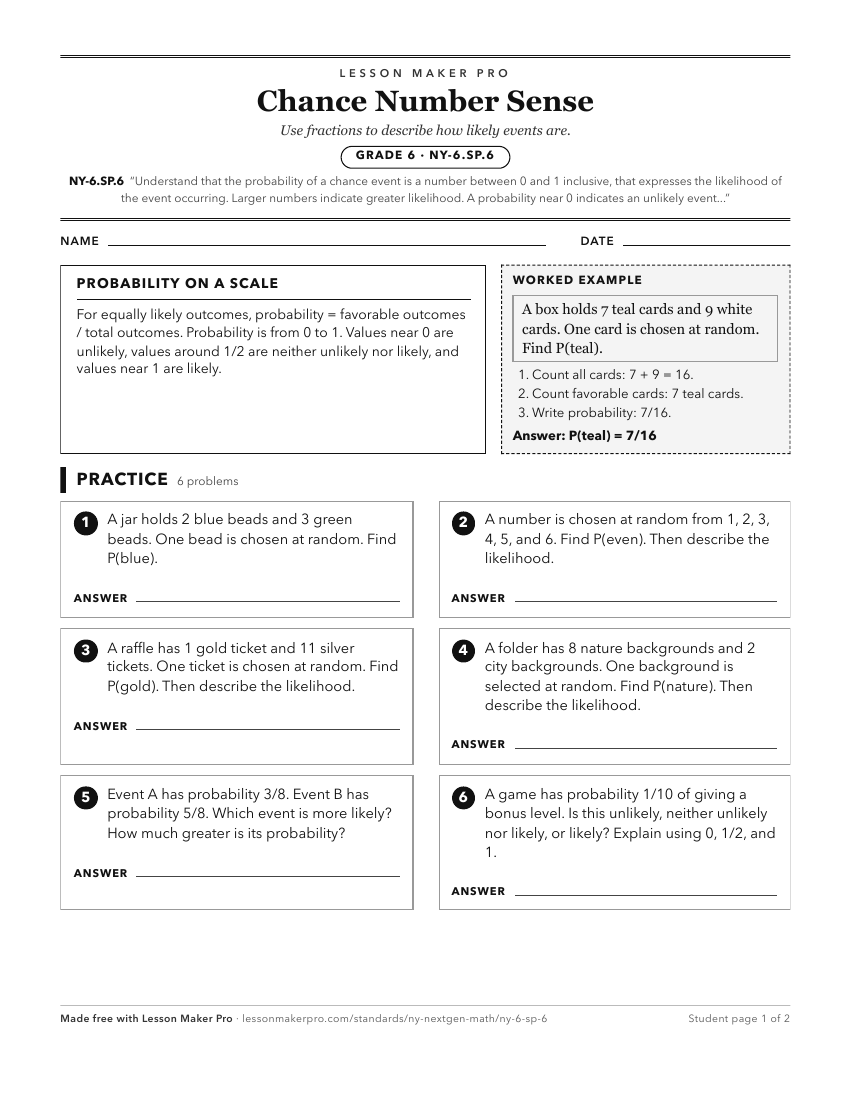
A ready-to-print activity worksheet aligned to NY-6.SP.6, with an answer key for the teacher on its own page. No account needed.
PDF, US Letter, prints cleanly in black and white.
Download the worksheetKeep exploring
Related Standards
- NY-6.SP.7
Approximate the probability of a simple event by collecting data on the chance process that produces it and observing its long-run relative frequency, and predi...
- NY-6.SP.8.a
Develop a uniform probability model by assigning equal probability to all outcomes, and use the model to determine probabilities of simple events.
- NY-6.SP.8
Develop a probability model and use it to find probabilities of simple events. Compare probabilities from a model to observed frequencies; if the agreement is n...
- NY-7.SP.8.a
Understand that, just as with simple events, the probability of a compound event is the fraction of outcomes in the sample space for which the compound event oc...
Turn this exact standard into a lesson
Grade, subject, topic, and the complete standard are prefilled. Create one free, no account needed.
Also for this standard:Make a WorksheetMake a QuizMake a Sub Lesson