NY Next Generation ELA 9-10SL3
The Standard
Evaluate a speaker’s point of view, reasoning, and use of evidence and rhetoric; identify any fallacious reasoning or exaggerated or distorted evidence.
New York State Next Generation English Language Arts Learning Standards
Teacher's field guide
What This Standard Means
What Students Need to Do
- Students evaluate a speaker’s viewpoint, reasoning, evidence, and rhetoric. They identify fallacious reasoning and exaggerated or distorted evidence.
What Mastery Looks Like
- The student delineates the argument, evaluates logic and evidence, and analyzes rhetorical choices. Any fallacy, exaggeration, or distortion is named and supported precisely.
Common Misconceptions
- Students may label strong rhetoric as fallacy or call all emotional appeal invalid. They may notice distortion without explaining the original evidence or effect.
How to Assess It
- Play a short speech containing one rhetorical appeal and one distorted evidence claim. Ask students to evaluate viewpoint, reasoning, evidence, rhetoric, and the distortion.
Lesson moves
Ways to Teach It
Annotate a speech transcript while listening for viewpoint, reasoning, evidence, rhetoric, and distortion.
Ask students when rhetorical appeal supports reasoning and when it distracts from it.
Play Fallacy and Evidence Clinic with short recorded claims.
Evaluate a campaign speech, advertisement, or advocacy presentation for reasoning and rhetoric.
Free download
Printable 9-10SL3 Worksheet
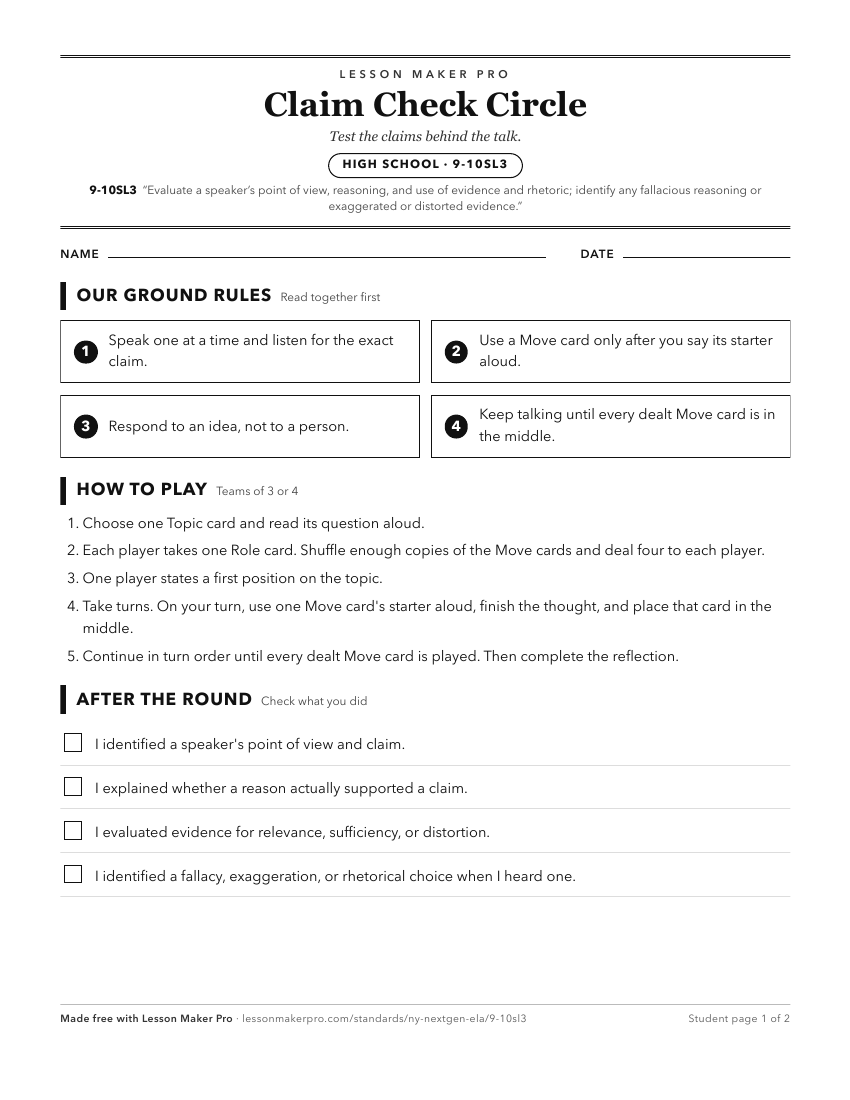
A ready-to-print activity worksheet aligned to 9-10SL3, with an answer key for the teacher on its own page. No account needed.
PDF, US Letter, prints cleanly in black and white.
Download the worksheetKeep exploring
Related Standards
- 5SL3
Identify and evaluate the reasons and evidence a speaker provides to support particular points.
- 7SL3
Delineate a speaker's argument and specific claims, evaluating for sound reasoning, and the relevance and sufficiency of the evidence.
- 8SL3
Delineate a speaker's argument and specific claims, evaluating for sound reasoning, and the relevance and sufficiency of the evidence; identify when irrelevant ...
- 4SL3
Identify and evaluate the reasons and evidence a speaker provides to support particular points.
Turn this exact standard into a lesson
Grade, subject, topic, and the complete standard are prefilled. Create one free, no account needed.
Also for this standard:Make a WorksheetMake a QuizMake a Sub Lesson