NGSS HS-PS4-1
The Standard
Use mathematical representations to support a claim regarding relationships among the frequency, wavelength, and speed of waves traveling in various media.
Next Generation Science Standards
Teacher's field guide
What This Standard Means
What Students Need to Do
- Students use the equation v = fλ to connect wave speed, frequency, and wavelength. They interpret calculations, tables, or graphs to support claims about waves in different media.
What Mastery Looks Like
- Students correctly use v = fλ to calculate a missing value and compare waves. They use equations, tables, or graphs to support claims about changes across media.
Common Misconceptions
- Students often treat frequency, wavelength, and speed as independent values. They may think frequency changes when a wave enters a new medium, or confuse wave speed with amplitude.
How to Assess It
- Give students two waves with frequencies of 200 Hz and 400 Hz traveling at 800 m/s. Ask them to calculate each wavelength and defend one comparison claim.
Lesson moves
Ways to Teach It
Use a slinky, meterstick, and stopwatch to measure wave speed, then compare trials with different frequencies and wavelengths.
Ask students to write a claim explaining what happens to wavelength when a wave enters a slower medium but keeps its frequency.
Run a card sort matching frequency, wavelength, and speed values, with students checking each set using v = fλ.
Compare sound in air and water using provided speed data, then calculate wavelengths for the same musical note in both media.
Free download
Printable HS-PS4-1 Worksheet
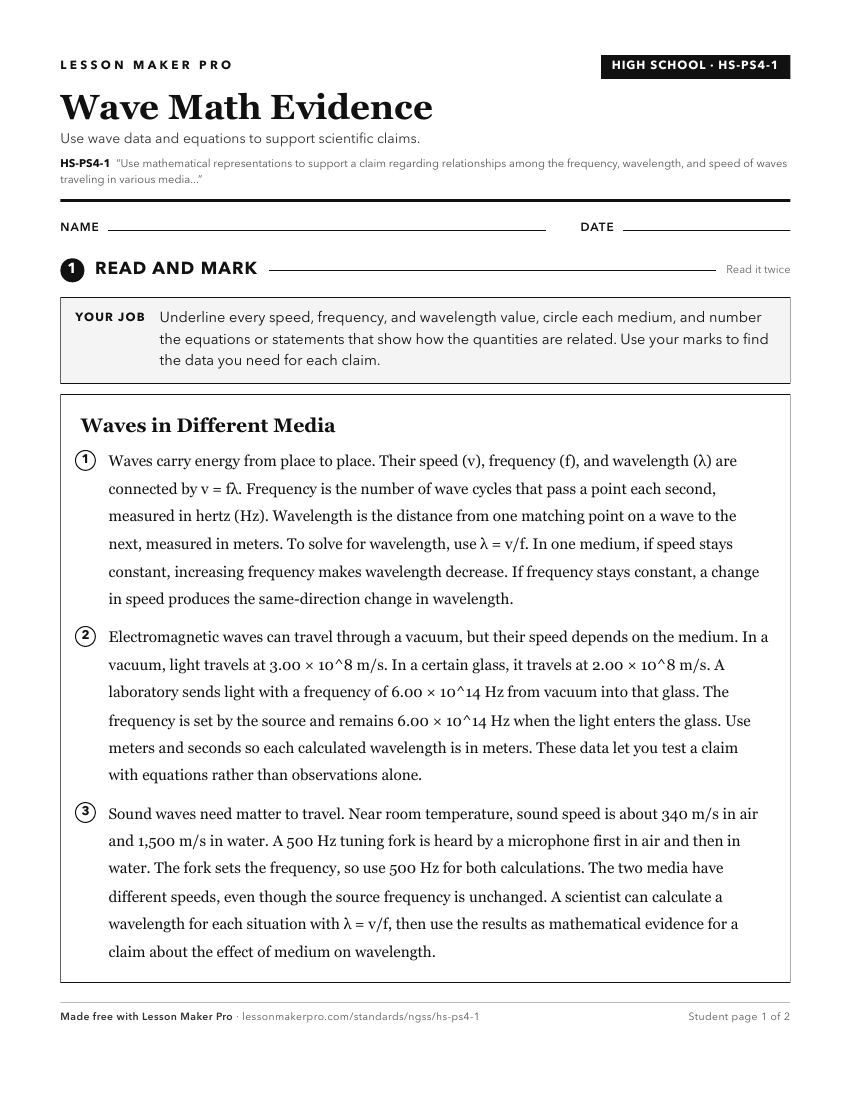
A ready-to-print activity worksheet aligned to HS-PS4-1, with an answer key for the teacher on its own page. No account needed.
PDF, US Letter, prints cleanly in black and white.
Download the worksheetLearning progression
Where This Standard Sits
See the whole path on the Physical Science progression map.
Before This Standard
If students are struggling here, check these first.
- MS-PS4-2
Qualitative models of waves in materials support later reasoning about wave speed, wavelength, and frequency across different media.
- MS-PS4-1
Middle school wave models introduce mathematical representations of amplitude and energy, supporting later quantitative relationships among frequency, wavelength, speed, and medium.
Keep exploring
Related Standards
- HS-PS4-3
Evaluate the claims, evidence, and reasoning behind the idea that electromagnetic radiation can be described either by a wave model or a particle model, and tha...
- HS-PS4-5
Communicate technical information about how some technological devices use the principles of wave behavior and wave interactions with matter to transmit and cap...
Turn this exact standard into a lesson
Grade, subject, topic, and the complete standard are prefilled. Create one free, no account needed.
Also for this standard:Make a WorksheetMake a QuizMake a Sub Lesson