NGSS MS-PS4-1
The Standard
Use mathematical representations to describe a simple model for waves that includes how the amplitude of a wave is related to the energy in a wave.
Next Generation Science Standards
Teacher's field guide
What This Standard Means
What Students Need to Do
- Students read and create graphs, tables, or diagrams for simple repeating waves. They measure amplitude from the rest position and show that waves with greater amplitude carry more energy.
What Mastery Looks Like
- Given two repeating wave diagrams or data sets, a student correctly identifies each amplitude and compares the energy carried. The student supports the comparison with numbers from a graph, table, or model.
Common Misconceptions
- Students often measure amplitude from crest to trough instead of from the rest position to a crest or trough. They may confuse amplitude with wavelength or think greater amplitude means greater frequency or speed.
How to Assess It
- Give students two scaled wave graphs with amplitudes of 2 cm and 5 cm. Ask them to label each amplitude and explain which wave carries more energy using the data.
Lesson moves
Ways to Teach It
Stretch a rope across the floor, create repeating waves at two measured amplitudes, and record the measurements in a table.
Show two graphs with equal wavelength but different amplitudes, then ask, "Which carries more energy, and what numerical evidence supports your claim?"
Run a card sort matching scaled wave diagrams to amplitude values and low, medium, or high energy labels.
Compare waveform screenshots of a quiet and loud clap, measure each amplitude, and connect larger amplitude with greater sound energy.
Free download
Printable MS-PS4-1 Worksheet
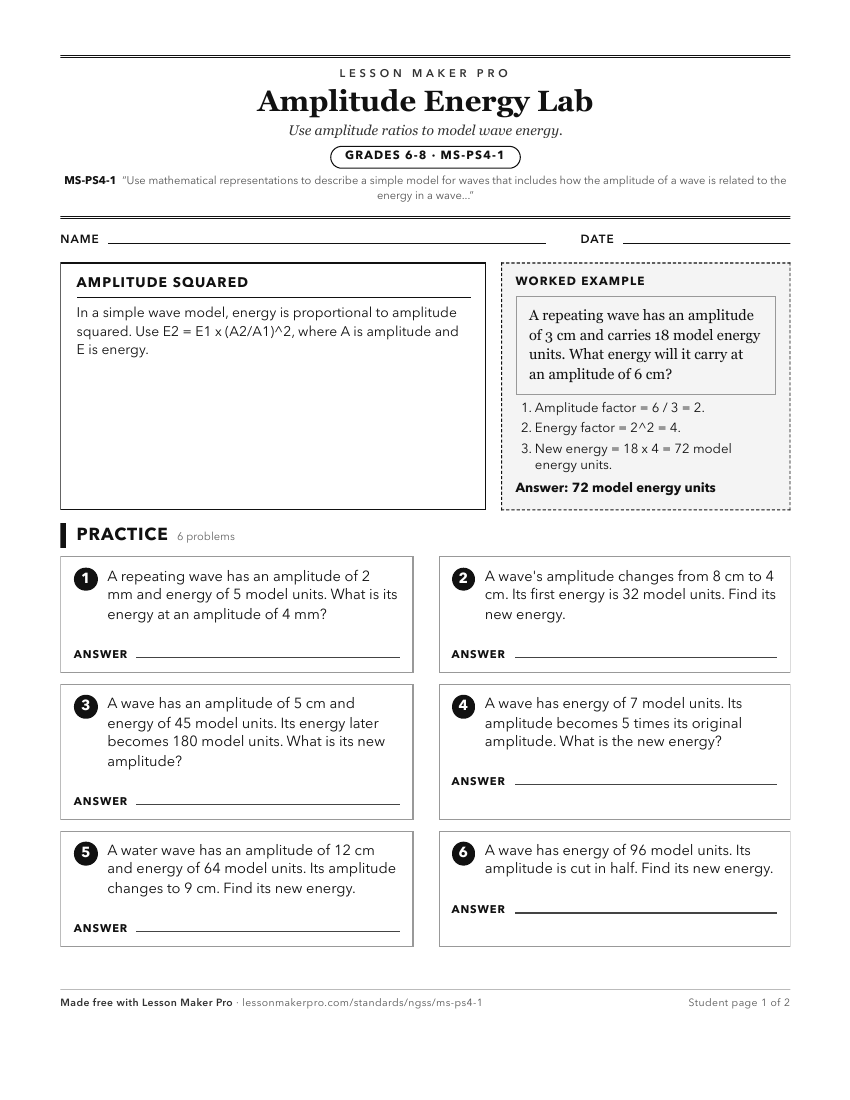
A ready-to-print activity worksheet aligned to MS-PS4-1, with an answer key for the teacher on its own page. No account needed.
PDF, US Letter, prints cleanly in black and white.
Download the worksheetLearning progression
Where This Standard Sits
See the whole path on the Physical Science progression map.
Before This Standard
If students are struggling here, check these first.
What This Unlocks
Mastery here sets students up for these next.
- HS-PS4-5
Wave models linking amplitude and energy help students explain how devices encode, transmit, and capture energy or information using waves.
- HS-PS4-2
Wave amplitude and energy support understanding signals, but digital transmission advantages mostly require information coding and noise considerations.
- HS-PS4-1
Middle school wave models introduce mathematical representations of amplitude and energy, supporting later quantitative relationships among frequency, wavelength, speed, and medium.
Keep exploring
Related Standards
Turn this exact standard into a lesson
Grade, subject, topic, and the complete standard are prefilled. Create one free, no account needed.
Also for this standard:Make a WorksheetMake a QuizMake a Sub Lesson