NGSS 4-PS4-1
The Standard
Develop a model of waves to describe patterns in terms of amplitude and wavelength and that waves can cause objects to move.
Next Generation Science Standards
Teacher's field guide
What This Standard Means
What Students Need to Do
- Students build and label physical or drawn models that show repeating wave patterns. They compare taller and shorter amplitudes, wider and narrower wavelengths, and explain how waves make objects move.
What Mastery Looks Like
- Given two wave diagrams, a student correctly compares their amplitudes and wavelengths without using calculations. The student can also use a model to predict how an object will bob or vibrate when a wave passes.
Common Misconceptions
- Students often mix up amplitude with wavelength, measuring height when asked about spacing. They may think greater amplitude means longer wavelength, or that material travels forward with the wave. Some expect an object to move only forward rather than bob or vibrate.
How to Assess It
- Exit ticket: Draw two waves with the same wavelength but different amplitudes, label both features, then show how a cork moves as one wave passes.
Lesson moves
Ways to Teach It
Bend flexible wire into repeating waves, then make models with equal wavelengths and different amplitudes.
Show two wave drawings and ask, “What changed, amplitude or wavelength, and what evidence supports your claim?”
Run a card sort using wave diagrams labeled same amplitude, different amplitude, same wavelength, and different wavelength.
Float a cork in a water tray, make gentle repeating waves, and record how the cork moves as waves pass.
Free download
Printable 4-PS4-1 Worksheet
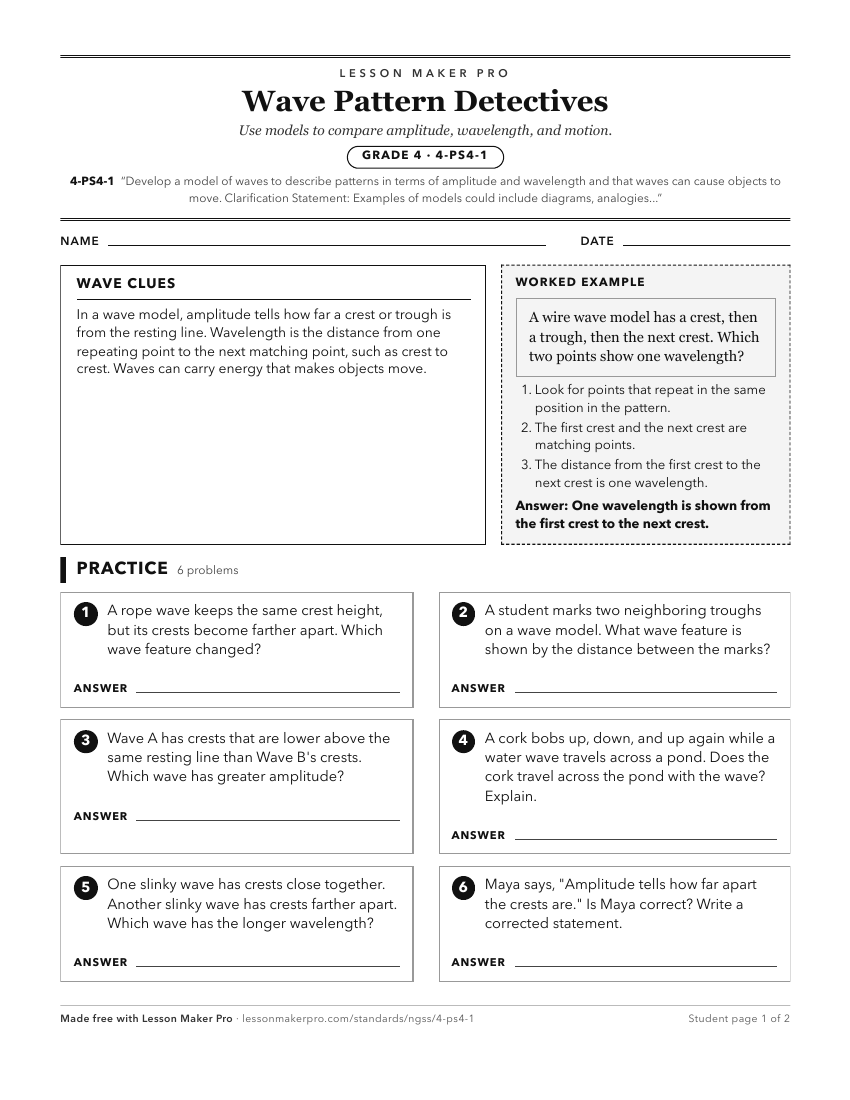
A ready-to-print activity worksheet aligned to 4-PS4-1, with an answer key for the teacher on its own page. No account needed.
PDF, US Letter, prints cleanly in black and white.
Download the worksheetLearning progression
Where This Standard Sits
See the whole path on the Physical Science progression map.
What This Unlocks
Mastery here sets students up for these next.
Keep exploring
Related Standards
- MS-PS4-2
Develop and use a model to describe that waves are reflected, absorbed, or transmitted through various materials.
- HS-PS3-5
Develop and use a model of two objects interacting through electric or magnetic fields to illustrate the forces between objects and the changes in energy of the...
- MS-PS3-2
Develop a model to describe that when the arrangement of objects interacting at a distance changes, different amounts of potential energy are stored in the syst...
Turn this exact standard into a lesson
Grade, subject, topic, and the complete standard are prefilled. Create one free, no account needed.
Also for this standard:Make a WorksheetMake a QuizMake a Sub Lesson