NGSS MS-PS4-2
The Standard
Develop and use a model to describe that waves are reflected, absorbed, or transmitted through various materials.
Next Generation Science Standards
Teacher's field guide
What This Standard Means
What Students Need to Do
- Students create diagrams, physical models, or written models showing how light and sound behave when they meet different materials. They describe the outcomes using observations rather than calculations.
What Mastery Looks Like
- Students can create a clear diagram showing what happens when light or sound meets a material. They correctly identify multiple possible outcomes and support each label with observations.
Common Misconceptions
- Students may think a wave must stop when it reaches a material. They may also assume only one outcome occurs, or confuse absorption with transmission.
How to Assess It
- Give students diagrams of light striking a window and sound reaching a curtain. Ask them to add arrows, label each outcome, and explain the material’s effect.
Lesson moves
Ways to Teach It
At stations, test flashlight beams and phone tones against mirrors, clear plastic, cardboard, and foam, then sketch what happens.
Ask students to explain why a closed window passes light but reduces sound, using labeled diagrams in their response.
Sort scenario cards into reflection, absorption, and transmission groups, then challenge classmates to defend or revise each placement.
Analyze a school window and acoustic ceiling tile, then explain which wave behaviors make each material useful.
Free download
Printable MS-PS4-2 Worksheet
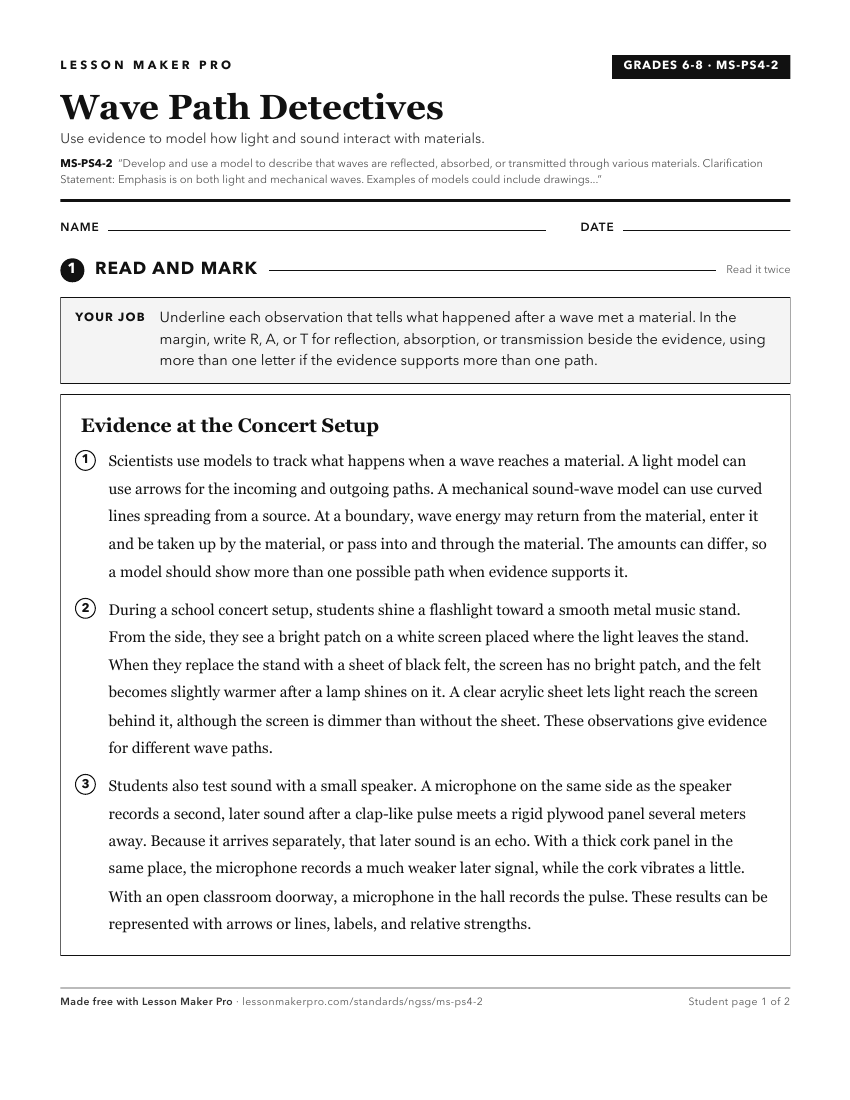
A ready-to-print activity worksheet aligned to MS-PS4-2, with an answer key for the teacher on its own page. No account needed.
PDF, US Letter, prints cleanly in black and white.
Download the worksheetLearning progression
Where This Standard Sits
See the whole path on the Physical Science progression map.
Before This Standard
If students are struggling here, check these first.
What This Unlocks
Mastery here sets students up for these next.
- HS-ESS1-2
Wave interactions with materials support understanding how light spectra from space carry evidence about galaxy motion and matter composition.
- HS-PS4-5
Understanding reflection, absorption, and transmission helps students explain how devices use waves to send, receive, or capture energy and information.
- HS-PS4-2
Understanding wave reflection, absorption, and transmission supports evaluating how digital signals move through media and preserve information.
- HS-PS4-1
Qualitative models of waves in materials support later reasoning about wave speed, wavelength, and frequency across different media.
- HS-PS4-4
Students extend wave absorption by materials to compare how different electromagnetic frequencies transfer energy and affect matter.
- HS-PS4-3
Understanding wave interactions with materials supports judging when electromagnetic radiation is better explained by wave or particle models.
Keep exploring
Related Standards
Turn this exact standard into a lesson
Grade, subject, topic, and the complete standard are prefilled. Create one free, no account needed.
Also for this standard:Make a WorksheetMake a QuizMake a Sub Lesson