NGSS 4-PS4-2
The Standard
Develop a model to describe that light reflecting from objects and entering the eye allows objects to be seen.
Next Generation Science Standards
Teacher's field guide
What This Standard Means
What Students Need to Do
- Students make a diagram or physical model showing light traveling from a source to an object and then toward an eye. They explain how the path makes the object visible.
What Mastery Looks Like
- A student can create a clear diagram with arrows from a light source to an object, then from the object to the eye. The student can explain why the object is hard to see in darkness.
Common Misconceptions
- Students may think eyes send out light or that objects can be seen without any light source. They may also show light stopping at the object instead of bouncing toward the eye.
How to Assess It
- Give students a picture of a lamp, book, and eye. Ask them to add arrows and labels showing how the book becomes visible.
Lesson moves
Ways to Teach It
Use flashlights, mirrors, and small objects to trace light paths, then have students sketch each path with labeled arrows.
Ask students to explain in writing why a book is visible under a lamp but not in a completely dark room.
Play a card sorting game where students arrange light source, object, reflected light, and eye cards in the correct sequence.
Compare bike reflectors, road signs, and dark clothing, then discuss how reflected light helps drivers see objects at night.
Free download
Printable 4-PS4-2 Worksheet
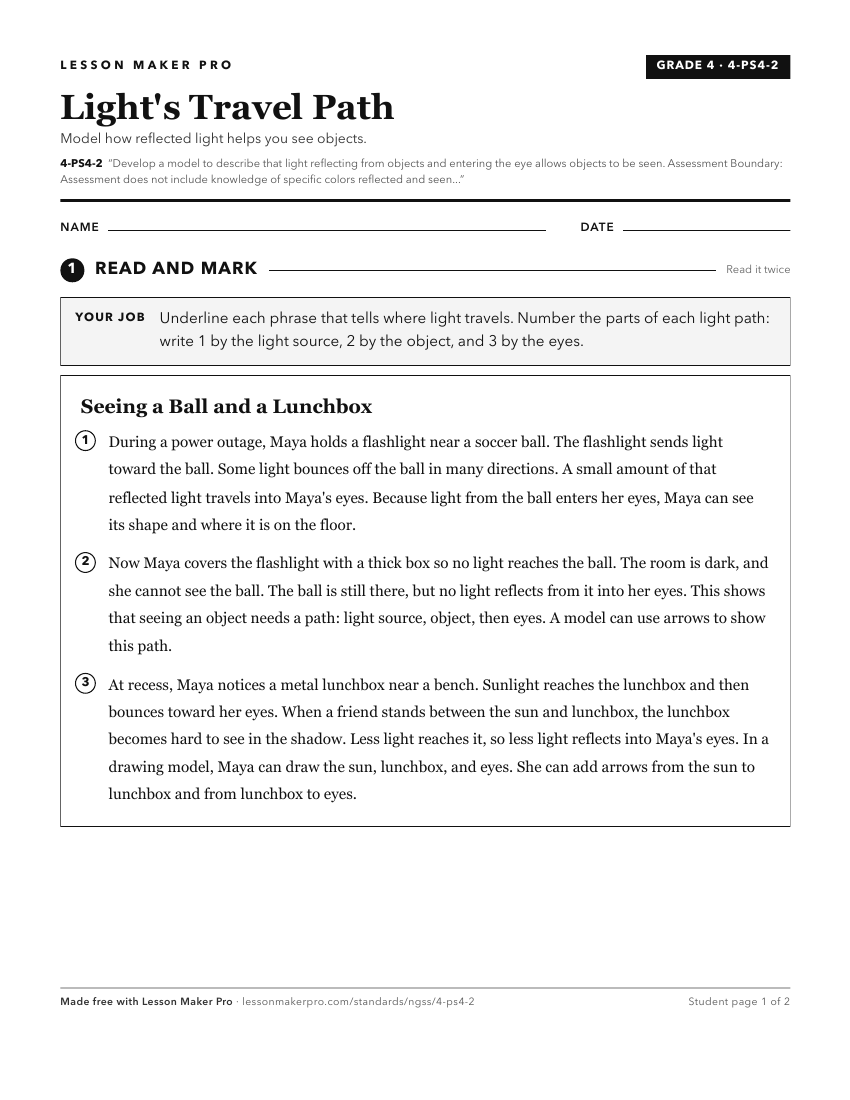
A ready-to-print activity worksheet aligned to 4-PS4-2, with an answer key for the teacher on its own page. No account needed.
PDF, US Letter, prints cleanly in black and white.
Download the worksheetLearning progression
Where This Standard Sits
See the whole path on the Physical Science progression map.
What This Unlocks
Mastery here sets students up for these next.
Keep exploring
Related Standards
- 5-PS1-1
Develop a model to describe that matter is made of particles too small to be seen.
- 1-PS4-2
Make observations to construct an evidence-based account that objects can be seen only when illuminated.
- 4-PS4-1
Develop a model of waves to describe patterns in terms of amplitude and wavelength and that waves can cause objects to move.
Turn this exact standard into a lesson
Grade, subject, topic, and the complete standard are prefilled. Create one free, no account needed.
Also for this standard:Make a WorksheetMake a QuizMake a Sub Lesson