NGSS 1-PS4-2
The Standard
Make observations to construct an evidence-based account that objects can be seen only when illuminated.
Next Generation Science Standards
Teacher's field guide
What This Standard Means
What Students Need to Do
- Students observe the same object under different lighting conditions. They use those observations to explain how light reaching an object affects whether it can be seen.
What Mastery Looks Like
- A student can predict whether an object will be visible in a given lighting setup and support the prediction with an observation. They can distinguish light sources from objects lit by another source.
Common Misconceptions
- Students may think eyes send out light or that waiting makes complete darkness visible. They may also think shiny or bright-colored objects make their own light.
How to Assess It
- Place a toy in a closed box with a viewing hole. Turn on a flashlight inside, then ask students to complete: “I saw the toy when ___ because ___.”
Lesson moves
Ways to Teach It
Place a toy in a shoebox, cut a viewing hole, and compare what students see with the lid closed and with a flashlight on.
Ask students to draw the same classroom object in light and darkness, then write one sentence explaining the difference.
Play Light Detective by sorting picture cards into objects that make light and objects that need another light source.
Examine a cave explorer photo and discuss why headlamps help explorers see rocks, signs, and equipment underground.
Free download
Printable 1-PS4-2 Worksheet
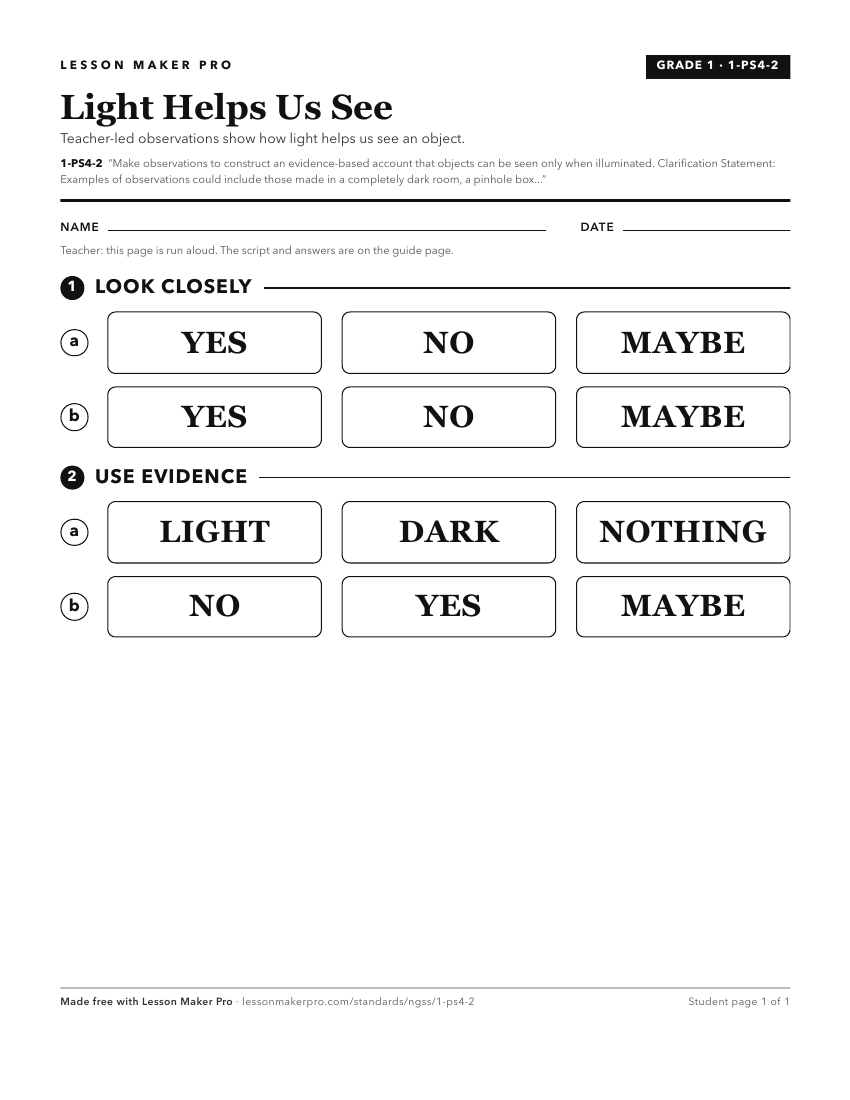
A ready-to-print activity worksheet aligned to 1-PS4-2, with an answer key for the teacher on its own page. No account needed.
PDF, US Letter, prints cleanly in black and white.
Download the worksheetKeep exploring
Related Standards
- 4-PS3-2
Make observations to provide evidence that energy can be transferred from place to place by sound, light, heat, and electric currents.
- 2-PS1-3
Make observations to construct an evidence-based account of how an object made of a small set of pieces can be disassembled and made into a new object.
- K-PS3-1
Make observations to determine the effect of sunlight on Earth's surface.
- 4-PS4-2
Develop a model to describe that light reflecting from objects and entering the eye allows objects to be seen.
Turn this exact standard into a lesson
Grade, subject, topic, and the complete standard are prefilled. Create one free, no account needed.
Also for this standard:Make a WorksheetMake a QuizMake a Sub Lesson