NGSS HS-ESS3-3
The Standard
Create a computational simulation to illustrate the relationships among management of natural resources, the sustainability of human populations, and biodiversity.
Next Generation Science Standards
Teacher's field guide
What This Standard Means
What Students Need to Do
- Students use a provided computer model or a simple spreadsheet to test how resource decisions affect people and biodiversity. They change inputs, compare outputs, and explain tradeoffs using data.
What Mastery Looks Like
- Students can adjust one or more inputs, run repeated trials, and read tables or graphs accurately. They can identify tradeoffs and explain how resource choices affect people and biodiversity over time.
Common Misconceptions
- Students may assume that conserving one resource always benefits every species and community. They may change several variables at once, making cause and effect unclear. They may treat model results as certain predictions rather than outcomes based on assumptions.
How to Assess It
- Give students a spreadsheet model with extraction rate, per-capita use, and habitat loss controls. Ask them to change one control, record all three outcomes, and explain the pattern.
Lesson moves
Ways to Teach It
Use a spreadsheet to model a forest, changing harvest rate and replanting rate while tracking timber supply, population needs, and species richness.
Write a recommendation to a town council choosing between two resource plans, using results from three simulation trials as evidence.
Run a simulation challenge where teams seek the highest population support without letting biodiversity fall below a set threshold.
Model local water use under drought conditions, then compare conservation, pricing, and new irrigation technology as management options.
Free download
Printable HS-ESS3-3 Worksheet
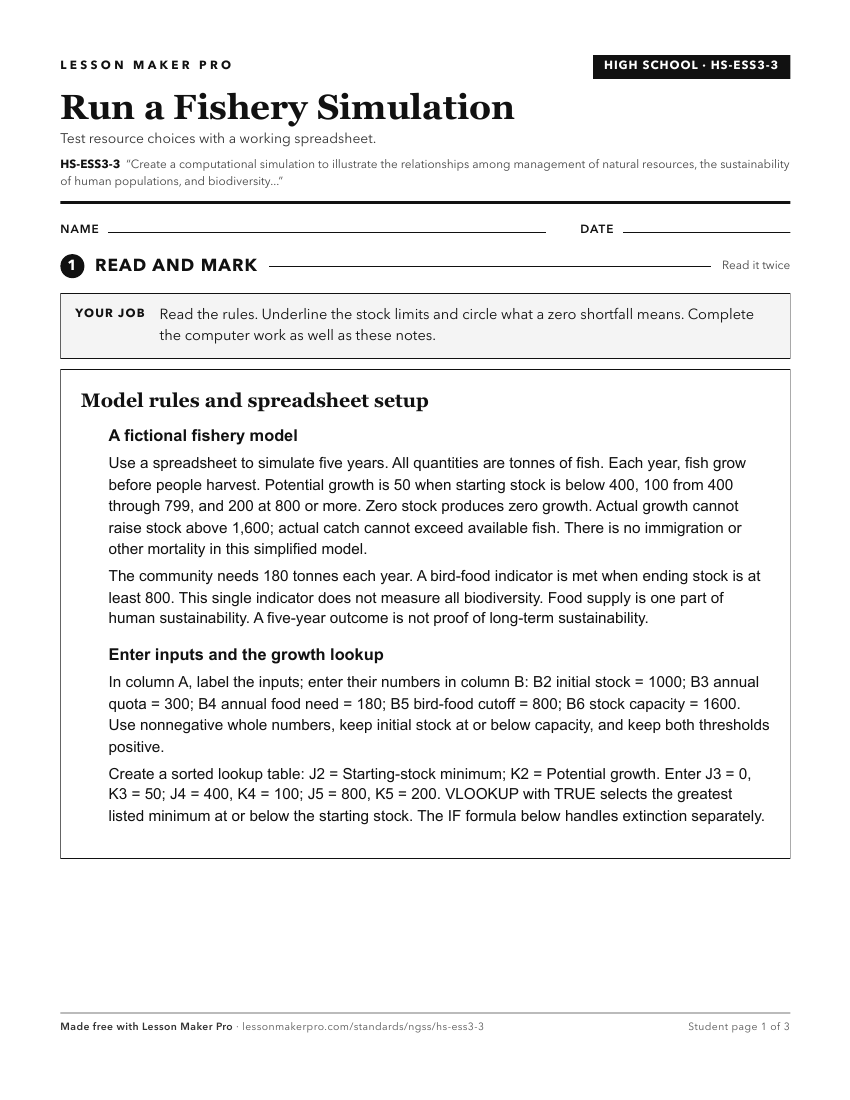
A ready-to-print activity worksheet aligned to HS-ESS3-3, with an answer key for the teacher on its own page. No account needed.
PDF, US Letter, prints cleanly in black and white.
Download the worksheetLearning progression
Where This Standard Sits
See the whole path on the Earth & Space Science progression map.
Before This Standard
If students are struggling here, check these first.
- MS-ESS3-3
Students carry forward how human actions can be monitored and reduced when modeling resource management, population sustainability, and biodiversity tradeoffs.
- MS-ESS3-4
Students extend population and resource consumption impact evidence into modeling how resource management affects human sustainability and biodiversity.
Keep exploring
Related Standards
- HS-LS4-6
Create or revise a simulation to test a solution to mitigate adverse impacts of human activity on biodiversity.
- HS-LS2-2
Use mathematical representations to support and revise explanations based on evidence about factors affecting biodiversity and populations in ecosystems of diff...
- HS-ESS3-6
Use a computational representation to illustrate the relationships among Earth systems and how those relationships are being modified due to human activity.
- HS-ETS1-4
Use a computer simulation to model the impact of proposed solutions to a complex real-world problem with numerous criteria and constraints on interactions withi...
Turn this exact standard into a lesson
Grade, subject, topic, and the complete standard are prefilled. Create one free, no account needed.
Also for this standard:Make a WorksheetMake a QuizMake a Sub Lesson