NGSS HS-ESS3-6
The Standard
Use a computational representation to illustrate the relationships among Earth systems and how those relationships are being modified due to human activity.
Next Generation Science Standards
Teacher's field guide
What This Standard Means
What Students Need to Do
- Students interpret tables, graphs, maps, or diagrams produced by computer models. They trace how a human-caused change in one Earth system affects others, using evidence from published model results.
What Mastery Looks Like
- Given published model outputs, students identify the scenario, relationships, and resulting impacts. They explain a chain of effects across systems, compare scenarios, and support claims with values or trends.
Common Misconceptions
- Students may treat model output as an exact prediction rather than a result based on assumptions and data. They may describe only the direct effect, skip linked system responses, or assume impacts occur everywhere at the same rate.
How to Assess It
- Give students three published model graphs showing atmospheric carbon dioxide, ocean pH, and shellfish survival. Ask them to identify one relationship, trace one effect into the biosphere, and cite two values from the graphs.
Lesson moves
Ways to Teach It
Give groups printed model-output cards for carbon dioxide, temperature, sea ice, ocean pH, and plankton, then connect them with labeled yarn arrows.
Display two emissions scenarios and ask students to write which Earth-system link is strongest, citing one pattern and one numerical value.
Run a scenario-matching game where teams pair human actions with published output graphs, then justify each match using axes and trends.
Use local heat, drought, flood, or coastal data to compare a community impact with the pattern shown in a published climate model.
Free download
Printable HS-ESS3-6 Worksheet
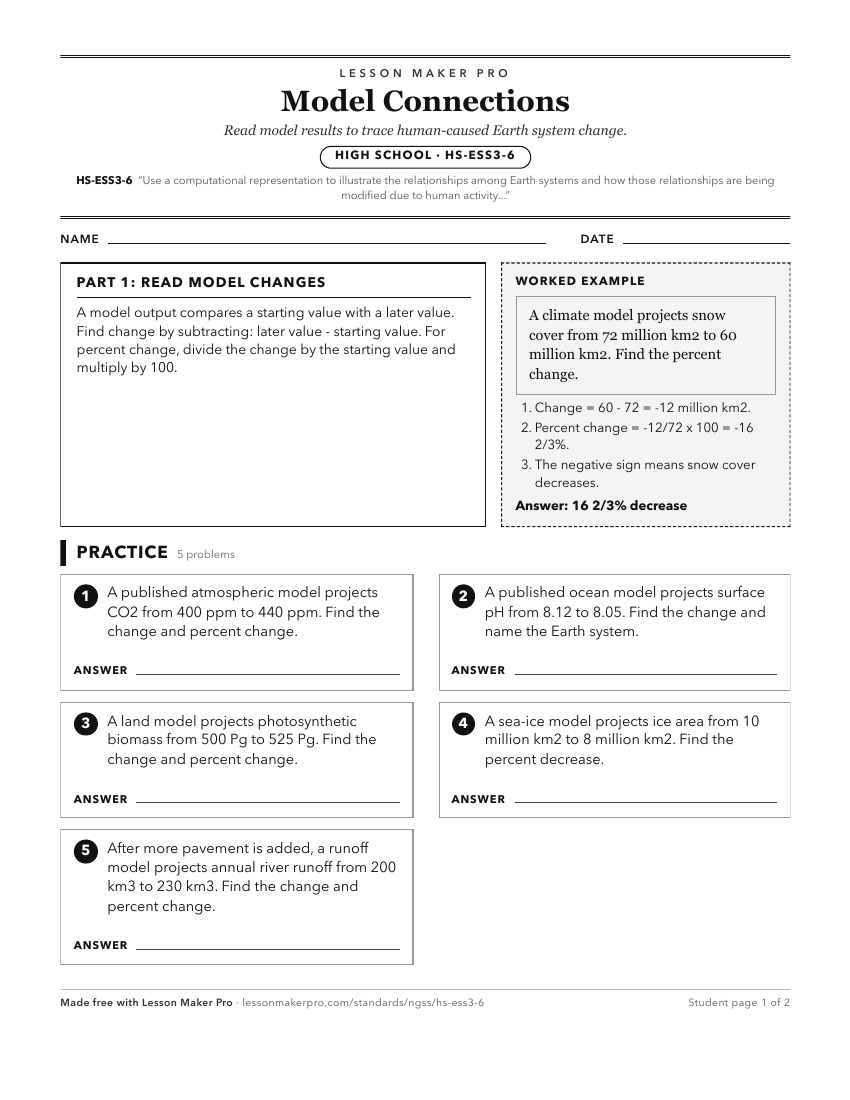
A ready-to-print activity worksheet aligned to HS-ESS3-6, with an answer key for the teacher on its own page. No account needed.
PDF, US Letter, prints cleanly in black and white.
Download the worksheetLearning progression
Where This Standard Sits
See the whole path on the Earth & Space Science progression map.
Before This Standard
If students are struggling here, check these first.
Keep exploring
Related Standards
- HS-ESS2-4
Use a model to describe how variations in the flow of energy into and out of Earth systems result in changes in climate.
- HS-ESS3-3
Create a computational simulation to illustrate the relationships among management of natural resources, the sustainability of human populations, and biodiversi...
- MS-ESS2-1
Develop a model to describe the cycling of Earth's materials and the flow of energy that drives this process.
- 4-ESS3-2
Generate and compare multiple solutions to reduce the impacts of natural Earth processes on humans.
Turn this exact standard into a lesson
Grade, subject, topic, and the complete standard are prefilled. Create one free, no account needed.
Also for this standard:Make a WorksheetMake a QuizMake a Sub Lesson