NGSS HS-ESS2-3
The Standard
Develop a model based on evidence of Earth's interior to describe the cycling of matter by thermal convection.
Next Generation Science Standards
Teacher's field guide
What This Standard Means
What Students Need to Do
- Students build a radial profile that places the crust, mantle, outer core, and inner core using density and composition evidence. They also create a three-dimensional model showing hot material rising, cooler material sinking, and plates moving above the mantle. They connect seismic, magnetic, and laboratory evidence to each model choice.
What Mastery Looks Like
- Students can create a correctly ordered radial diagram and a three-dimensional convection sketch. They use arrows to track matter through a convection cell and connect that motion to plate movement. They justify layer properties with at least two evidence sources, such as S-wave behavior and high-pressure experiments.
Common Misconceptions
- Students often draw the mantle as a liquid ocean, although it is mostly solid rock that flows slowly. They may show heat moving but not matter, or draw convection arrows that stop without completing a cycle. They may also assume seismic waves directly sample material rather than provide indirect evidence from wave speed and path.
How to Assess It
- Exit ticket: On a blank Earth cross-section, label four layers, draw one complete mantle convection loop, and cite one seismic observation supporting a layer boundary.
Lesson moves
Ways to Teach It
Place a clear pan of colored water over a safe heat source, then sketch rising warm water and sinking cool water as a convection model.
Discuss: Which evidence best supports each interior layer, seismic wave paths, magnetic field changes, or high-pressure rock tests, and why?
Play an evidence-card relay where teams match seismic, magnetic, and laboratory clues to interior layers, then correct one disputed match.
Compare a USGS seismic tomography image with a plate boundary map and explain where moving mantle material may shape volcano and earthquake patterns.
Free download
Printable HS-ESS2-3 Worksheet
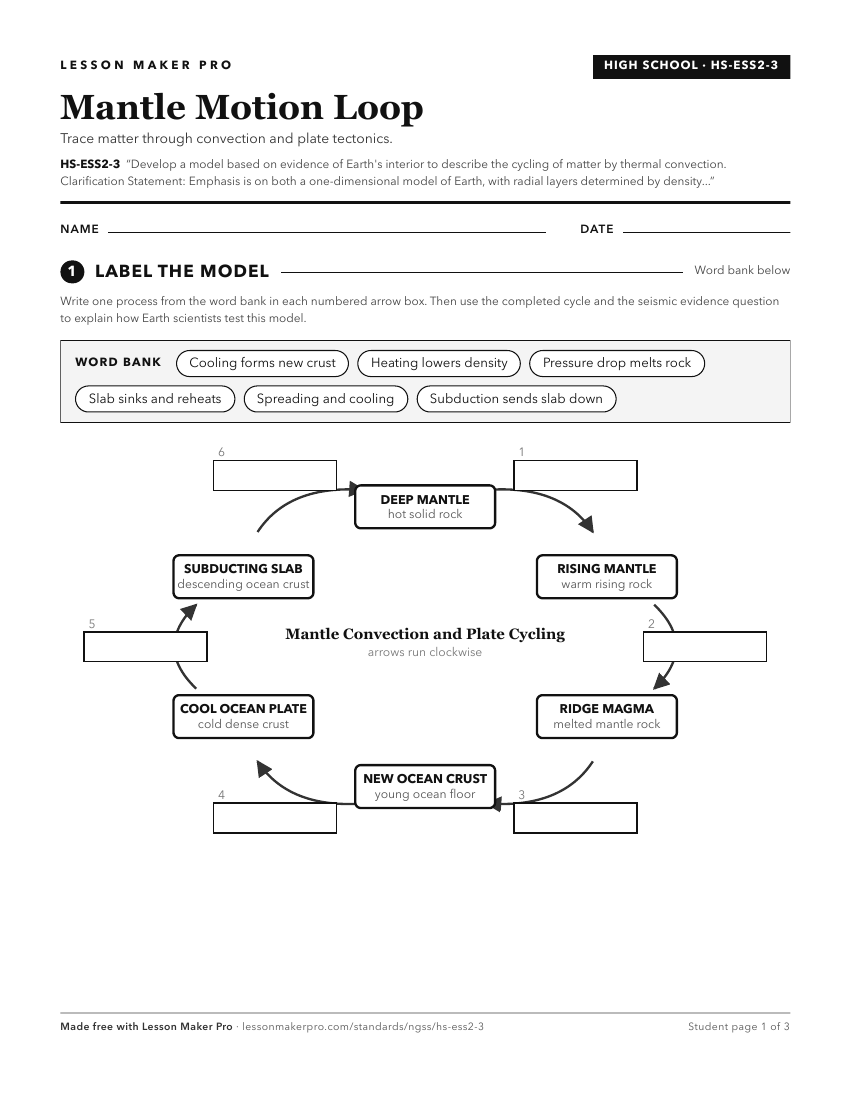
A ready-to-print activity worksheet aligned to HS-ESS2-3, with an answer key for the teacher on its own page. No account needed.
PDF, US Letter, prints cleanly in black and white.
Download the worksheetLearning progression
Where This Standard Sits
See the whole path on the Earth & Space Science progression map.
Before This Standard
If students are struggling here, check these first.
- MS-ESS2-2
Middle school explanations of geoscience processes and scale support modeling how interior convection cycles matter in Earth systems.
- MS-ESS2-1
Students carry forward modeling Earth material cycling and energy flow, then focus that model on evidence for mantle convection.
- MS-ESS2-3
Interpreting evidence for plate motion supports modeling how mantle convection moves and recycles Earth’s materials.
Keep exploring
Related Standards
- MS-ESS2-4
Develop a model to describe the cycling of water through Earth's systems driven by energy from the sun and the force of gravity.
- HS-ESS2-1
Develop a model to illustrate how Earth's internal and surface processes operate at different spatial and temporal scales to form continental and ocean-floor fe...
- HS-ESS1-1
Develop a model based on evidence to illustrate the life span of the sun and the role of nuclear fusion in the sun's core to release energy that eventually reac...
Turn this exact standard into a lesson
Grade, subject, topic, and the complete standard are prefilled. Create one free, no account needed.
Also for this standard:Make a WorksheetMake a QuizMake a Sub Lesson