NGSS HS-ESS2-1
The Standard
Develop a model to illustrate how Earth's internal and surface processes operate at different spatial and temporal scales to form continental and ocean-floor features.
Next Generation Science Standards
Teacher's field guide
What This Standard Means
What Students Need to Do
- Students create a labeled model showing how processes inside Earth and at the surface shape land and seafloor features. They show that these processes work across different distances and time spans.
What Mastery Looks Like
- A strong model uses arrows, labels, and time or distance scales to connect processes with land and seafloor features. Students can explain how slow tectonic change and faster surface change act together.
Common Misconceptions
- Students may treat uplift and erosion as separate events rather than processes happening together. They may assume all changes occur quickly, or that the ocean floor is flat and unchanging.
How to Assess It
- Give students a blank continent-to-ocean cross section. Ask them to draw and label two interacting processes, their time and space scales, and the features produced.
Lesson moves
Ways to Teach It
Build a clay landscape, raise one section, cut a stream channel, then label which processes add relief and which wear it down.
Write a claim explaining why a mountain range can rise while erosion lowers its peaks, using evidence from a process timeline.
Sort process and feature cards by spatial scale, time scale, and constructive or destructive effect, then defend one disputed match.
Compare maps of the Mid-Atlantic Ridge and Himalayas, then sketch how plate motion and surface erosion shape each region over time.
Free download
Printable HS-ESS2-1 Worksheet
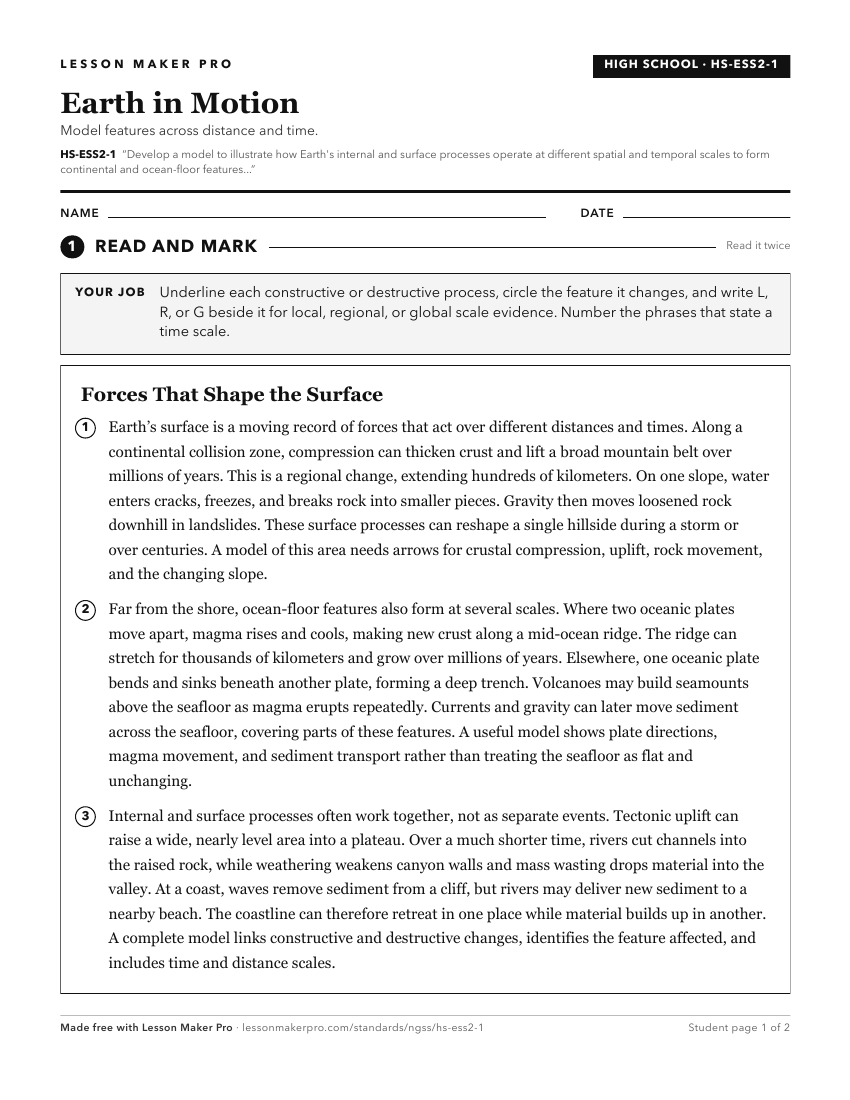
A ready-to-print activity worksheet aligned to HS-ESS2-1, with an answer key for the teacher on its own page. No account needed.
PDF, US Letter, prints cleanly in black and white.
Download the worksheetLearning progression
Where This Standard Sits
See the whole path on the Earth & Space Science progression map.
Before This Standard
If students are struggling here, check these first.
- MS-ESS2-2
Explaining how geoscience processes change surfaces across scales supports modeling how internal and surface processes form major Earth features.
- MS-ESS2-3
Evidence for past plate motions supports HS modeling of how plate-driven internal and surface processes form continents and ocean floors.
- MS-ESS2-1
Understanding Earth material cycling and energy flow supports modeling how tectonic and surface processes create features over varied scales.
Keep exploring
Related Standards
Turn this exact standard into a lesson
Grade, subject, topic, and the complete standard are prefilled. Create one free, no account needed.
Also for this standard:Make a WorksheetMake a QuizMake a Sub Lesson