NGSS HS-ESS1-1
The Standard
Develop a model based on evidence to illustrate the life span of the sun and the role of nuclear fusion in the sun's core to release energy that eventually reaches Earth in the form of radiation.
Next Generation Science Standards
Teacher's field guide
What This Standard Means
What Students Need to Do
- Students build and revise a visual model of the Sun from formation through its final white dwarf stage. They trace fusion-generated energy through the radiative and convective zones, then across space as electromagnetic radiation. They support model choices with observations of other stars and changes in solar activity.
What Mastery Looks Like
- A strong model correctly sequences formation, main sequence, red giant, planetary nebula, and white dwarf stages. Arrows show fusion in the core, radiation and convection inside the Sun, and electromagnetic radiation crossing space. The student uses stellar observations to justify the sequence.
Common Misconceptions
- Students may say the Sun burns fuel like a fire or that sunlight travels directly from the core to Earth. Some confuse energy transfer with matter moving outward, or treat sunspots as holes. They may predict a supernova, although the Sun lacks enough mass.
How to Assess It
- Exit ticket: Draw and label how energy moves from the Sun’s core to Earth. Add one sentence explaining how observations of other stars support the Sun’s predicted life span.
Lesson moves
Ways to Teach It
Use colored beads, yarn, and a paper Sun cross-section to build a model tracing energy from the core to a solar panel.
Write: How can observations of stars with different masses and ages help us predict the Sun’s past and future?
Have teams race to sequence stage, evidence, and energy-transfer cards, then require one spoken justification for every match.
Compare a recent NOAA solar flare alert with GPS or radio reports, then explain how changing solar radiation can affect technology.
Free download
Printable HS-ESS1-1 Worksheet
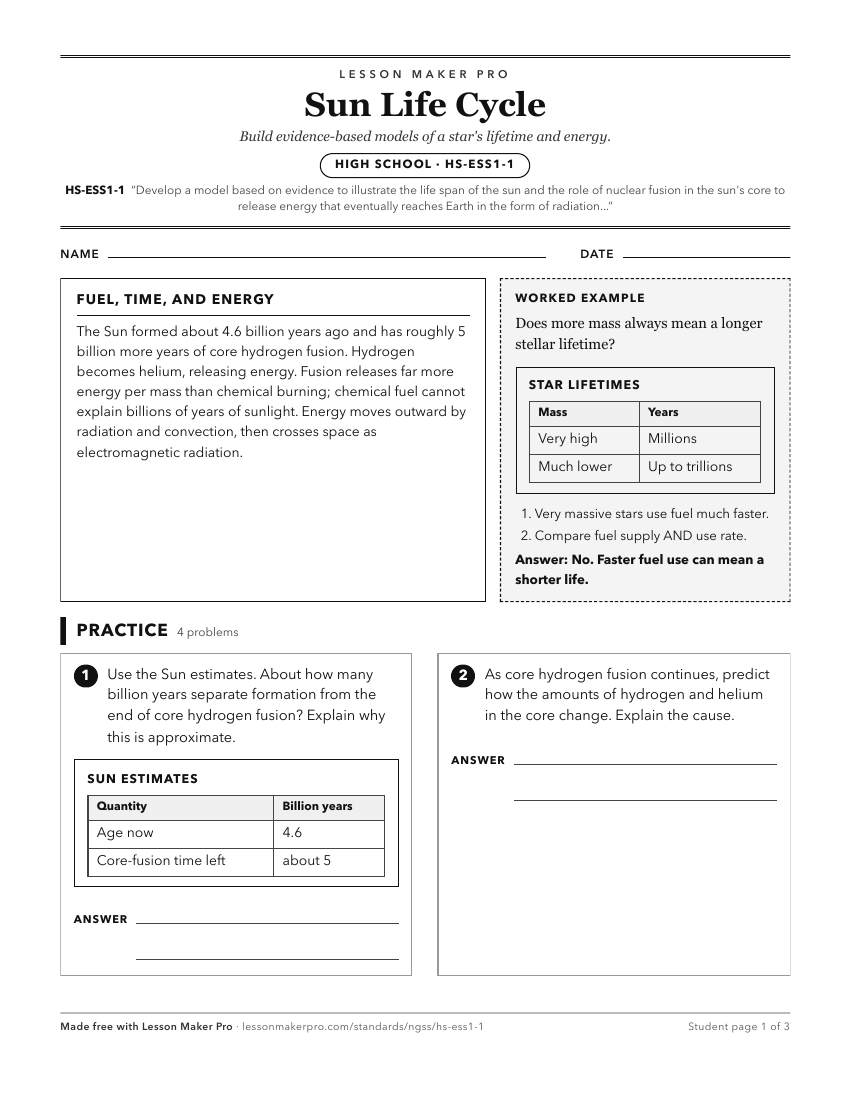
A ready-to-print activity worksheet aligned to HS-ESS1-1, with an answer key for the teacher on its own page. No account needed.
PDF, US Letter, prints cleanly in black and white.
Download the worksheetLearning progression
Where This Standard Sits
See the whole path on the Earth & Space Science progression map.
Before This Standard
If students are struggling here, check these first.
Keep exploring
Related Standards
- MS-ESS2-4
Develop a model to describe the cycling of water through Earth's systems driven by energy from the sun and the force of gravity.
- MS-ESS2-1
Develop a model to describe the cycling of Earth's materials and the flow of energy that drives this process.
- HS-ESS2-3
Develop a model based on evidence of Earth's interior to describe the cycling of matter by thermal convection.
- HS-PS1-8
Develop models to illustrate the changes in the composition of the nucleus of the atom and the energy released during the processes of fission, fusion, and radi...
Turn this exact standard into a lesson
Grade, subject, topic, and the complete standard are prefilled. Create one free, no account needed.
Also for this standard:Make a WorksheetMake a QuizMake a Sub Lesson