NGSS 4-PS4-3
The Standard
Generate and compare multiple solutions that use patterns to transfer information.
Next Generation Science Standards
Teacher's field guide
What This Standard Means
What Students Need to Do
- Students create more than one way to send a message using a pattern of sounds, symbols, lights, or colors. They test each code and compare how well the solutions communicate the message.
What Mastery Looks Like
- Students create at least two workable codes with clear keys. They test whether another student can decode each message and compare the codes using evidence about accuracy, speed, or ease of use.
Common Misconceptions
- Students may think any repeating pattern carries a message, even when no meaning or code key is assigned. They may also judge a code by appearance rather than accuracy, speed, or ease of decoding.
How to Assess It
- Exit ticket: Create two different codes for the word GO, include a key, then choose which code would be easier to decode and explain why.
Lesson moves
Ways to Teach It
In pairs, students create tap codes for four classroom messages, send them across the room, and record how many are decoded correctly.
Ask students to compare Morse code and a black-and-white grid code, then write which better sends a short message and why.
Play Code Relay, where teams encode a word, pass it to another team, and earn points for accurate decoding.
Study a pedestrian crossing signal and list how its light and sound patterns send different messages to people.
Free download
Printable 4-PS4-3 Worksheet
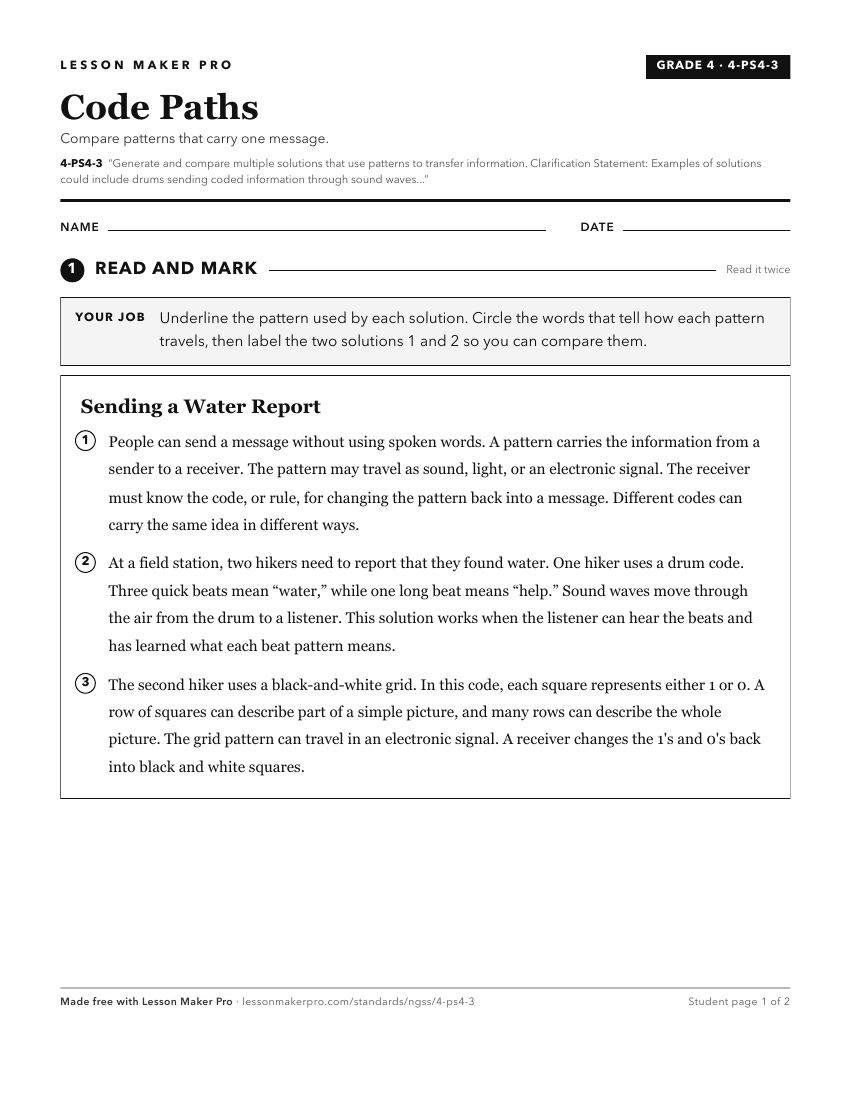
A ready-to-print activity worksheet aligned to 4-PS4-3, with an answer key for the teacher on its own page. No account needed.
PDF, US Letter, prints cleanly in black and white.
Download the worksheetLearning progression
Where This Standard Sits
See the whole path on the Physical Science progression map.
What This Unlocks
Mastery here sets students up for these next.
Keep exploring
Related Standards
- MS-ETS1-3
Analyze data from tests to determine similarities and differences among several design solutions to identify the best characteristics of each that can be combin...
- 3-5-ETS1-2
Generate and compare multiple possible solutions to a problem based on how well each is likely to meet the criteria and constraints of the problem.
- K-2-ETS1-3
Analyze data from tests of two objects designed to solve the same problem to compare the strengths and weaknesses of how each performs.
- 4-ESS3-2
Generate and compare multiple solutions to reduce the impacts of natural Earth processes on humans.
Turn this exact standard into a lesson
Grade, subject, topic, and the complete standard are prefilled. Create one free, no account needed.
Also for this standard:Make a WorksheetMake a QuizMake a Sub Lesson