NGSS MS-PS4-3
The Standard
Integrate qualitative scientific and technical information to support the claim that digitized signals are a more reliable way to encode and transmit information than analog signals. Clarification Statement: Emphasis is on a basic understanding that waves can be used for communication purposes. Examples could include using fiber optic cable to transmit light pulses, radio wave pulses in wifi devices, and conversion of stored binary patterns to make sound or text on a computer screen. Assessment Boundary: Assessment does not include binary counting. Assessment does not include the specific mechanism of any given device.
Next Generation Science Standards
Teacher's field guide
What This Standard Means
What Students Need to Do
- Students compare how continuous signals and separated pulses carry the same message when noise changes the wave. They combine evidence from diagrams, demonstrations, and short technical texts to explain why pulse patterns are often easier to identify and rebuild.
What Mastery Looks Like
- A student can interpret diagrams showing a continuous signal becoming distorted while a pulse pattern remains recognizable. They combine details from a diagram and a short technical text to explain why digital messages can be rebuilt accurately.
Common Misconceptions
- Students may think digital signals are not waves, or that digital means wireless. They may claim digital transmission never has errors. They may focus on speed or strength instead of how distinct pulse states can be recognized and rebuilt after noise.
How to Assess It
- On an exit ticket, show a smooth wave and a pulse train before and after mild noise. Ask, "Which signal preserves the message more reliably, and what feature in the diagrams supports your claim?"
Adopted as
This framework is adopted as written in California, Connecticut, Delaware, District of Columbia, Hawaii, Illinois, Kansas, Maryland, Nevada, New Hampshire, New Mexico, Rhode Island, Vermont.
Lesson moves
Ways to Teach It
Pairs send the same message with flashlight brightness levels and on-off pulses, add translucent paper, then compare decoding errors.
Write a claim explaining why a distorted pulse pattern can still be read, using evidence from two provided diagrams or short texts.
Play Signal Sort: teams classify cards as analog or digital, then rank which messages can be reconstructed after noise.
Trace a text message from phone to router to recipient, labeling where radio pulses carry information and devices rebuild it.
Free download
Printable MS-PS4-3 Worksheet
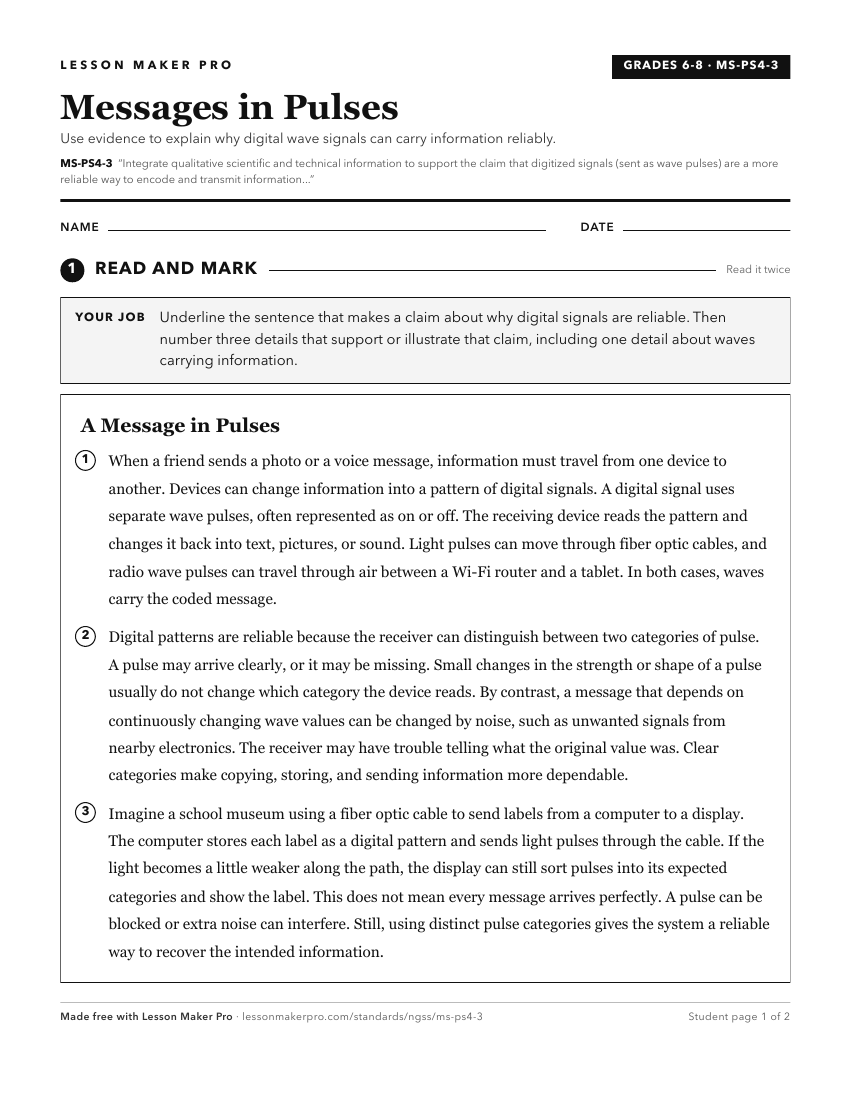
A ready-to-print activity worksheet aligned to MS-PS4-3, with an answer key for the teacher on its own page. No account needed.
PDF, US Letter, prints cleanly in black and white.
Download the worksheetLearning progression
Where This Standard Sits
See the whole path on the Physical Science progression map.
Before This Standard
If students are struggling here, check these first.
What This Unlocks
Mastery here sets students up for these next.
Keep exploring
Related Standards
- HS-PS4-2
Evaluate questions about the advantages of using a digital transmission and storage of information.
- HS-PS4-1
Use mathematical representations to support a claim regarding relationships among the frequency, wavelength, and speed of waves traveling in various media.
- HS-PS4-3
Evaluate the claims, evidence, and reasoning behind the idea that electromagnetic radiation can be described either by a wave model or a particle model, and tha...
Turn this exact standard into a lesson
Grade, subject, topic, and the complete standard are prefilled. Create one free, no account needed.
Also for this standard:Make a WorksheetMake a QuizMake a Sub Lesson