NGSS HS-PS4-2
The Standard
Evaluate questions about the advantages of using a digital transmission and storage of information.
Next Generation Science Standards
Teacher's field guide
What This Standard Means
What Students Need to Do
- Students evaluate questions about storing and sending information digitally. They use evidence to compare benefits and drawbacks, then decide whether a question is focused, fair, and answerable.
What Mastery Looks Like
- Students can identify a focused question, choose useful criteria, and judge evidence about digital information. They can explain a tradeoff involving reliability, speed, copying, access, security, or data loss.
Common Misconceptions
- Students may assume digital files never lose quality, cannot be damaged, or are always secure. They may also confuse fast copying with accurate copying and overlook accidental deletion, unauthorized access, and device failure.
How to Assess It
- Exit ticket: A hospital is replacing paper records with digital files. Write one question that would help evaluate the change, then name the evidence needed to answer it.
Lesson moves
Ways to Teach It
Have pairs copy an image file across three USB drives, compare file hashes, then discuss what the match does and does not prove.
Write a response to this prompt: Should schools keep report cards only as digital files, or also keep paper copies?
Give teams question cards to sort into useful, too broad, or biased piles, then require a reason for each choice.
Ask students to design a storage plan for school emergency contacts that balances quick access, backups, privacy, and protection from deletion.
Free download
Printable HS-PS4-2 Worksheet
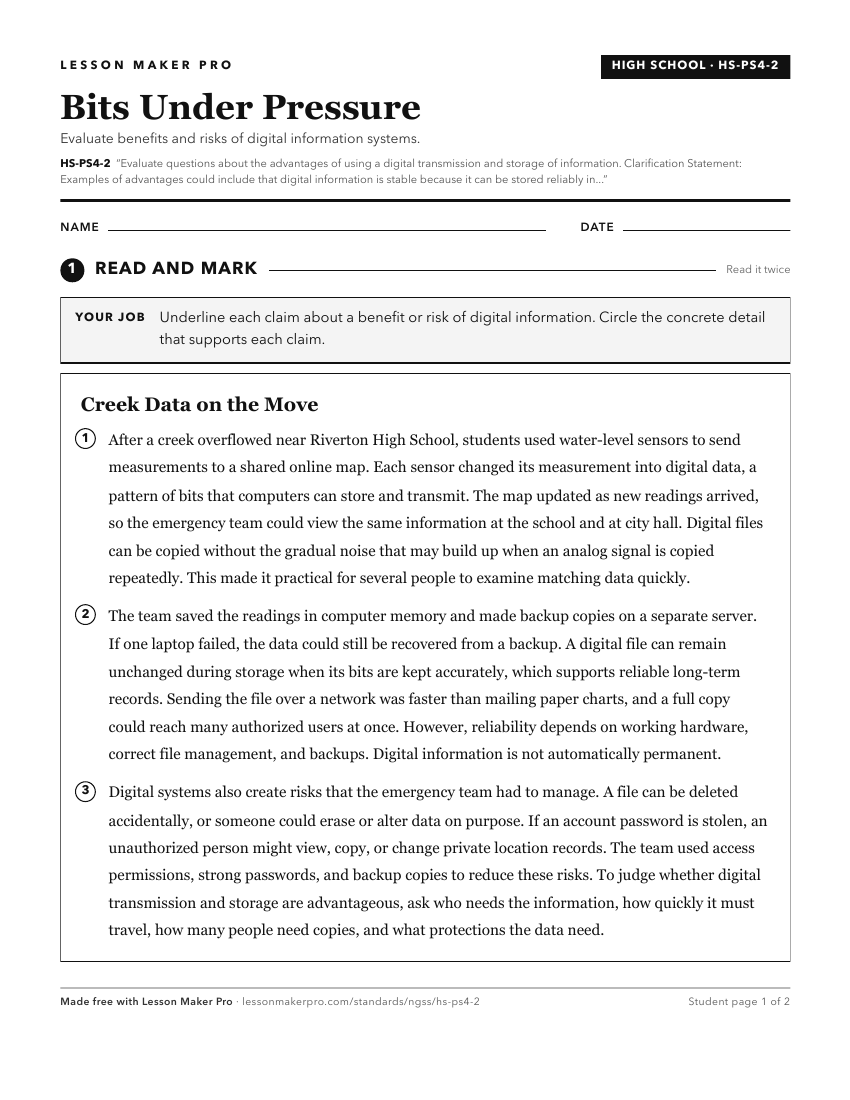
A ready-to-print activity worksheet aligned to HS-PS4-2, with an answer key for the teacher on its own page. No account needed.
PDF, US Letter, prints cleanly in black and white.
Download the worksheetLearning progression
Where This Standard Sits
See the whole path on the Physical Science progression map.
Before This Standard
If students are struggling here, check these first.
- MS-PS4-1
Wave amplitude and energy support understanding signals, but digital transmission advantages mostly require information coding and noise considerations.
- MS-PS4-2
Understanding wave reflection, absorption, and transmission supports evaluating how digital signals move through media and preserve information.
Keep exploring
Related Standards
- MS-PS2-3
Ask questions about data to determine the factors that affect the strength of electric and magnetic forces.
- 1-PS4-4
Use tools and materials to design and build a device that uses light or sound to solve the problem of communicating over a distance.
- MS-PS4-3
Integrate qualitative scientific and technical information to support the claim that digitized signals (sent as wave pulses) are a more reliable way to encode a...
- HS-PS4-5
Communicate technical information about how some technological devices use the principles of wave behavior and wave interactions with matter to transmit and cap...
Turn this exact standard into a lesson
Grade, subject, topic, and the complete standard are prefilled. Create one free, no account needed.
Also for this standard:Make a WorksheetMake a QuizMake a Sub Lesson