Montana Math MT.CORE.GEOM.MEAS.4
Standard Cluster
Use geometric shapes, their measures, and their properties to model objects and use those models to solve problems in context. This standard should incorporate cultural context relating to Montana Indigenous Peoples and local communities by: Modeling and solving problems with 2D shapes by using the perimeter and area of polygons, circles, and composite shapes with portions removed, Modeling and solving problems with 3D solids by using surface area and volume of solids, including composite solids and solids with portions removed, and Deriving and applying the relationships between the lengths, perimeters, areas, and volumes of similar figures in relation to their scale factor.
2026 Montana Mathematics Content Standards · Geometric Reasoning
Cluster contents
Standards in This Cluster
MT.CORE.GEOM.MEAS.4 is a cluster heading. These are the individual standards under it.
- MT.CORE.GEOM.MEAS.4.a
Modeling and solving problems with 2D shapes by using the perimeter and area of polygons, circles, and composite shapes with portions removed,
- MT.CORE.GEOM.MEAS.4.b
Modeling and solving problems with 3D solids by using surface area and volume of solids, including composite solids and solids with portions removed, and
- MT.CORE.GEOM.MEAS.4.c
Deriving and applying the relationships between the lengths, perimeters, areas, and volumes of similar figures in relation to their scale factor.
Teacher's field guide
What This Cluster Means
What Students Need to Do
- Students sketch real objects as polygons, circles, or solids and use measurements to solve practical problems. They account for openings and removed pieces, then work out how changes in scale affect length, perimeter, area, and volume.
What Mastery Looks Like
- A student can choose a useful shape model, label its dimensions, and calculate the space it covers, material it needs, or volume it holds. They include the right units and account for cutouts. They can explain why a scale factor of 2 doubles perimeter, quadruples area, and multiplies volume by 8.
Common Misconceptions
- Students may add a cutout's area instead of subtracting it, or miss the edges and faces exposed by a cut. They may report volume in square units or assume doubling lengths doubles area and volume too.
How to Assess It
- Exit ticket: A 12 m by 8 m garden has a circular pond with a radius of 2 m. Find the planting area, then explain what happens to that area if every length doubles.
Lesson moves
Ways to Teach It
Build a rectangular prism from centimeter cubes, remove a corner block, then compare volume and exposed surface area before and after.
Ask, "If a round window is cut from a rectangular wall, what area remains, and which edges count toward the perimeter?"
Give pairs dimension cards for composite solids; have them sketch each solid, mark shared faces, and calculate its volume.
Use a Google Maps scale bar to estimate the area and perimeter of a parking lot at Salish Kootenai College on the Flathead Reservation.
Free download
Printable MT.CORE.GEOM.MEAS.4 Worksheet
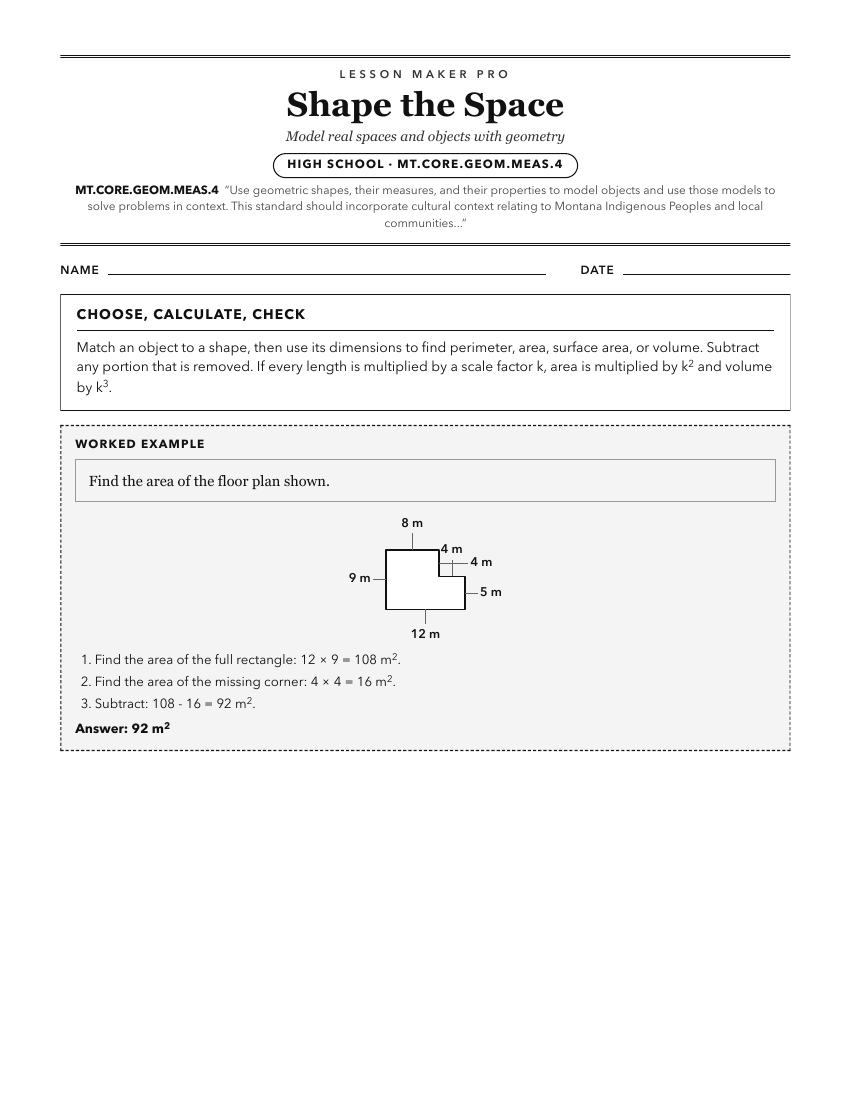
A ready-to-print activity worksheet aligned to MT.CORE.GEOM.MEAS.4, with an answer key for the teacher on its own page. No account needed.
PDF, US Letter, prints cleanly in black and white.
Download the worksheetKeep exploring
Related Standards
- MT.7.G.5
Solve geometrical problems including problems in context that involve area, volume, and surface area of two- and three-dimensional objects composed of triangles...
- MT.6.G.1
Find the area of triangles, quadrilaterals, and other polygons by composing them into rectangles or decomposing them into triangles and other shapes. This stand...
- MT.4.MD.2
Use the four operations to solve problems in context using distances, intervals of time, liquid volumes, masses of objects, and money, including problems with s...
- MT.6.G.4
Represent three-dimensional figures using nets made up of rectangles and triangles and use the nets to find the surface area of these figures in problems includ...
Turn this cluster into a lesson
Grade, subject, topic, and the complete cluster are prefilled. Create one free, no account needed.
Also for this cluster:Make a WorksheetMake a QuizMake a Sub Lesson