Montana Math MT.CORE.GEOM.MEAS.4.a
The Standard
- MT.CORE.GEOM.MEAS.4
- Use geometric shapes, their measures, and their properties to model objects and use those models to solve problems in context. This standard should incorporate cultural context relating to Montana Indigenous Peoples and local communities by: Modeling and solving problems with 2D shapes by using the perimeter and area of polygons, circles, and composite shapes with portions removed, Modeling and solving problems with 3D solids by using surface area and volume of solids, including composite solids and solids with portions removed, and Deriving and applying the relationships between the lengths, perimeters, areas, and volumes of similar figures in relation to their scale factor.
Use geometric shapes, their measures, and their properties to model objects and use those models to solve problems in context. This standard should incorporate cultural context relating to Montana Indigenous Peoples and local communities by: Modeling and solving problems with 2D shapes by using the perimeter and area of polygons, circles, and composite shapes with portions removed,
2026 Montana Mathematics Content Standards · Geometric Reasoning
Teacher's field guide
What This Standard Means
What Students Need to Do
- Students use polygons and circles to make a simple plan of a real space. They calculate area and perimeter, including the effect of a piece cut out or a space left open.
What Mastery Looks Like
- A student can split a plan into familiar shapes, label the needed measurements, and subtract the area of a pond or path. They can calculate fence and edging lengths separately and use the right units for each answer.
Common Misconceptions
- Students may add a pond’s area instead of subtracting it, or use the diameter as the radius. They may count a pond’s edge as outside fencing, or leave a curved cutout edge out of the perimeter.
How to Assess It
- Give students this prompt: A proposed garden is a 12 m by 8 m rectangle with a circular pond of radius 2 m inside. Find the planting area, outside fence length, and pond edging length.
Lesson moves
Ways to Teach It
Cut a semicircle from a paper rectangle, measure the new edges, and calculate the remaining area and perimeter.
Show a garden with an interior pond and one with a semicircular notch; ask which edges need fencing in each plan.
Give pairs shape cards and cutout cards; have them calculate remaining area, then check each other’s units.
Use a proposed Salish Kootenai College garden plan with a circular seating space; calculate planting area and edging needed around it.
Free download
Printable MT.CORE.GEOM.MEAS.4.a Worksheet
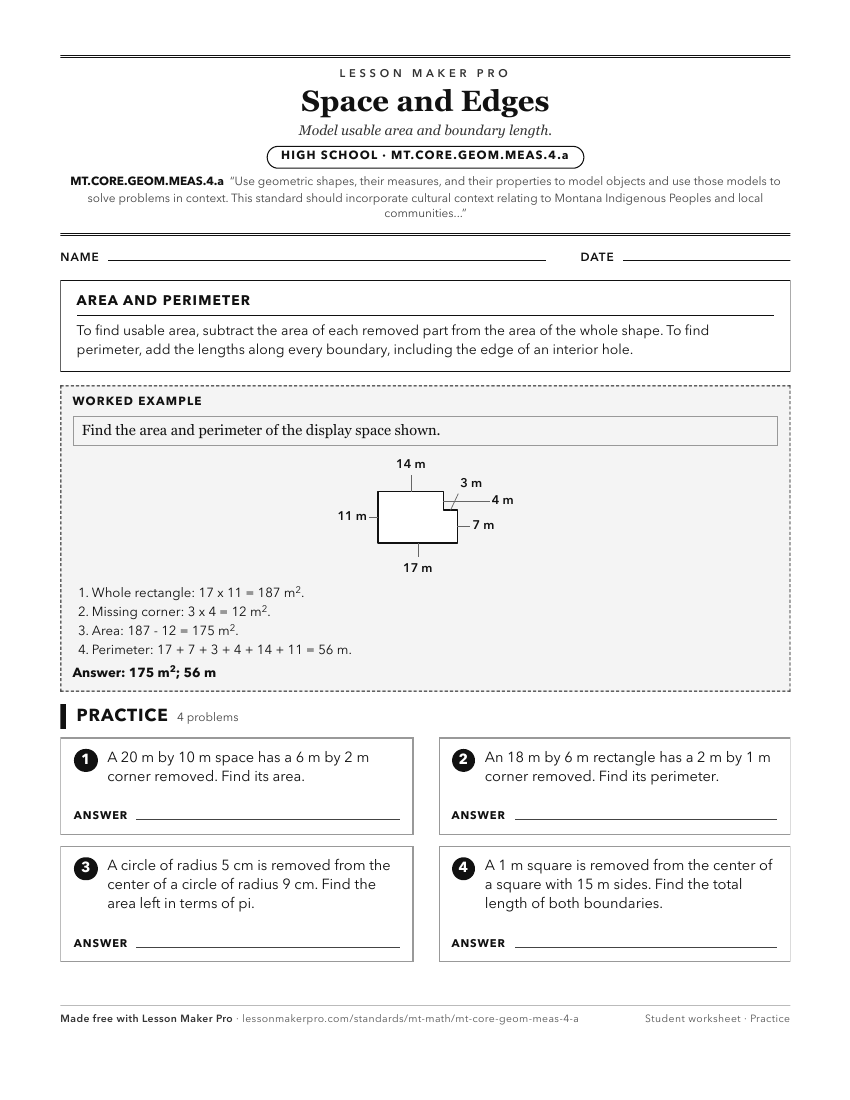
A ready-to-print activity worksheet aligned to MT.CORE.GEOM.MEAS.4.a, with an answer key for the teacher on its own page. No account needed.
PDF, US Letter, prints cleanly in black and white.
Download the worksheetKeep exploring
Related Standards
- MT.CORE.GEOM.MEAS.4
Use geometric shapes, their measures, and their properties to model objects and use those models to solve problems in context. This standard should incorporate ...
- MT.3.MD.8
Solve problems in context involving perimeters of polygons, including finding the perimeter given the side lengths, finding an unknown side length, and exhibiti...
- MT.CORE.GEOM.MEAS.4.b
Modeling and solving problems with 3D solids by using surface area and volume of solids, including composite solids and solids with portions removed, and
- MT.K.G.4
Analyze and compare two- and three-dimensional shapes using informal language and other attributes.
Turn this exact standard into a lesson
Grade, subject, topic, and the complete standard are prefilled. Create one free, no account needed.
Also for this standard:Make a WorksheetMake a QuizMake a Sub Lesson