Montana Math MT.K.G.4
The Standard
Analyze and compare two- and three-dimensional shapes using informal language and other attributes.
2026 Montana Mathematics Content Standards
Teacher's field guide
What This Standard Means
What Students Need to Do
- Students compare flat shapes and solid objects. They use words such as round, straight, corner, flat, and curved to tell how shapes are alike and different.
What Mastery Looks Like
- A student can say that a paper circle and a ball are both round, but only the ball is solid. They can compare a square and a triangle by counting corners, even when the shapes are turned.
Common Misconceptions
- Students may call a ball a circle because both look round. They may think a tilted square is a new shape or sort shapes by color instead of shape features.
How to Assess It
- Show a paper circle and a ball. Ask students how they are alike and different, and listen for round and flat versus solid.
Lesson moves
Ways to Teach It
Give pairs paper circles, paper squares, cube blocks, and balls to sort into flat and solid groups, then compare a circle and ball.
Show a square card tilted like a diamond and ask, “Did the shape change? How can you tell?”
Play shape detective: describe a mystery shape using corners, straight sides, or curved surfaces while classmates choose from shape cards and blocks.
Trace the circular end of a soup can on paper, then compare the traced circle with the can.
Free download
Printable MT.K.G.4 Worksheet
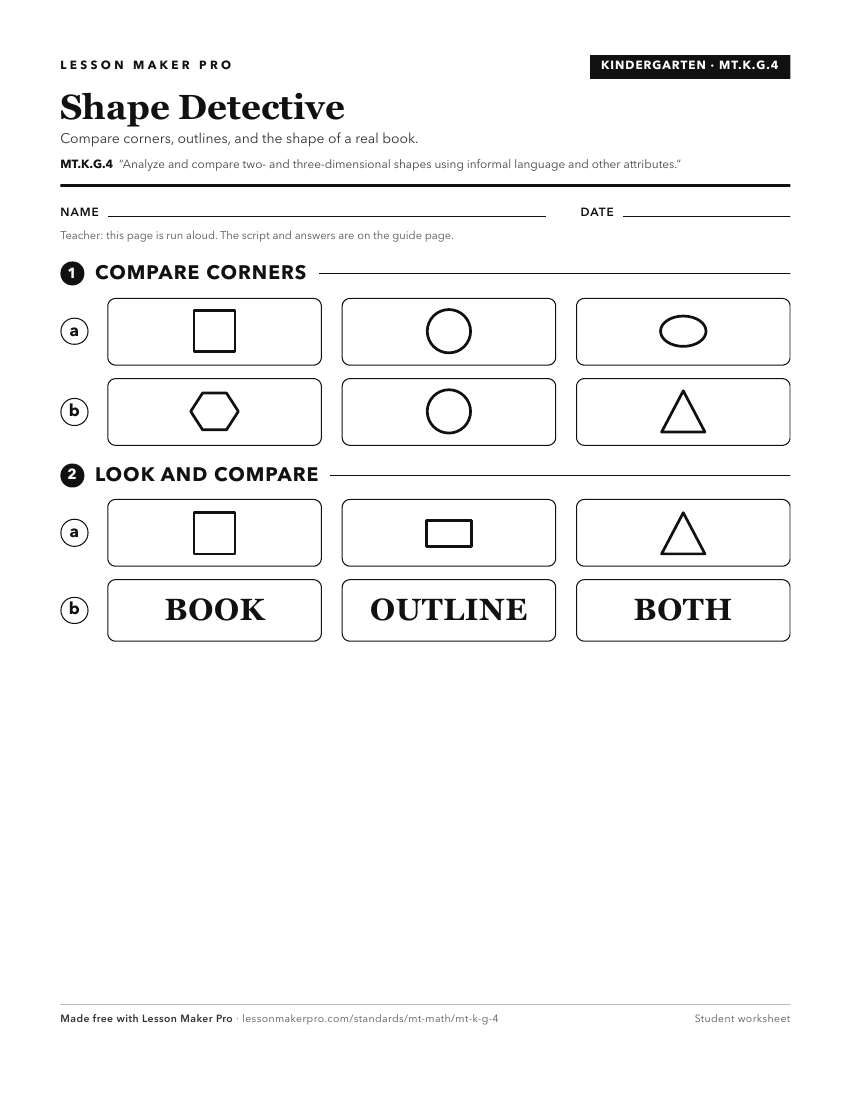
A ready-to-print activity worksheet aligned to MT.K.G.4, with an answer key for the teacher on its own page. No account needed.
PDF, US Letter, prints cleanly in black and white.
Download the worksheetKeep exploring
Related Standards
Turn this exact standard into a lesson
Grade, subject, topic, and the complete standard are prefilled. Create one free, no account needed.
Also for this standard:Make a WorksheetMake a QuizMake a Sub Lesson