Montana Math MT.6.G.1
The Standard
Find the area of triangles, quadrilaterals, and other polygons by composing them into rectangles or decomposing them into triangles and other shapes. This standard should incorporate cultural context relating to Montana Indigenous Peoples and local communities.
2026 Montana Mathematics Content Standards
Teacher's field guide
What This Standard Means
What Students Need to Do
- Students split polygons into rectangles and triangles, or rearrange pieces to make a rectangle. They find the area of each part using the correct base and perpendicular height, then combine the areas.
What Mastery Looks Like
- Students draw cuts that leave no gaps or overlaps. They calculate the area, label it in square units, and check it using a different set of cuts.
Common Misconceptions
- Students may use a triangle’s slanted side as its height or forget to halve its base times height. They may also count overlapping pieces twice or leave part of the polygon out.
How to Assess It
- Exit ticket: A 10 cm by 6 cm rectangle has a triangle attached with a base of 6 cm and a perpendicular height of 4 cm. Draw the split, find the total area, and label the units.
Lesson moves
Ways to Teach It
Cut a paper parallelogram along its height and move the triangular end to make a rectangle; compare their areas on grid paper.
Show a pentagon on grid paper and ask, “Where could you cut it two different ways, and why should both give the same area?”
Give pairs four grid-paper polygon cards; each partner draws different cuts, finds the area, and checks whether their totals match.
On a public satellite map of Salish Kootenai College in Pablo, trace a roof, use the map scale, and estimate its area.
Free download
Printable MT.6.G.1 Worksheet
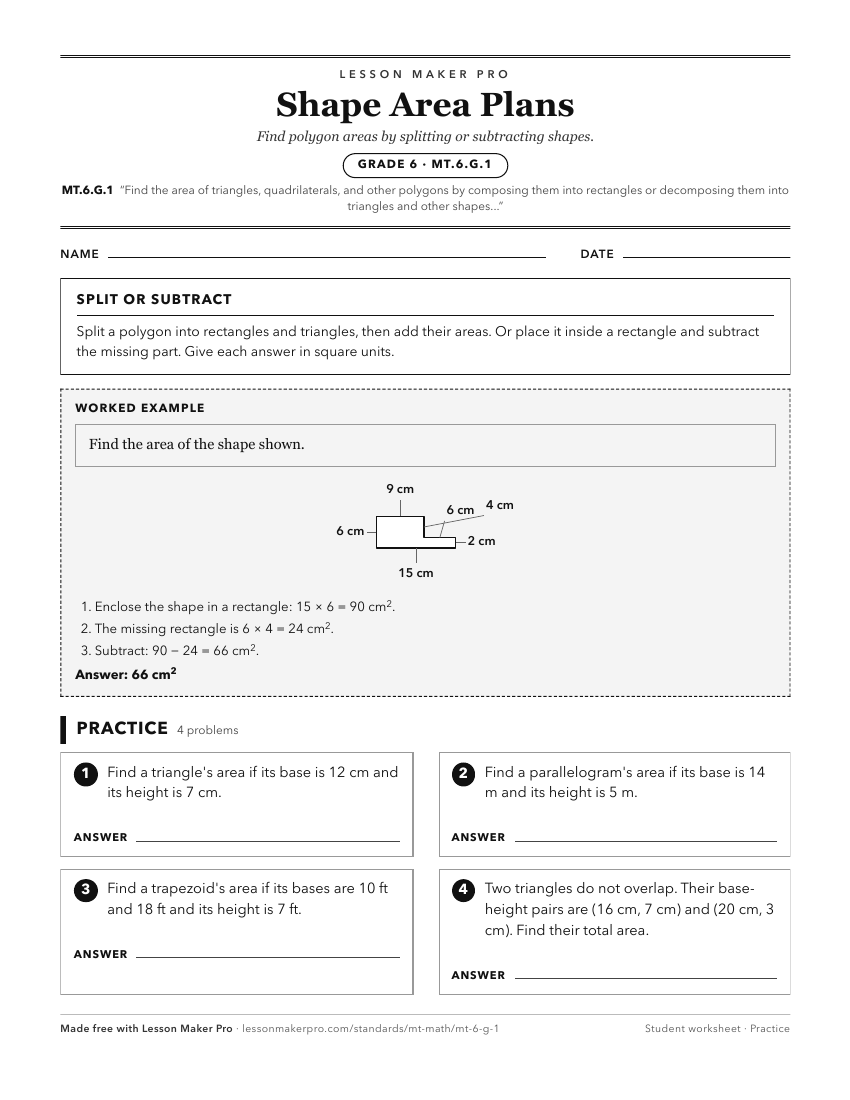
A ready-to-print activity worksheet aligned to MT.6.G.1, with an answer key for the teacher on its own page. No account needed.
PDF, US Letter, prints cleanly in black and white.
Download the worksheetKeep exploring
Related Standards
- MT.3.MD.7
Relate area to the operations of multiplication and addition by: Finding the area of a rectangle with whole-number side lengths by tiling it, and showing that t...
- MT.7.G.5
Solve geometrical problems including problems in context that involve area, volume, and surface area of two- and three-dimensional objects composed of triangles...
- MT.6.G.4
Represent three-dimensional figures using nets made up of rectangles and triangles and use the nets to find the surface area of these figures in problems includ...
- MT.8.G.7
Apply the Pythagorean Theorem to determine unknown side lengths in right triangle problems, including problems in context in two and three dimensions. This stan...
Turn this exact standard into a lesson
Grade, subject, topic, and the complete standard are prefilled. Create one free, no account needed.
Also for this standard:Make a WorksheetMake a QuizMake a Sub Lesson