Montana Math MT.3.MD.7
The Standard
Relate area to the operations of multiplication and addition by: Finding the area of a rectangle with whole-number side lengths by tiling it, and showing that the area is the same as would be found by multiplying the side lengths, Multiplying side lengths to find areas of rectangles with whole-number side lengths while solving problems in context and representing whole-number products as rectangular areas, Using tiling and area models to represent the distributive property in finding area of a rectangle with whole-number side lengths a and b + c is the sum of a × b and a × c, and Recognizing area as additive, finding areas of straight-line figures by decomposing them into nonoverlapping rectangles and adding the areas of the nonoverlapping parts. This standard should incorporate cultural context relating to Montana Indigenous Peoples and local communities.
2026 Montana Mathematics Content Standards
Teacher's field guide
What This Standard Means
What Students Need to Do
- Students cover rectangles with unit squares, then multiply rows by squares per row to find area. They split rectangles and L-shaped figures into smaller rectangles and add the areas.
What Mastery Looks Like
- A student can show why a 4-by-7 rectangle has 28 square units. They can split it into 4-by-3 and 4-by-4 parts, then add the two areas. They can also find an L-shape’s area without leaving a gap or counting a part twice.
Common Misconceptions
- Students may add side lengths instead of multiplying them, or count grid lines instead of squares. When splitting a shape, they may leave out a section or count the same section twice.
How to Assess It
- Draw a 6-by-5 grid with a 2-by-3 corner removed. Ask students to split the remaining shape into two rectangles, label each multiplication, and find the total area in square units.
Lesson moves
Ways to Teach It
Give pairs 24 square tiles to build a 4-by-6 rectangle, split it into 4-by-2 and 4-by-4 parts, and compare areas.
Display a 5-by-8 grid split into 5-by-3 and 5-by-5 parts; ask students to explain why the smaller areas add to the whole.
Hand out L-shaped grids; partners mark nonoverlapping rectangles, multiply each part’s side lengths, and check each other’s totals.
At a fictional local art fair featuring Montana Indigenous artists, have students sketch two 4-by-6-foot booths and calculate their combined area.
Free download
Printable MT.3.MD.7 Worksheet
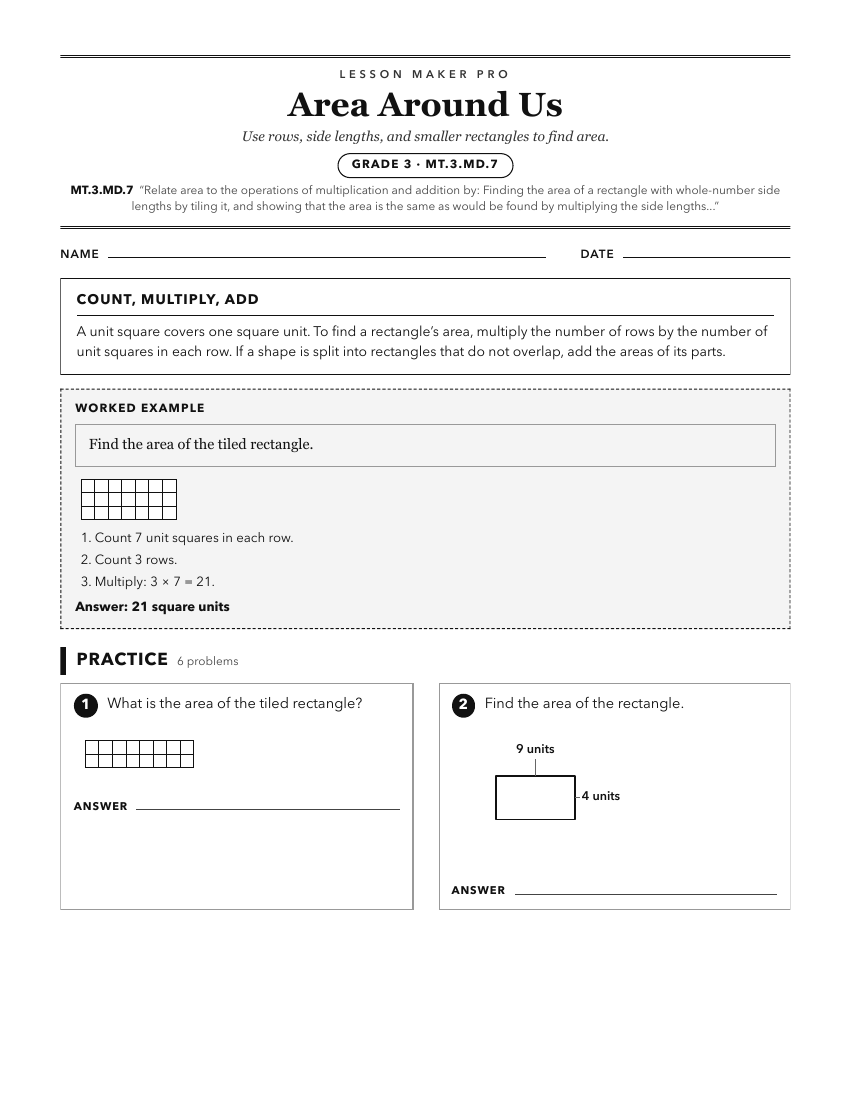
A ready-to-print activity worksheet aligned to MT.3.MD.7, with an answer key for the teacher on its own page. No account needed.
PDF, US Letter, prints cleanly in black and white.
Download the worksheetKeep exploring
Related Standards
- MT.6.G.1
Find the area of triangles, quadrilaterals, and other polygons by composing them into rectangles or decomposing them into triangles and other shapes. This stand...
- MT.5.MD.5
Relate volume to the operations of multiplication and addition and volume problems including problems in context by: Finding the volume of a right rectangular p...
- MT.4.NF.4
Apply and extend previous understandings of multiplication to multiply a fraction by a whole number by: Understanding a fraction a/b as a multiple of 1/b and re...
- MT.5.NF.6
Solve problems in context that involve multiplication of fractions and mixed numbers. This standard should incorporate cultural context relating to Montana Indi...
Turn this exact standard into a lesson
Grade, subject, topic, and the complete standard are prefilled. Create one free, no account needed.
Also for this standard:Make a WorksheetMake a QuizMake a Sub Lesson