Montana Math MT.CORE.GEOM.MEAS.4.c
The Standard
- MT.CORE.GEOM.MEAS.4
- Use geometric shapes, their measures, and their properties to model objects and use those models to solve problems in context. This standard should incorporate cultural context relating to Montana Indigenous Peoples and local communities by: Modeling and solving problems with 2D shapes by using the perimeter and area of polygons, circles, and composite shapes with portions removed, Modeling and solving problems with 3D solids by using surface area and volume of solids, including composite solids and solids with portions removed, and Deriving and applying the relationships between the lengths, perimeters, areas, and volumes of similar figures in relation to their scale factor.
Use geometric shapes, their measures, and their properties to model objects and use those models to solve problems in context. This standard should incorporate cultural context relating to Montana Indigenous Peoples and local communities by: Deriving and applying the relationships between the lengths, perimeters, areas, and volumes of similar figures in relation to their scale factor.
2026 Montana Mathematics Content Standards · Geometric Reasoning
Teacher's field guide
What This Standard Means
What Students Need to Do
- Students use shapes to model real objects and estimate their measurements. They use formulas to show why scaling lengths by a factor of k scales perimeter by k, area by k², and volume by k³. They use those changes to solve a practical problem.
What Mastery Looks Like
- Given a cone model doubled in size, a student finds that its base circumference doubles, its floor area quadruples, and its volume grows eightfold. They can show why using the formulas and explain what the cone leaves out of the real object.
Common Misconceptions
- Students may double an area or volume when every length doubles. Some scale the radius but forget to scale the height. Others treat a cone model as an exact measure of cover material, ignoring openings and seams.
How to Assess It
- Exit ticket: A cone model of a tipi doubles in radius and height. Use the formulas for base circumference, circle area, and cone volume to show how each measure changes.
Lesson moves
Ways to Teach It
Print a cone net at 100% and 200%, assemble both, and measure base circumference and slant height to compare cover areas.
Show a publicly shared photo of a Blackfeet tipi, credit its source, and ask which features a cone model misses.
Run a card sort matching scale factors of 1/2, 2, and 3 to perimeter, area, and volume multipliers; students justify each match.
Plan a half-scale cone exhibit for a Montana cultural center: with a 4-meter radius and 5-meter height, calculate floor area and volume.
Free download
Printable MT.CORE.GEOM.MEAS.4.c Worksheet
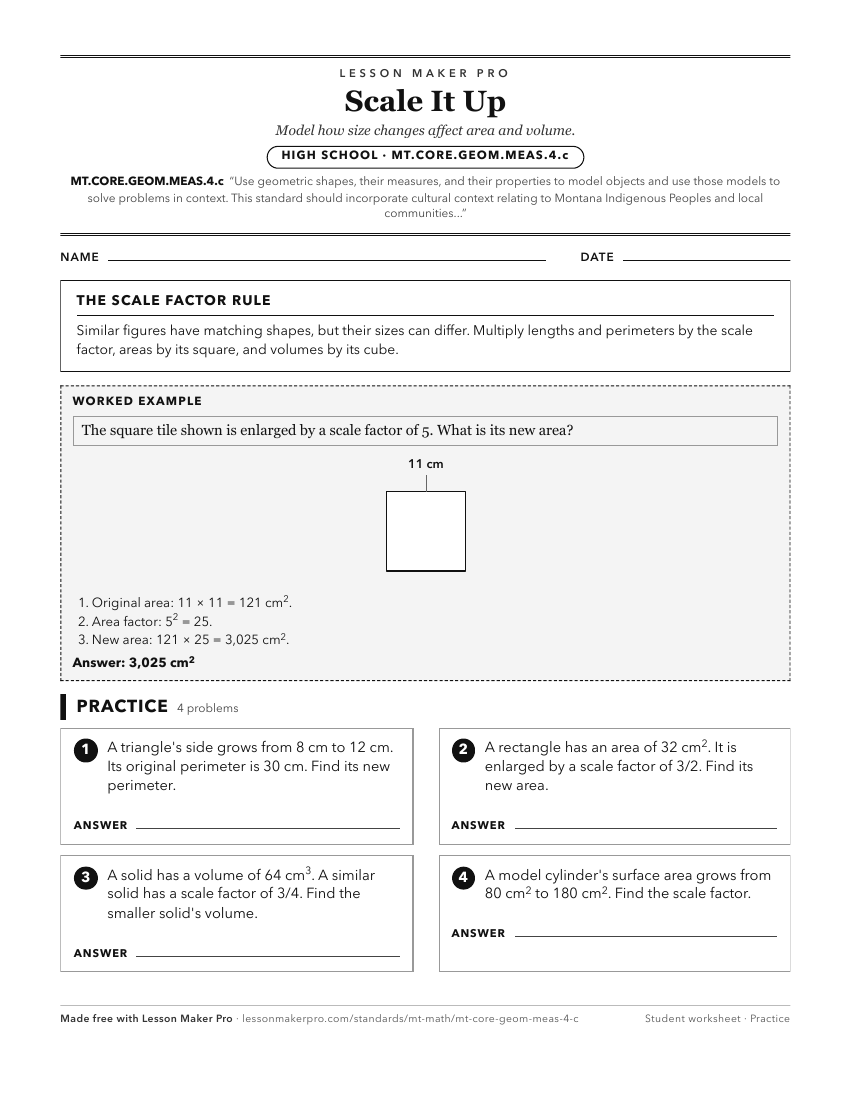
A ready-to-print activity worksheet aligned to MT.CORE.GEOM.MEAS.4.c, with an answer key for the teacher on its own page. No account needed.
PDF, US Letter, prints cleanly in black and white.
Download the worksheetKeep exploring
Related Standards
Turn this exact standard into a lesson
Grade, subject, topic, and the complete standard are prefilled. Create one free, no account needed.
Also for this standard:Make a WorksheetMake a QuizMake a Sub Lesson