Montana Math MT.CORE.DATA.PROB.2.b
The Standard
- MT.CORE.DATA.PROB.2
- Understand the concepts of conditional probability and independence in context. This standard should incorporate cultural context relating to Montana Indigenous Peoples and local communities by: Determining whether two events, A and B, are independent by using two-way tables, tree diagrams, and/or Venn diagrams, and interpreting the answer in context, and Computing the conditional probability of event A given event B by using two-way tables, tree diagrams, and/or Venn diagrams, and interpreting the answer in context.
Understand the concepts of conditional probability and independence in context. This standard should incorporate cultural context relating to Montana Indigenous Peoples and local communities by: Computing the conditional probability of event A given event B by using two-way tables, tree diagrams, and/or Venn diagrams, and interpreting the answer in context.
2026 Montana Mathematics Content Standards · Data Reasoning and Probability
Teacher's field guide
What This Standard Means
What Students Need to Do
- Students use a two-way table, tree diagram, or Venn diagram to find a probability within a named group. They explain what the result means for that group. They compare it with the overall rate to check whether the events are independent.
What Mastery Looks Like
- A student finds the same conditional rate from a two-way table and a diagram. They name the group used as the denominator, interpret the rate, and compare it with the overall rate to check independence.
Common Misconceptions
- Students use everyone as the denominator instead of only the group named after “given.” They confuse the chance of borrowing given attendance with the chance of attending given borrowing. Some assume different rates prove that attendance caused borrowing.
How to Assess It
- Draw a two-way table for this fictional school library: 30 students attended a Montana Indigenous authors reading, and 12 borrowed a featured book; of 20 nonattendees, 4 borrowed one. Find the chance of borrowing given attendance, explain it in words, and decide whether attendance and borrowing are independent.
Lesson moves
Ways to Teach It
Use 40 counters to build a two-way table: 20 attended a Montana Indigenous authors reading; 12 attendees and 4 nonattendees borrowed books.
Ask: “Does borrowing seem independent of attending the reading? Compare the attendees’ checkout rate with the rate for all 40 students.”
Turn the 40-counter table into tree and Venn diagrams; pairs race to find the borrowing rate given attendance in each.
Show a mock flyer for a Montana Indigenous authors reading; ask what attendance and checkout counts a local librarian needs to compare rates.
Free download
Printable MT.CORE.DATA.PROB.2.b Worksheet
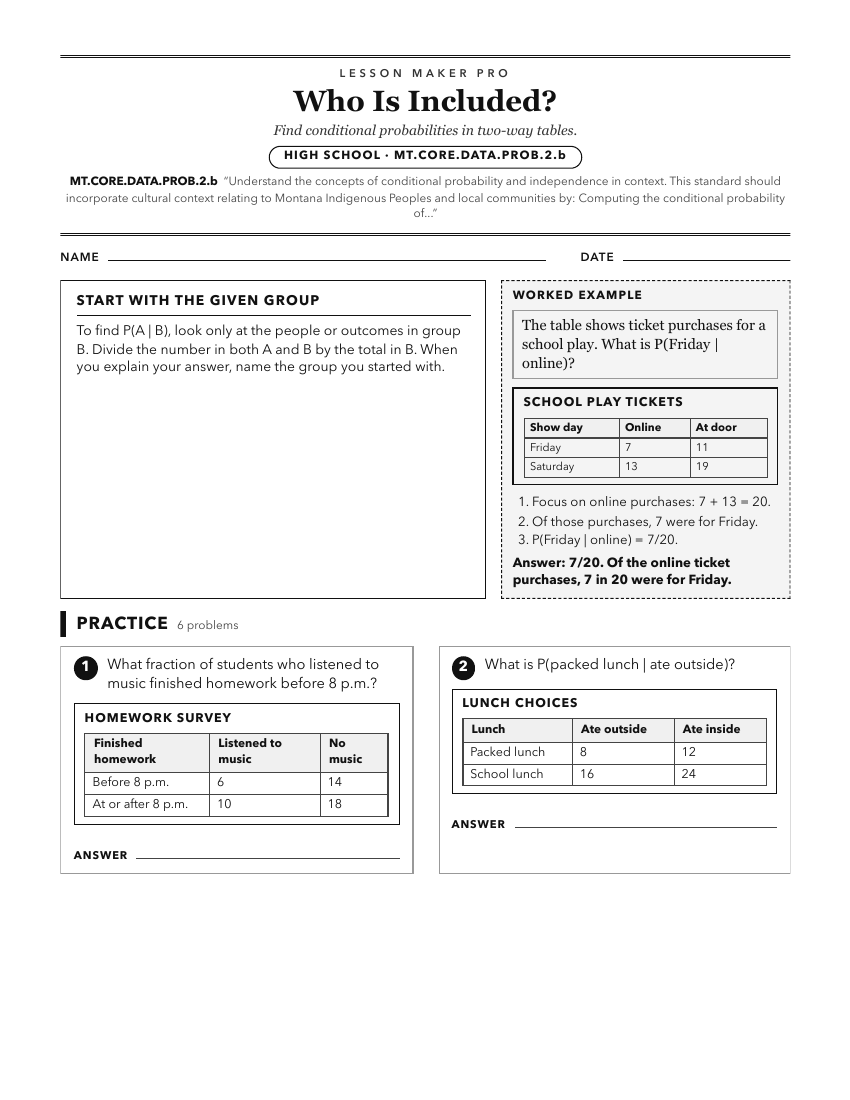
A ready-to-print activity worksheet aligned to MT.CORE.DATA.PROB.2.b, with an answer key for the teacher on its own page. No account needed.
PDF, US Letter, prints cleanly in black and white.
Download the worksheetKeep exploring
Related Standards
- MT.7.SP.8
Represent sample spaces for compound events, identify the desired outcomes in the sample spaces, and find probabilities of events using organized lists, tables,...
- MT.CORE.DATA.PROB.2.a
Determining whether two events, A and B, are independent by using two-way tables, tree diagrams, and/or Venn diagrams, and interpreting the answer in context, a...
- MT.CORE.DATA.PROB.2
Understand the concepts of conditional probability and independence in context. This standard should incorporate cultural context relating to Montana Indigenous...
- MT.7.SP.7
Develop a theoretical probability model and use it to find probabilities of events, compare theoretical and experimental probabilities, and explain possible sou...
Turn this exact standard into a lesson
Grade, subject, topic, and the complete standard are prefilled. Create one free, no account needed.
Also for this standard:Make a WorksheetMake a QuizMake a Sub Lesson