Mississippi Science HAP.7
Standard Cluster
Students will demonstrate an understanding of the major organs of the endocrine system and the associated hormonal production and regulation. Obtain, evaluate, and communicate information to illustrate that the endocrine glands secrete hormones that help the body maintain homeostasis through feedback mechanisms. Discuss the function of each endocrine gland and the various hormones secreted. Model specific mechanisms through which the endocrine system maintains homeostasis (e.g., insulin/glucagon and glucose regulation; T3 / T4 and metabolic rates; calcitonin/parathyroid and calcium regulation; antidiuretic hormone and water balance; growth hormone; and cortisol and stress). Research and analyze the effects of various pathological conditions (e.g., diabetes mellitus, pituitary dwarfism, Graves’ disease, Cushing’s syndrome, hypothyroidism, and obesity). Enrichment: Use an engineering design process to develop effective treatments for endocrine disorders (e.g., methods to regulate hormonal imbalance). *
2026 Mississippi College- and Career-Readiness Standards for Science · Endocrine System
Cluster contents
Standards in This Cluster
HAP.7 is a cluster heading. These are the individual standards under it.
- HAP.7.1
Obtain, evaluate, and communicate information to illustrate that the endocrine glands secrete hormones that help the body maintain homeostasis through feedback ...
- HAP.7.2
Discuss the function of each endocrine gland and the various hormones secreted.
- HAP.7.3
Model specific mechanisms through which the endocrine system maintains homeostasis (e.g., insulin/glucagon and glucose regulation; T3 / T4 and metabolic rates; ...
- HAP.7.4
Research and analyze the effects of various pathological conditions (e.g., diabetes mellitus, pituitary dwarfism, Graves’ disease, Cushing’s syndrome, hypothyro...
- HAP.7.5
Enrichment: Use an engineering design process to develop effective treatments for endocrine disorders (e.g., methods to regulate hormonal imbalance). *
Teacher's field guide
What This Cluster Means
What Students Need to Do
- Students locate major endocrine glands and match them to the hormones they release. They trace how hormones help regulate blood glucose, calcium, water, and metabolism. They use symptoms and lab results to explain a hormone disorder.
What Mastery Looks Like
- A student can label the pituitary, thyroid, parathyroids, pancreas, and adrenal glands and describe their jobs. They can draw how insulin and glucagon respond to changes in blood glucose. Given high thyroid hormone and low TSH, they can explain why the pituitary releases less TSH.
Common Misconceptions
- Students may say insulin raises blood glucose and glucagon lowers it. Some think negative feedback turns a gland off permanently. Others confuse a hormone’s source with its target, such as saying the kidneys produce ADH.
How to Assess It
- Exit ticket: After a meal, blood glucose rises. Name the gland and hormone that respond, describe what happens to glucose, and explain how hormone release changes afterward.
Lesson moves
Ways to Teach It
Give pairs pancreas, insulin, glucagon, liver, and blood glucose cards to arrange into two labeled feedback loops.
Ask students to explain in three sentences why Graves’ disease can cause a fast heartbeat and weight loss.
Play a matching relay with gland, hormone, and effect cards for the thyroid, parathyroids, pancreas, adrenals, and pituitary.
After a hot practice scenario, have students predict ADH release and urine volume before and after drinking water.
Free download
Printable HAP.7 Worksheet
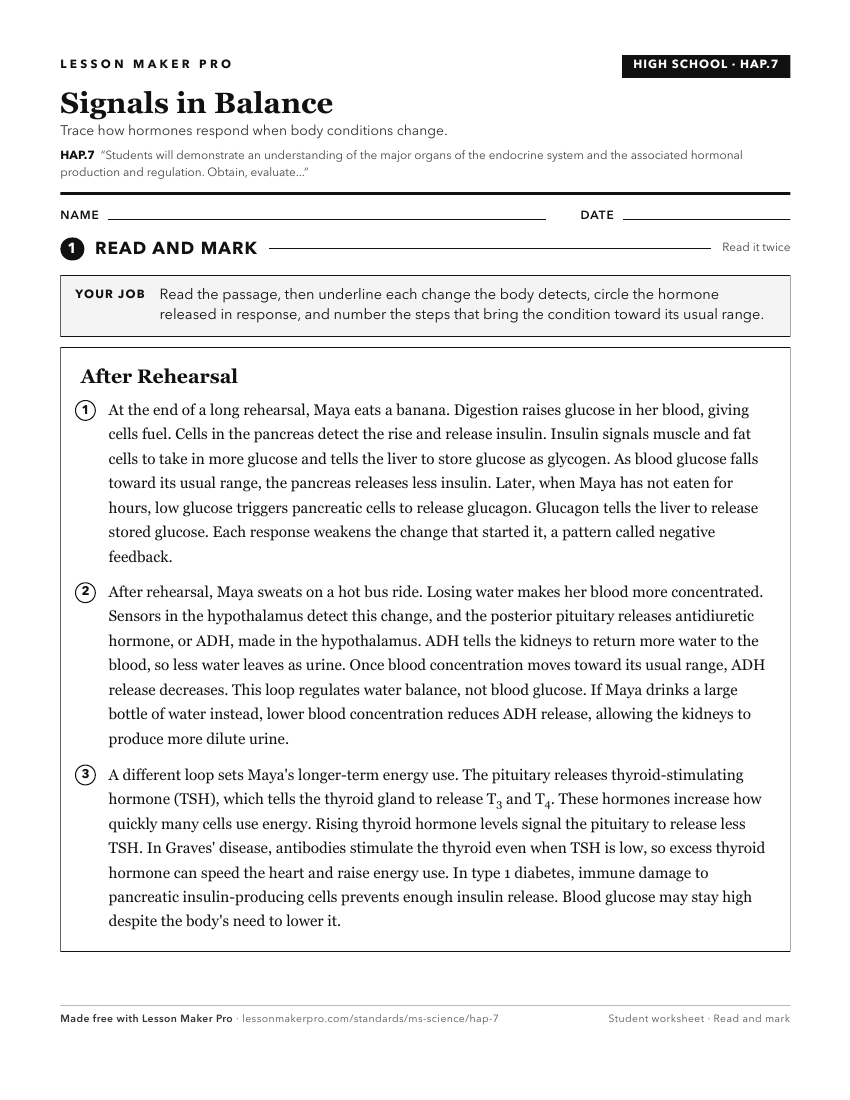
A ready-to-print activity worksheet aligned to HAP.7, with an answer key for the teacher on its own page. No account needed.
PDF, US Letter, prints cleanly in black and white.
Download the worksheetKeep exploring
Related Standards
- L.4.1
Students will demonstrate an understanding of the organization, functions, and interconnections of the major human body systems.
- HAP.2
Students will demonstrate an understanding of the relationship of cells and tissues that form complex structures of the body.
- BIO.1A
Students will demonstrate an understanding of the characteristics of life and biological organization.
Turn this cluster into a lesson
Grade, subject, topic, and the complete cluster are prefilled. Create one free, no account needed.
Also for this cluster:Make a WorksheetMake a QuizMake a Sub Lesson