Mississippi Science HAP.3.1
The Standard
- HAP.3
- Students will investigate the structures and functions of the integumentary system, including the cause and effect of diseases and disorders.
Identify structures and explain the functions of the integumentary system, including layers of skin, accessory structures, and types of membranes.
2026 Mississippi College- and Career-Readiness Standards for Science · Integumentary System
Teacher's field guide
What This Standard Means
What Students Need to Do
- Students label the epidermis, dermis, and tissue beneath the skin. They identify hair, nails, sweat glands, and oil glands, and explain what each does. They also locate four body membranes and describe their jobs.
What Mastery Looks Like
- A student can label an unfamiliar skin diagram and explain how sweat cools the body and oil helps keep skin from drying out. They can match cutaneous, mucous, serous, and synovial membranes to the skin, mouth, lung lining, and knee joint, and explain each lining's job.
Common Misconceptions
- Students may put blood vessels in the epidermis, though they are in the dermis. They may call the tissue beneath the skin a skin layer or mix up sweat and oil glands. Some think every membrane covers an outside surface.
How to Assess It
- Exit ticket: Label the epidermis, dermis, tissue beneath the skin, and one gland on a skin sketch, then state the gland's job. Match cutaneous, mucous, serous, and synovial membranes to outer skin, mouth, lung lining, and knee joint.
Lesson moves
Ways to Teach It
Use colored clay to build a skin cross-section with epidermis, dermis, fat, a hair follicle, and sweat and oil glands; add function tags.
Ask students to explain why a shallow scrape may not bleed but a deeper cut does, using the locations of skin layers and blood vessels.
Play a matching game with membrane cards and location cards for outer skin, mouth, lung lining, and knee joint.
Show a sunscreen label and ask students which skin layer UV rays reach first and how that layer helps protect the body.
Free download
Printable HAP.3.1 Worksheet
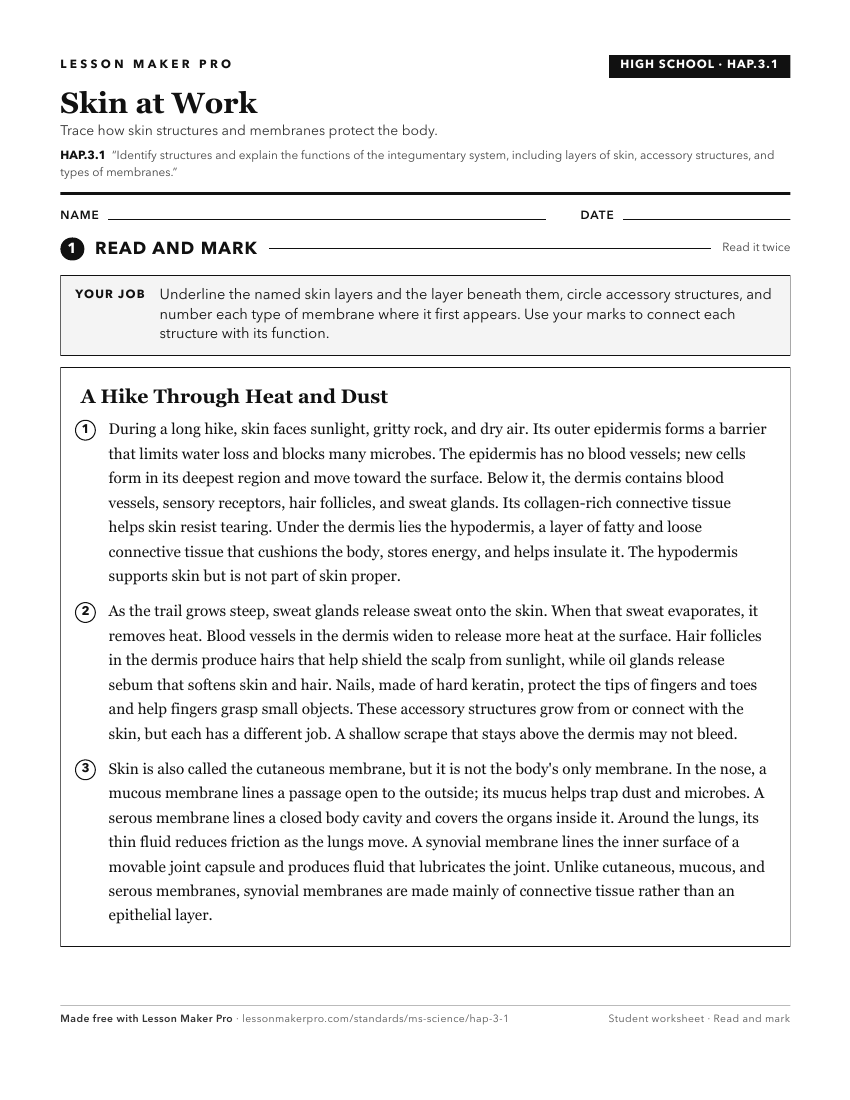
A ready-to-print activity worksheet aligned to HAP.3.1, with an answer key for the teacher on its own page. No account needed.
PDF, US Letter, prints cleanly in black and white.
Download the worksheetKeep exploring
Related Standards
- L.3.1.1
Examine evidence to communicate information that the internal and external structures of animals (e.g., heart, stomach, bone, lung, brain, skin, ears, appendage...
- BIO.1D
Students will describe the structure of the cell membrane and analyze how the structure is related to its primary function of regulating transport in and out of...
- HAP.3
Students will investigate the structures and functions of the integumentary system, including the cause and effect of diseases and disorders.
- HAP.3.2
Investigate specific mechanisms (e.g., feedback and temperature regulation) through which the skin maintains homeostasis.
Turn this exact standard into a lesson
Grade, subject, topic, and the complete standard are prefilled. Create one free, no account needed.
Also for this standard:Make a WorksheetMake a QuizMake a Sub Lesson