Mississippi Science GEN.2A
Standard Cluster
Students will analyze and explain the processes of transcription and translation in protein production. Compare and contrast the structures of RNA and DNA and relate this structure to the different functions of each molecule. Describe and model how the process of transcription produces RNA from a DNA template in both prokaryotes and eukaryotes. Develop a model to show the relationship between the components involved in the mechanics of translation at the ribosome. Analyze the multiple roles of RNA in translation. Compare the structure and function of tRNA, rRNA, mRNA, and snRNA. Enrichment: Evaluate Beadle and Tatum’s “One Gene-One Enzyme Hypothesis” (1941) in the development of the central dogma (DNA →RNA →Protein). Explain how new discoveries, such as alternate splicing of introns, have led to the revision of the central dogma.
2026 Mississippi College- and Career-Readiness Standards for Science · Transcription, Translation, and Mutations
Cluster contents
Standards in This Cluster
GEN.2A is a cluster heading. These are the individual standards under it.
- GEN.2A.1
Compare and contrast the structures of RNA and DNA and relate this structure to the different functions of each molecule.
- GEN.2A.2
Describe and model how the process of transcription produces RNA from a DNA template in both prokaryotes and eukaryotes.
- GEN.2A.3
Develop a model to show the relationship between the components involved in the mechanics of translation at the ribosome.
- GEN.2A.4
Analyze the multiple roles of RNA in translation. Compare the structure and function of tRNA, rRNA, mRNA, and snRNA.
- GEN.2A.5
Enrichment: Evaluate Beadle and Tatum’s “One Gene-One Enzyme Hypothesis” (1941) in the development of the central dogma (DNA →RNA →Protein). Explain how new dis...
Teacher's field guide
What This Cluster Means
What Students Need to Do
- Students compare DNA's double strands, deoxyribose, and thymine with RNA's usual single strand, ribose, and uracil. They model how a DNA template becomes mRNA, then show how tRNA and a ribosome use that message to build a protein. They compare protein production in bacteria and eukaryotic cells.
What Mastery Looks Like
- Given a DNA template, students write the matching mRNA and use a codon chart to find its amino acids. They show tRNA matching codons and rRNA helping form amino acid bonds at the ribosome. They explain how snRNA helps splice eukaryotic RNA, while bacteria can start translation before transcription ends.
Common Misconceptions
- Students may copy the wrong DNA strand or put T in RNA instead of U. They may confuse an mRNA codon with a tRNA anticodon. Some think splicing happens in bacteria or that every RNA molecule becomes a protein.
How to Assess It
- Give students the DNA template TAC GAA ATT. Ask them to write the mRNA, use a codon chart to name the amino acids, and label where tRNA, rRNA, and snRNA act.
Lesson moves
Ways to Teach It
Give pairs paper DNA, mRNA, tRNA, and ribosome cutouts to build a short protein from a three-codon DNA template.
Ask students to write why alternative splicing challenges the claim that one gene makes just one protein.
Play a codon relay: teams match mRNA codon cards to tRNA anticodon cards, then check amino acids with a codon chart.
Give students hemoglobin mRNA cards marked GAG and GUG; use a codon chart to find the amino acid change linked to sickle cell disease.
Free download
Printable GEN.2A Worksheet
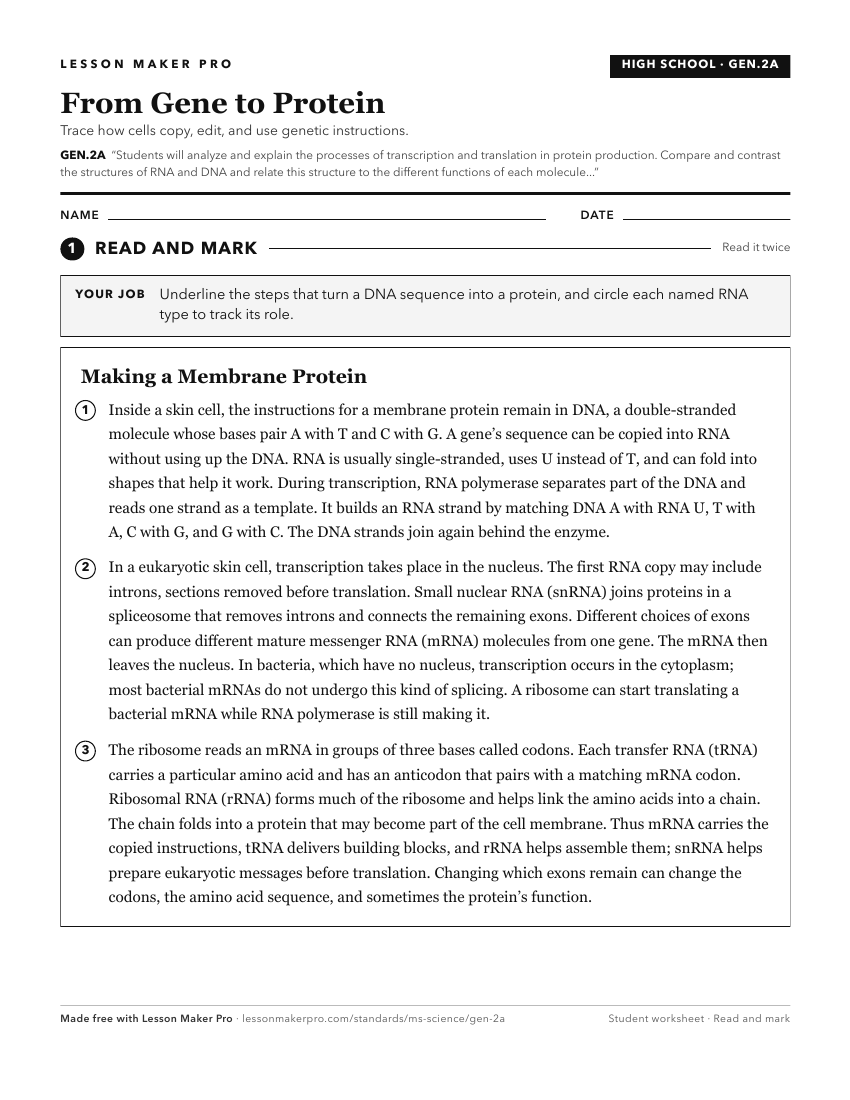
A ready-to-print activity worksheet aligned to GEN.2A, with an answer key for the teacher on its own page. No account needed.
PDF, US Letter, prints cleanly in black and white.
Download the worksheetKeep exploring
Related Standards
- GEN.1B
Students will analyze how the DNA sequence is copied and transmitted to new cells.
- BIO.3C.2
Evaluate the mechanisms of transcription and translation in protein synthesis.
- L.8.2C
Students will demonstrate an understanding that chromosomes contain many distinct genes and that each gene holds the instructions for the production of a specif...
- BIO.3C
Students will construct an explanation based on evidence to describe how the structure and nucleotide base sequence of DNA determines the structure of proteins ...
Turn this cluster into a lesson
Grade, subject, topic, and the complete cluster are prefilled. Create one free, no account needed.
Also for this cluster:Make a WorksheetMake a QuizMake a Sub Lesson