Mississippi Science GEN.2A.5
The Standard
- GEN.2A
- Students will analyze and explain the processes of transcription and translation in protein production.
Enrichment: Evaluate Beadle and Tatum’s “One Gene-One Enzyme Hypothesis” (1941) in the development of the central dogma (DNA →RNA →Protein). Explain how new discoveries, such as alternate splicing of introns, have led to the revision of the central dogma.
2026 Mississippi College- and Career-Readiness Standards for Science · Transcription, Translation, and Mutations
Teacher's field guide
What This Standard Means
What Students Need to Do
- Use mold growth results to explain why scientists linked genes to enzymes. Trace how DNA is copied into RNA and used to make protein. Show how one gene can produce different proteins when its RNA is spliced in different ways.
What Mastery Looks Like
- Given mold growth data and an arginine pathway, students identify a likely blocked step and support their choice with evidence. They draw two mRNAs with different exon sets from one gene. They explain why this limits the one-gene-one-enzyme claim without reversing the usual flow from DNA to RNA to protein.
Common Misconceptions
- Students may think every protein is an enzyme. Some think splicing changes DNA, or that introns are translated into protein. Others think alternative splicing reverses the flow from DNA to RNA to protein.
How to Assess It
- Exit ticket: On minimal medium, a mold mutant grows only when arginine is added. Explain what this suggests about its pathway, then draw two exon combinations from one gene that challenge the one-gene-one-enzyme claim.
Lesson moves
Ways to Teach It
Give pairs paper strips labeled introns and exons 1 through 4; have them remove introns and join exons 1-2-4 and 1-3-4.
Have students write two claims: what nutrient-rescued mold growth supports, and what two protein products from one gene challenge.
Deal mutant growth cards listing rescue by ornithine, citrulline, or arginine; teams race to place each mutant on a printed arginine pathway.
Sketch SMN2 RNA with exon 7 skipped, then add exon 7 to show how the SMA drug nusinersen helps make working protein.
Free download
Printable GEN.2A.5 Worksheet
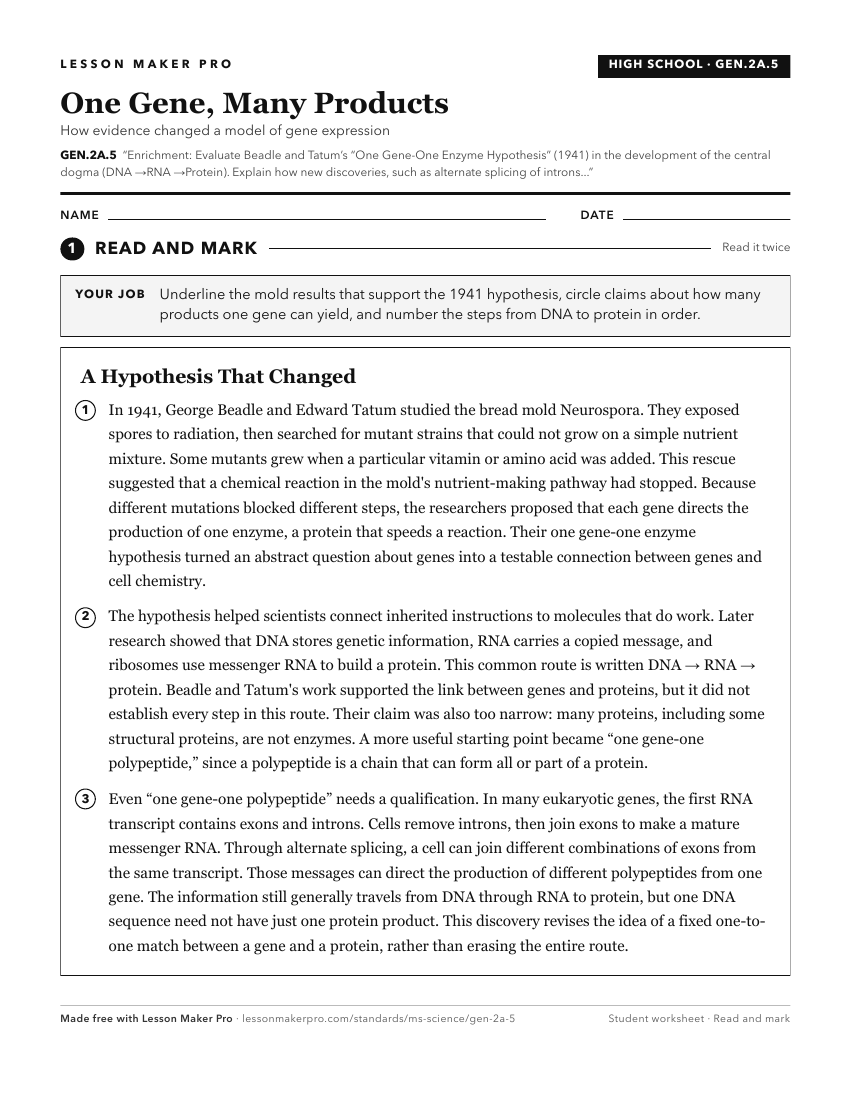
A ready-to-print activity worksheet aligned to GEN.2A.5, with an answer key for the teacher on its own page. No account needed.
PDF, US Letter, prints cleanly in black and white.
Download the worksheetKeep exploring
Related Standards
- L.8.2C.1
Communicate through diagrams that chromosomes contain many distinct genes and that each gene holds the instructions for the production of specific proteins, whi...
- BOT.2.5
Enrichment: Referencing the National Center for Biotechnology Information’s gene/protein databases, propose and design a scientifically supportable cladogram or...
- BIO.3C.1
Develop and use models to explain the relationship between DNA, genes, and chromosomes in coding the instructions for the traits transferred from parent to offs...
- BIO.3C.5
Enrichment: Investigate current biotechnological applications in the study of the genome (e.g., transcriptome, proteome, individualized sequencing, and individu...
Turn this exact standard into a lesson
Grade, subject, topic, and the complete standard are prefilled. Create one free, no account needed.
Also for this standard:Make a WorksheetMake a QuizMake a Sub Lesson