Mississippi Science E.8.10
Standard Cluster
Students will demonstrate an understanding that a decrease in natural resources is directly related to the increase in human population on Earth and must be conserved. Read and evaluate scientific information about advancements in renewable and nonrenewable resources. Propose and defend ways to decrease national and global dependency on nonrenewable resources. Create and defend a proposal for reducing the environmental effects humans have on Earth (e.g., population increases, consumer demands, chemical pollution, deforestation, and change in average annual temperature). Using scientific data, debate the societal advantages and disadvantages of technological advancements in renewable energy sources. Using an engineering design process, develop a system to capture and distribute thermal energy that makes renewable energy more readily available and reduces human impact on the environment (e.g., building solar water heaters, conserving home energy). *
2026 Mississippi College- and Career-Readiness Standards for Science · Earth’s Resources
Cluster contents
Standards in This Cluster
E.8.10 is a cluster heading. These are the individual standards under it.
- E.8.10.1
Read and evaluate scientific information about advancements in renewable and nonrenewable resources. Propose and defend ways to decrease national and global dep...
- E.8.10.2
Create and defend a proposal for reducing the environmental effects humans have on Earth (e.g., population increases, consumer demands, chemical pollution, defo...
- E.8.10.3
Using scientific data, debate the societal advantages and disadvantages of technological advancements in renewable energy sources.
- E.8.10.4
Using an engineering design process, develop a system to capture and distribute thermal energy that makes renewable energy more readily available and reduces hu...
Teacher's field guide
What This Cluster Means
What Students Need to Do
- Use population and resource-use data to explain changes in demand. Check claims about renewable energy against scientific evidence. Build and test a way to collect and move heat, then defend a plan to reduce fuel use and pollution.
What Mastery Looks Like
- Students use graph data to show that population growth and consumption both affect resource use. They weigh a renewable energy benefit against a cost. They use temperature readings to improve a solar water heater and explain how it could replace some fuel use.
Common Misconceptions
- Students may think renewable energy has no environmental costs or that fossil fuels replenish quickly. Some assume population growth alone explains every increase in resource use. Others think a solar water heater makes electricity rather than warming water.
How to Assess It
- Exit ticket: A town grows from 100 to 150 households while fuel use rises from 1,000 to 2,000 gallons. Explain why population growth alone cannot account for the increase, then describe how a solar water heater could reduce fuel use.
Lesson moves
Ways to Teach It
Tape water-filled tubing to black paper under clear wrap; after 20 minutes in sunlight, drain it and compare temperatures with shaded water.
Give pairs population and oil-use graphs from 2000 to 2020; ask, “Does population growth explain every change in oil use?”
Race to sort coal, oil, wind, and solar source cards as renewable or nonrenewable, then name one environmental cost for each.
Read a sample home energy bill showing 400 kWh for water heating; propose how a rooftop solar heater could lower that number.
Free download
Printable E.8.10 Worksheet
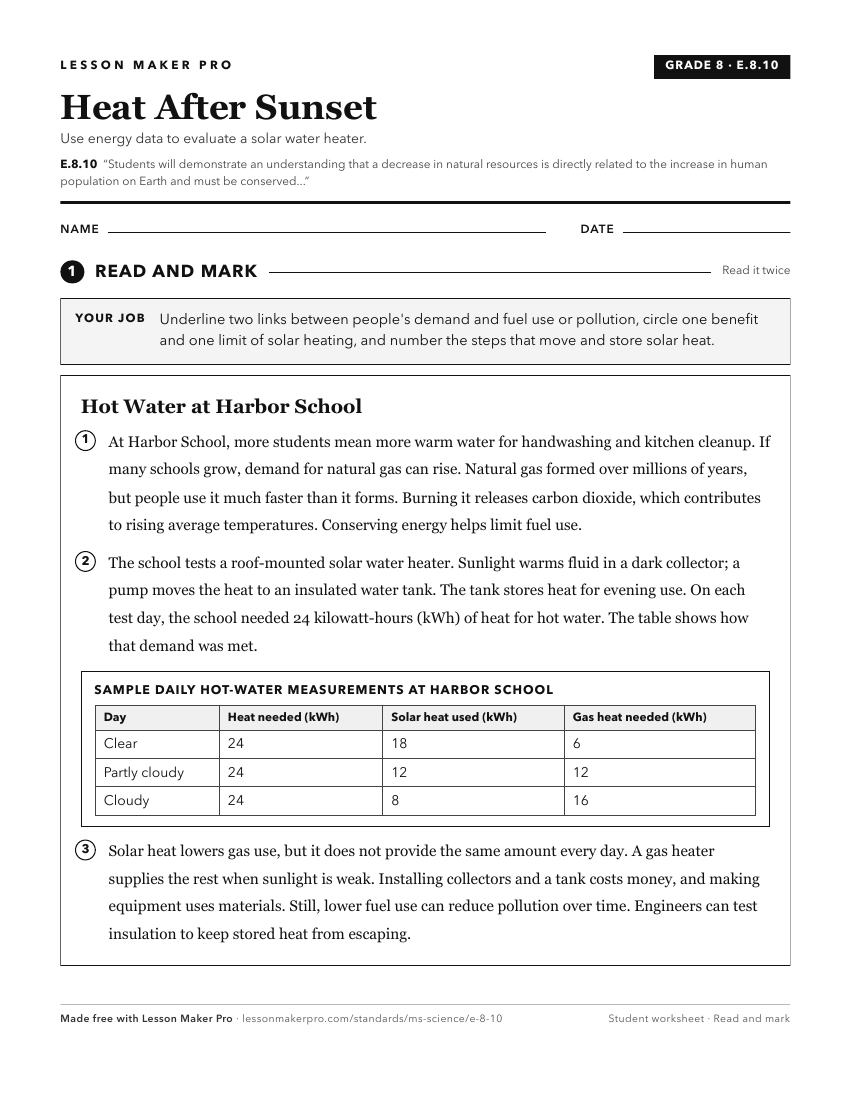
A ready-to-print activity worksheet aligned to E.8.10, with an answer key for the teacher on its own page. No account needed.
PDF, US Letter, prints cleanly in black and white.
Download the worksheetKeep exploring
Related Standards
- ENV.4
Students will demonstrate an understanding of the interdependence of human sustainability and the environment.
- E.2.10
Students will demonstrate an understanding of how humans use Earth’s resources.
- E.5.10
Students will demonstrate an understanding of the effects of human interaction with Earth and how Earth’s natural resources can be protected and conserved.
- E.K.10
Students will demonstrate an understanding of how humans use Earth’s resources.
Turn this cluster into a lesson
Grade, subject, topic, and the complete cluster are prefilled. Create one free, no account needed.
Also for this cluster:Make a WorksheetMake a QuizMake a Sub Lesson