Mississippi Science CHE.1
Standard Cluster
Students will use mathematical and computational analysis to evaluate problems. Use dimensional analysis (factor/label) and significant figures to convert units and solve problems. Design and conduct experiments using appropriate measurements, significant figures, graphical analysis to analyze data. Enrichment: Research information from multiple appropriate sources and assess the credibility, accuracy, possible bias, and conclusions of each publication.
2026 Mississippi College- and Career-Readiness Standards for Science · Mathematical and Computational Analysis
Cluster contents
Standards in This Cluster
CHE.1 is a cluster heading. These are the individual standards under it.
- CHE.1.1
Use dimensional analysis (factor/label) and significant figures to convert units and solve problems.
- CHE.1.2
Design and conduct experiments using appropriate measurements, significant figures, graphical analysis to analyze data.
- CHE.1.3
Enrichment: Research information from multiple appropriate sources and assess the credibility, accuracy, possible bias, and conclusions of each publication.
Teacher's field guide
What This Cluster Means
What Students Need to Do
- Students convert measurements by canceling units and round answers to the precision the measurements allow. They choose measuring tools, collect data for a test, and graph the results to answer a question.
What Mastery Looks Like
- A student sets up conversion factors so units cancel and reports a correctly rounded answer. They record measurements to the precision of the tool. Their graph has labeled axes and supports a conclusion based on the data.
Common Misconceptions
- Students may flip a conversion factor and end up with units that do not cancel. They may count leading zeros as significant digits or write more decimal places than their measuring tool allows. Some connect every graph point without looking for the overall trend.
How to Assess It
- On an exit ticket, ask students to convert 0.0250 L to mL, show how the units cancel, and explain why their answer has three significant figures.
Lesson moves
Ways to Teach It
Tare a graduated cylinder on a balance, add water to the 10, 20, and 30 mL marks, record mass, and graph mass against volume.
Compare a bottled-water ad with a water-quality report; ask which pH claim is better supported by measurements, methods, and funding information.
Give pairs conversion cards for 2.50 g to mg and 35.0 mL to L; have them race to show units cancel and round correctly.
Use a sports drink label to calculate grams of sugar in 100 mL from its listed serving size.
Free download
Printable CHE.1 Worksheet
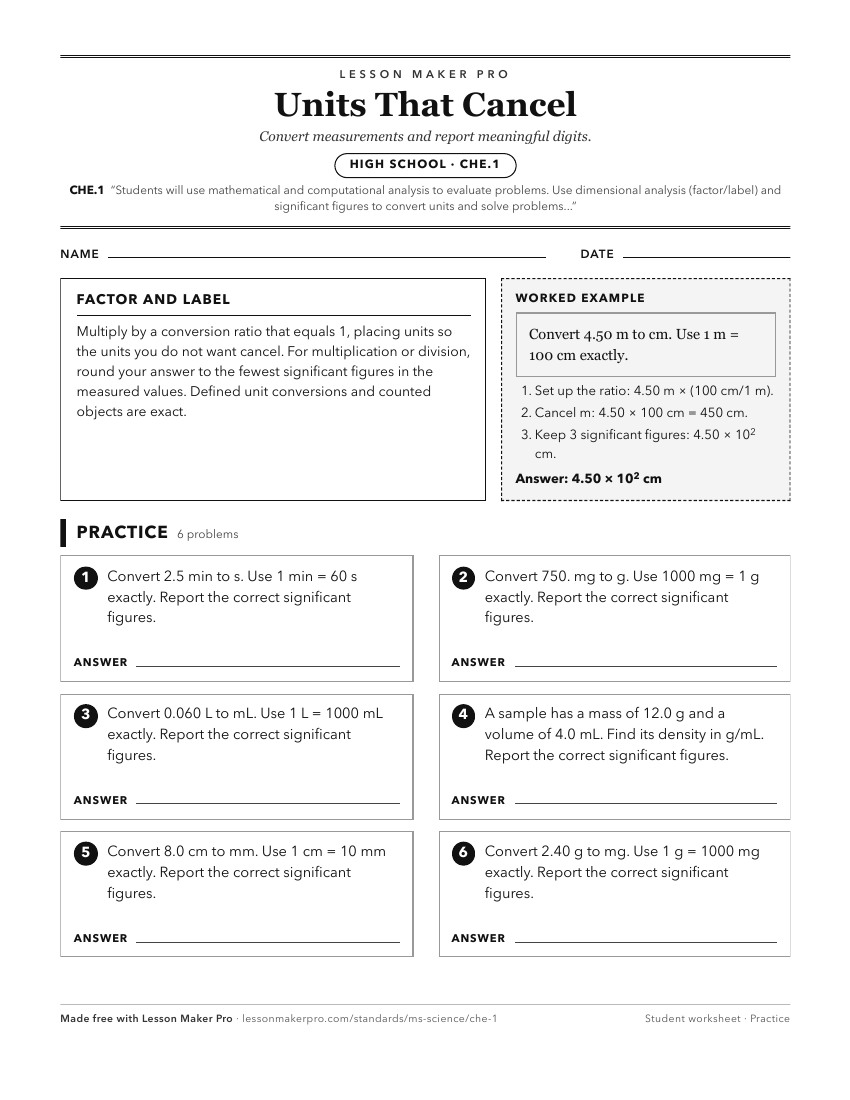
A ready-to-print activity worksheet aligned to CHE.1, with an answer key for the teacher on its own page. No account needed.
PDF, US Letter, prints cleanly in black and white.
Download the worksheetKeep exploring
Related Standards
- PHY.3.7
Enrichment: Use mathematical and computational analysis to analyze problems involving specific heat and heat capacity.
- PHY.1.3
Use mathematical and computational analysis to solve problems using kinematic equations.
- PHY.1
Students will investigate and understand how to analyze and interpret data.
- PHS.1.6
Use mathematical and computational analysis to solve density problems. Manipulate the density formula to determine density, volume, or mass or use dimensional a...
Turn this cluster into a lesson
Grade, subject, topic, and the complete cluster are prefilled. Create one free, no account needed.
Also for this cluster:Make a WorksheetMake a QuizMake a Sub Lesson