Maryland Math 6.DS.A.2
The Standard
Use the language of probability (e.g., likely, unlikely, certain, impossible) to describe the likelihood of possible outcomes and to anticipate variability in data collected from statistical questions. Explain how the likelihood of outcomes helps predict which responses may be more or less common in the data and justify predictions using probability terms.
Maryland College and Career Ready Standards for Mathematics (2025) · EXTEND UNDERSTANDING OF STATISTICAL VARIABILITY
Teacher's field guide
What This Standard Means
What Students Need to Do
- Students describe possible results as likely, unlikely, certain, or impossible. They use those words to predict which answers will appear more often when a class collects data.
What Mastery Looks Like
- Given a bag with eight red and two blue counters, a student predicts red will appear more often in repeated draws. They explain that blue is unlikely, not impossible, and red is likely, not certain.
Common Misconceptions
- Students may treat likely as guaranteed or unlikely as impossible. They may expect exactly 16 red draws in 20 trials, or think one blue draw proves their prediction wrong.
How to Assess It
- A bag has eight red and two blue counters. In 20 draws with replacement, which color will probably appear more often? Is blue impossible? Explain using likely and unlikely.
Lesson moves
Ways to Teach It
Put eight red and two blue counters in a bag; have pairs draw with replacement 20 times and tally the colors.
Ask, "Will red appear more often in every set of ten draws?" Have students write why their prediction is likely but not certain.
Give pairs cards showing different bag contents; have them predict which color will appear most often in ten draws and compare answers.
Show an 80% rain forecast; ask students which outcome would be more common across ten days with that forecast and why results might vary.
Free download
Printable 6.DS.A.2 Worksheet
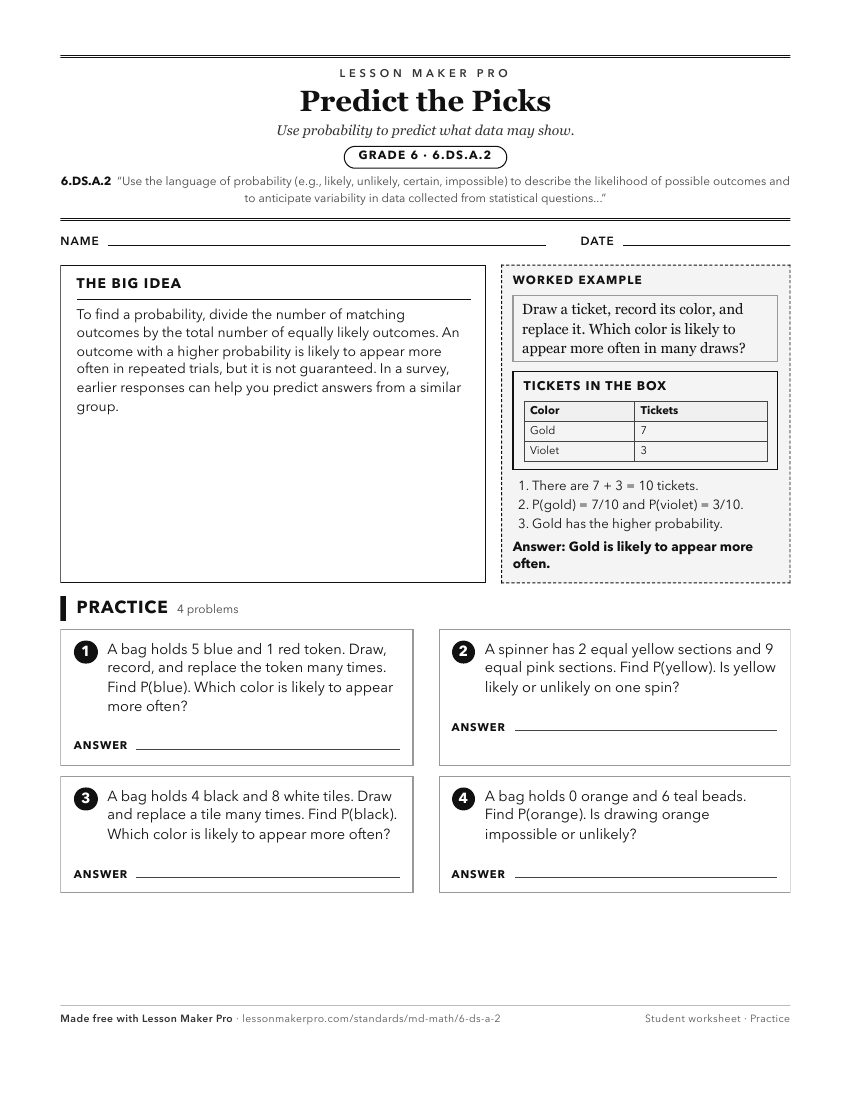
A ready-to-print activity worksheet aligned to 6.DS.A.2, with an answer key for the teacher on its own page. No account needed.
PDF, US Letter, prints cleanly in black and white.
Download the worksheetKeep exploring
Related Standards
- 7.DS.C.5.b
Use a known or estimated probability to evaluate whether the number of outcomes in a given number of simulation trials is reasonable.
- 7.DS.C.4
Explain that a probability of 0 means the event is impossible, 1 means it is certain, and values closer to 0 or 1 indicate how unlikely or likely the event is. ...
- 7.DS.C.6
Develop and use probability models to find probabilities of events and compare them to observed results.
- 7.DS.C.5
Understand and apply long-run relative frequency to approximate probabilities and make predictions about chance events.
Turn this exact standard into a lesson
Grade, subject, topic, and the complete standard are prefilled. Create one free, no account needed.
Also for this standard:Make a WorksheetMake a QuizMake a Sub Lesson