Maryland Math 7.DS.C.5.b
The Standard
- 7.DS.C.5
- Understand and apply long-run relative frequency to approximate probabilities and make predictions about chance events.
Use a known or estimated probability to evaluate whether the number of outcomes in a given number of simulation trials is reasonable.
Maryland College and Career Ready Standards for Mathematics (2025) · MODEL AND ANALYZE PROBABILITY TO INTERPRET CHANCE EVENTS, COMPARE MODELS WITH OBSERVED DATA, AND MAKE PREDICTIONS.
Teacher's field guide
What This Standard Means
What Students Need to Do
- Students use a probability and the number of simulation trials to estimate how often an outcome should happen. They compare that estimate with the observed count and decide whether the difference seems reasonable.
What Mastery Looks Like
- For 40 simulated coin flips, a student expects about 20 heads. They can explain why 18 heads seems reasonable but 38 would be surprising.
Common Misconceptions
- Students may think a fair coin must land on heads exactly 20 times in 40 flips. Some compare the count with the probability of 1/2 without first finding the expected count.
How to Assess It
- Exit ticket: A fair die is simulated for 60 rolls. Are 12 sixes and 35 sixes equally reasonable? Explain using the expected number of sixes.
Lesson moves
Ways to Teach It
Have pairs flip a coin 30 times, tally heads, and compare their count with the expected 15 and other pairs' counts.
Ask: A bag has one blue and three red counters. In 40 draws with replacement, would 8 blues or 30 blues surprise you more? Why?
Give pairs cards showing 2, 4, or 18 sixes in 20 simulated die rolls; have them sort the counts by how surprising they are.
Use a player's 70% free-throw rate to judge whether 13 makes in 20 simulated shots seems reasonable.
Free download
Printable 7.DS.C.5.b Worksheet
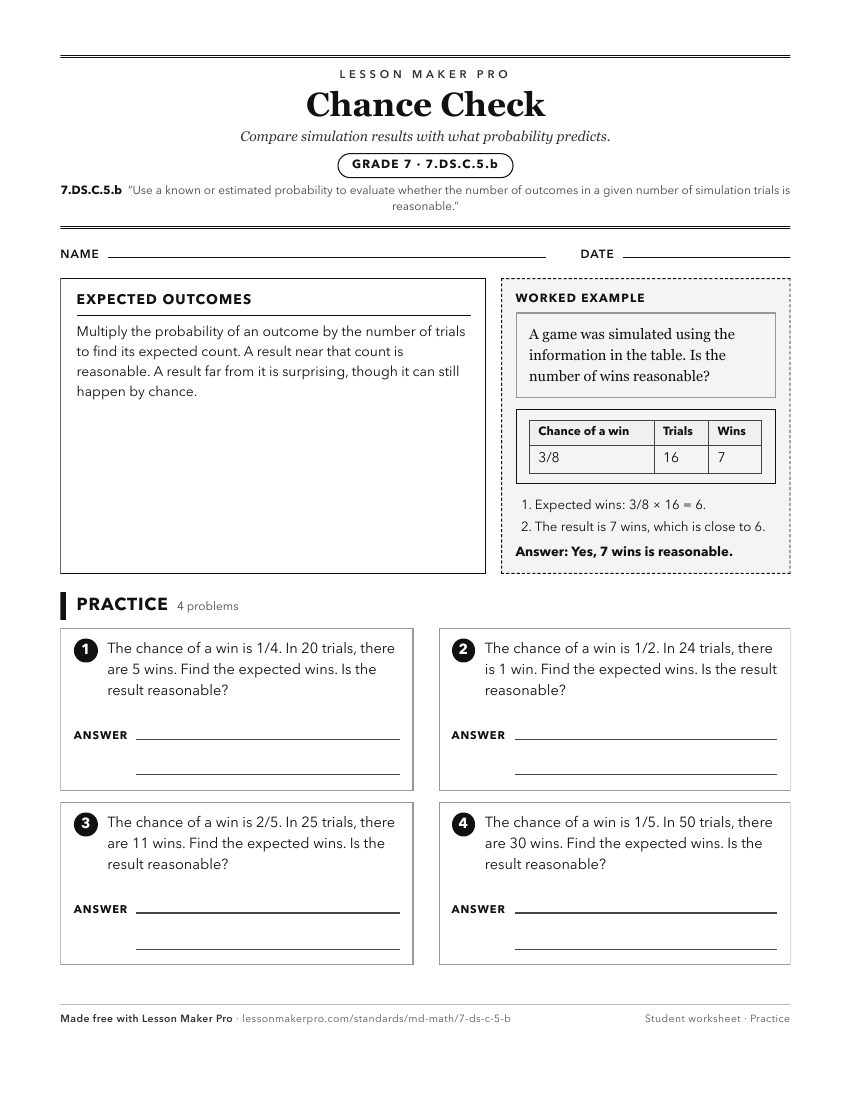
A ready-to-print activity worksheet aligned to 7.DS.C.5.b, with an answer key for the teacher on its own page. No account needed.
PDF, US Letter, prints cleanly in black and white.
Download the worksheetKeep exploring
Related Standards
- 8.DS.C.6
Find probabilities of compound events by representing or simulating the sample space or simulating events.
- 7.DS.C.5.a
Use data collection or simulation to approximate the probability of a chance event by observing its long-run relative frequency.
- 7.DS.C.6
Develop and use probability models to find probabilities of events and compare them to observed results.
- 7.DS.C.5
Understand and apply long-run relative frequency to approximate probabilities and make predictions about chance events.
Turn this exact standard into a lesson
Grade, subject, topic, and the complete standard are prefilled. Create one free, no account needed.
Also for this standard:Make a WorksheetMake a QuizMake a Sub Lesson