Maryland Math 7.DS.C.5.a
The Standard
- 7.DS.C.5
- Understand and apply long-run relative frequency to approximate probabilities and make predictions about chance events.
Use data collection or simulation to approximate the probability of a chance event by observing its long-run relative frequency.
Maryland College and Career Ready Standards for Mathematics (2025) · MODEL AND ANALYZE PROBABILITY TO INTERPRET CHANCE EVENTS, COMPARE MODELS WITH OBSERVED DATA, AND MAKE PREDICTIONS.
Teacher's field guide
What This Standard Means
What Students Need to Do
- Students repeat a chance event or simulate it many times. They divide the number of times an outcome occurs by the total number of trials to estimate its probability.
What Mastery Looks Like
- A student uses 47 heads in 100 flips to estimate the probability of heads as 0.47. They know another set of flips may give a different result, and more trials usually give a steadier estimate.
Common Misconceptions
- Students may divide by the number of other outcomes instead of the total number of trials. Some expect exactly half of coin flips to be heads or think a streak changes the chance of heads on the next flip.
How to Assess It
- Exit ticket: A spinner lands on blue 18 times in 60 spins. Estimate the probability of blue, then explain why an estimate from 6 spins might differ.
Lesson moves
Ways to Teach It
In pairs, flip a coin 30 times, tally heads, then combine the class counts and compare estimates.
Ask: Why is 51 heads in 100 flips usually a steadier estimate than 6 heads in 10 flips?
Play a spinner game: estimate red's chance after 20 spins, predict its count in 20 more spins, and score if within three.
Give students a printed log of 50 bus arrivals; have them count late buses and estimate the chance the next bus is late.
Free download
Printable 7.DS.C.5.a Worksheet
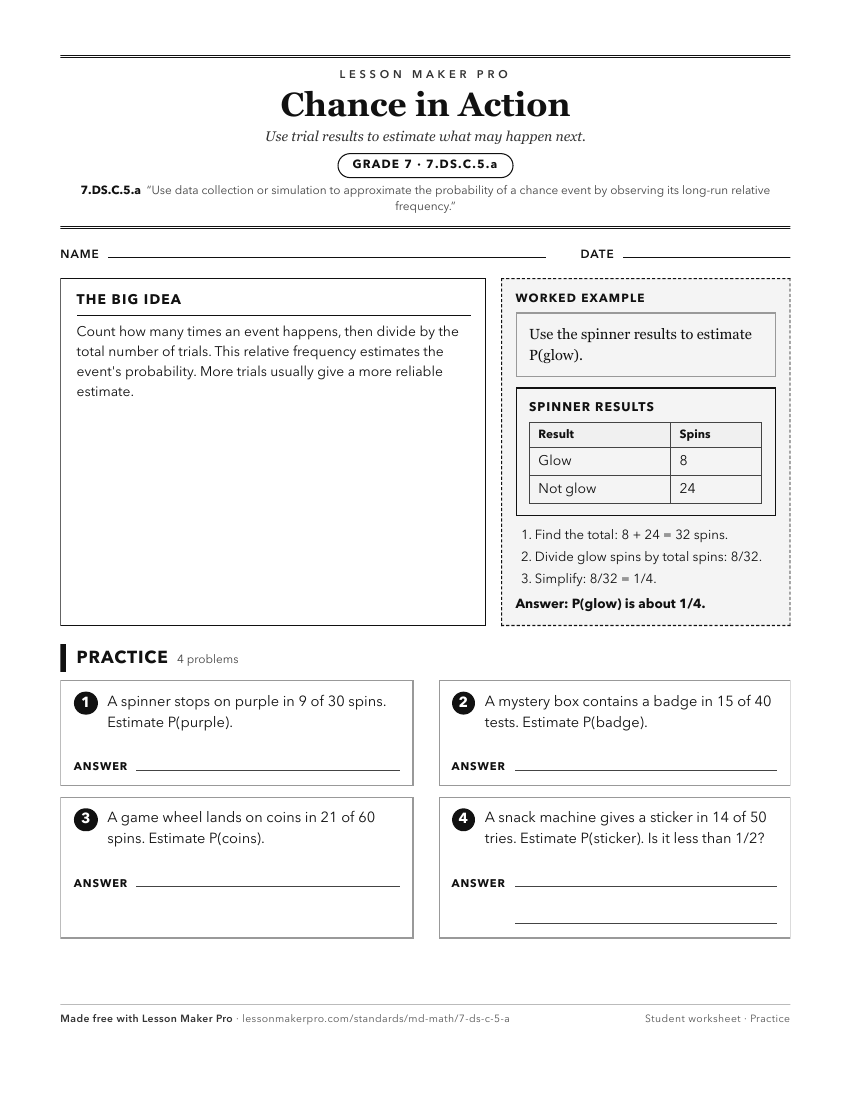
A ready-to-print activity worksheet aligned to 7.DS.C.5.a, with an answer key for the teacher on its own page. No account needed.
PDF, US Letter, prints cleanly in black and white.
Download the worksheetKeep exploring
Related Standards
- 7.DS.C.5.b
Use a known or estimated probability to evaluate whether the number of outcomes in a given number of simulation trials is reasonable.
- 7.DS.C.6
Develop and use probability models to find probabilities of events and compare them to observed results.
- 7.DS.C.5
Understand and apply long-run relative frequency to approximate probabilities and make predictions about chance events.
Turn this exact standard into a lesson
Grade, subject, topic, and the complete standard are prefilled. Create one free, no account needed.
Also for this standard:Make a WorksheetMake a QuizMake a Sub Lesson