Kentucky Reading and Writing C.9-10.3
Standard Cluster
Use narratives strategically in other modes of writing, utilizing effective technique, well-chosen details and well-structured sequences for an intended purpose, including but not limited to introducing an idea and/or supporting a claim. Produce clear and coherent writing in which the development, organization and style are appropriate to task and purpose. Engage and orient the reader by setting out a problem, situation or observation, establishing one or multiple point(s) of view and introducing a narrator and/or characters; create a smooth progression of experiences or events. Use narrative techniques, such as dialogue, pacing, description, reflection and multiple plot lines, to develop experiences, events and/or characters. Use a variety of techniques to sequence events so that they build on one another to create a coherent whole. Use precise words and phrases, telling details sensory language to convey a vivid picture of the experiences, events, setting and/or characters. Provide a conclusion that explicitly connects the narrative’s relevance to the intended purpose of the writing. Develop and strengthen writing as needed by planning, revising, editing, rewriting or trying a new approach, focusing on addressing what is most significant for a specific purpose and audience.
Kentucky Academic Standards for Reading and Writing (2025) · Text Types and Purpose
Cluster contents
Standards in This Cluster
C.9-10.3 is a cluster heading. These are the individual standards under it.
- C.9-10.3.a
Produce clear and coherent writing in which the development, organization and style are appropriate to task and purpose.
- C.9-10.3.e
Use precise words and phrases, telling details
- C.9-10.3.f
sensory language to convey a vivid picture of the experiences, events, setting and/or characters.
- C.9-10.3.g
Provide a conclusion that explicitly connects the narrative’s relevance to the intended purpose of the writing.
Teacher's field guide
What This Cluster Means
What Students Need to Do
- Students use a brief scene to introduce an idea or support a claim. They choose a point of view, put events in order, add details or dialogue, and explain why the scene matters.
What Mastery Looks Like
- A student can support a claim about later school starts with a short scene of someone falling asleep during a quiz. The events are easy to follow, the details support the claim, and the ending makes the connection clear. The student cuts details that distract from that point.
Common Misconceptions
- Students may write a long story that crowds out their main point. They may add details that do not help, jump in time without a cue, or end the scene without saying why it matters.
How to Assess It
- Exit ticket: Write a four-sentence scene to support the claim, 'Our school should offer a quiet lunch space.' Include one concrete detail and end by explaining how the scene supports the claim.
Lesson moves
Ways to Teach It
Give pairs five mixed-up lunchroom scene cards; have them order the events and tape the sequence beneath a claim for a quiet lunch space.
Ask: Which better supports a later school start, 'I was tired' or a scene of dozing through a quiz, and why?
Play Detail Swap: partners replace 'I was tired' in a school-start scene with a precise detail, then explain which version better supports later starts.
Write the principal a quiet lunch space request with a short lunchroom scene and a final line showing how the scene supports the request.
Free download
Printable C.9-10.3 Worksheet
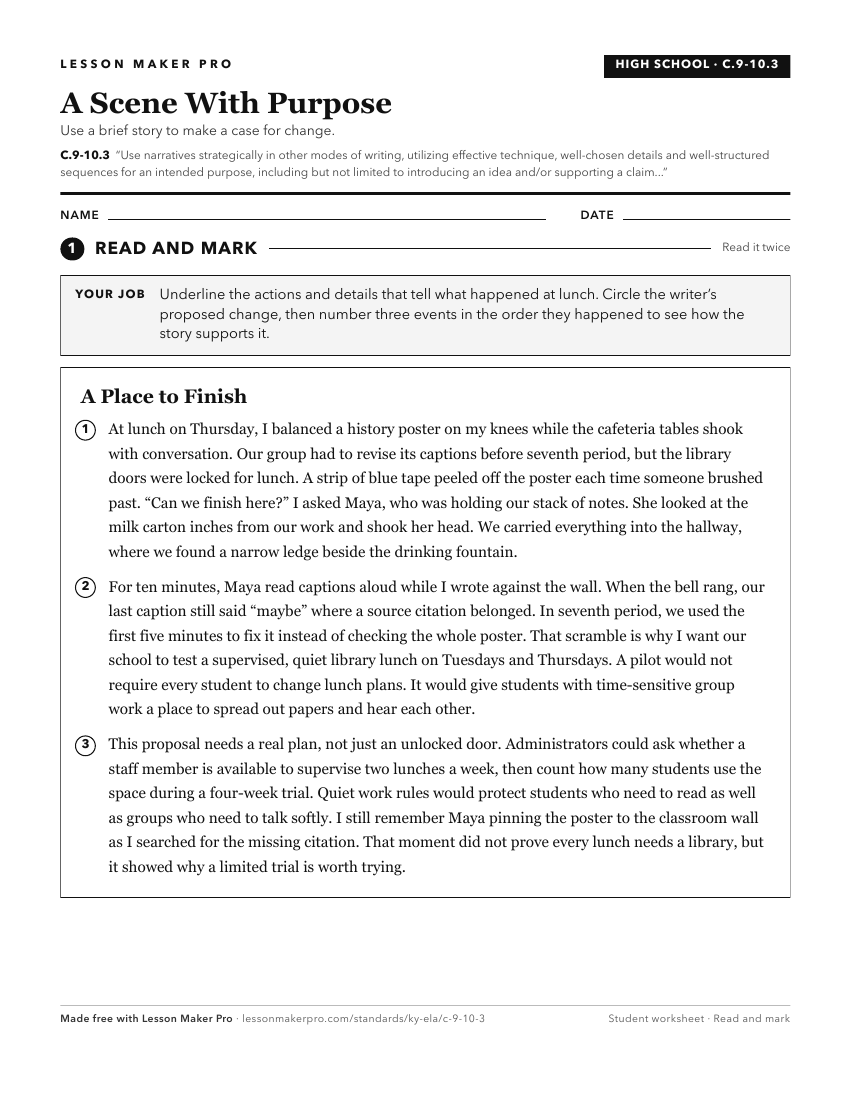
A ready-to-print activity worksheet aligned to C.9-10.3, with an answer key for the teacher on its own page. No account needed.
PDF, US Letter, prints cleanly in black and white.
Download the worksheetKeep exploring
Related Standards
- C.5.3
Compose narratives, using writing and digital resources, to develop real or imagined experiences or multiple events or ideas, using effective technique, descrip...
- C.11-12.3
Use narratives strategically in other modes of writing utilizing effective technique, well-chosen details and well-structured sequences for an intended purpose,...
- C.2.3
Compose narratives, using writing and digital resources, to develop real or imagined experiences or multiple events or ideas, using effective technique, descrip...
- C.8.3
Use narratives strategically in other modes of writing, utilizing effective technique, well-chosen details and well-structured sequences for an intended purpose...
Turn this cluster into a lesson
Grade, subject, topic, and the complete cluster are prefilled. Create one free, no account needed.
Also for this cluster:Make a WorksheetMake a QuizMake a Sub Lesson