Kentucky Reading and Writing C.11-12.3
Standard Cluster
Use narratives strategically in other modes of writing utilizing effective technique, well-chosen details and well-structured sequences for an intended purpose, including but not limited to introducing an issue and/or supporting a claim. Produce clear and coherent writing in which the development, organization and style are appropriate to task, purpose and audience. Engage and orient the reader by setting up a problem, situation or observation and its significance, establishing one or multiple point(s) of view and introducing a narrator and/or characters; create a smooth progression of experiences or events. Use narrative techniques, such as dialogue, pacing, description, reflection and multiple plot lines, to develop experiences, events and/or characters. Use a variety of techniques to sequence events so that they build on one another to create a coherent whole and build toward a particular tone and outcome. Use precise words and phrases, telling details and sensory language to convey a vivid picture of the experiences, events, setting and/or characters. Provide a conclusion that explicitly connects the narrative’s relevance to the intended purpose of the writing. Develop and strengthen writing as needed by planning, revising, editing, rewriting or trying a new approach, focusing on addressing what is most significant for a specific purpose and audience.
Kentucky Academic Standards for Reading and Writing (2025) · Text Types and Purpose
Cluster contents
Standards in This Cluster
C.11-12.3 is a cluster heading. These are the individual standards under it.
Teacher's field guide
What This Cluster Means
What Students Need to Do
- Students use a brief story within an argument or explanation to make a point. They choose a point of view, order events, and use details that help the reader understand why the moment matters. They revise the ending to connect the story to their claim or explanation.
What Mastery Looks Like
- A student can open a school board comment with a clear, well-ordered moment from a school morning. They choose a telling detail or line of dialogue, then explain how that moment supports their position. They cut details that do not help the reader follow the point.
Common Misconceptions
- Students may write a vivid story but never connect it to their claim. They may add dialogue that slows the argument or skip steps so readers cannot tell what happened.
How to Assess It
- Exit ticket: Write a four-sentence opening for a school board comment on later start times. Show one school-morning moment in order, then link it to your position.
Lesson moves
Ways to Teach It
Pairs reorder four printed sentences about a sleepy student, then tape the sequence above a claim for later school start times.
Ask: Which detail of a student's first period would help a school board judge later start times, and which detail would distract?
Students race to replace three vague words in a school-start anecdote, then add one sentence linking the moment to the claim.
Hand out a school board agenda; students draft a public comment that opens with a real school-morning experience and ends with a policy request.
Free download
Printable C.11-12.3 Worksheet
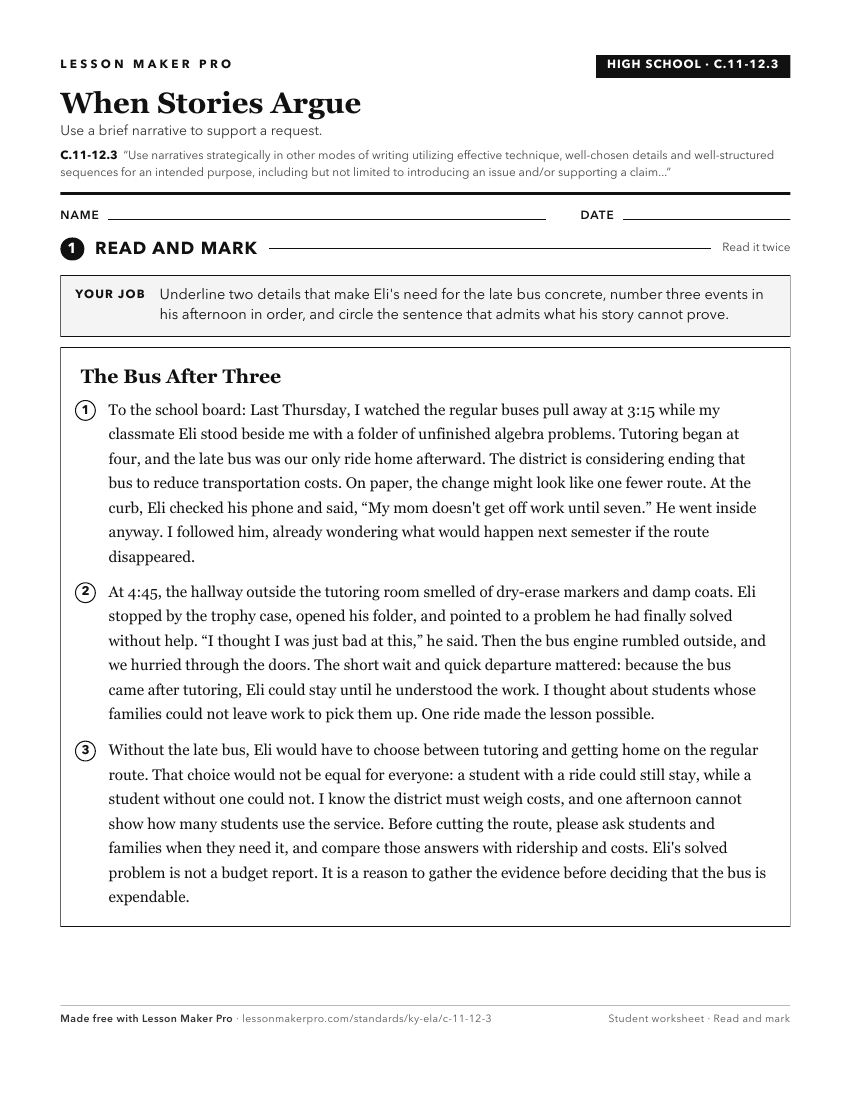
A ready-to-print activity worksheet aligned to C.11-12.3, with an answer key for the teacher on its own page. No account needed.
PDF, US Letter, prints cleanly in black and white.
Download the worksheetKeep exploring
Related Standards
- C.5.3
Compose narratives, using writing and digital resources, to develop real or imagined experiences or multiple events or ideas, using effective technique, descrip...
- C.2.3
Compose narratives, using writing and digital resources, to develop real or imagined experiences or multiple events or ideas, using effective technique, descrip...
- C.8.3
Use narratives strategically in other modes of writing, utilizing effective technique, well-chosen details and well-structured sequences for an intended purpose...
- C.9-10.3
Use narratives strategically in other modes of writing, utilizing effective technique, well-chosen details and well-structured sequences for an intended purpose...
Turn this cluster into a lesson
Grade, subject, topic, and the complete cluster are prefilled. Create one free, no account needed.
Also for this cluster:Make a WorksheetMake a QuizMake a Sub Lesson