Indiana Social Studies WH.5.5
The Standard
Analyze the causes and consequences of 19th century imperialism for Asia, Africa, and the Americas, including resistance movements to imperial control.
2026 Indiana Academic Standards: K-12 Social Studies
Teacher's field guide
What This Standard Means
What Students Need to Do
- Students explain why powerful countries sought control of land and resources in Asia, Africa, and the Americas. They trace what changed under imperial rule and how people resisted it.
What Mastery Looks Like
- A student can connect British control in India to trade and taxation, then explain how the 1857 uprising changed British rule. They can compare that outcome with Ethiopia's victory over Italy and Cuba's revolt against Spain.
Common Misconceptions
- Students may assume every resistance movement won independence or that Ethiopia became an Italian colony in the 1890s. They may see a railroad and assume colonial rule benefited everyone, without asking who controlled its profits.
How to Assess It
- On an exit ticket, ask: For India in 1857, Ethiopia in 1896, and Cuba in 1895, name the imperial power, one way people resisted, and one outcome.
Lesson moves
Ways to Teach It
Give pairs blank maps and case cards for India, Ethiopia, and Cuba; have them mark each location and label its ruler and resistance.
Ask students to write: Why did Ethiopia keep its independence after Adwa while the 1857 uprising did not end British rule in India?
Play a card sort: match India, Ethiopia, and Cuba to cards naming an imperial goal, a resistance action, and an outcome.
On a current map, mark Maasai communities in Kenya and Tanzania; discuss how a border formed under colonial rule separates them.
Free download
Printable WH.5.5 Worksheet
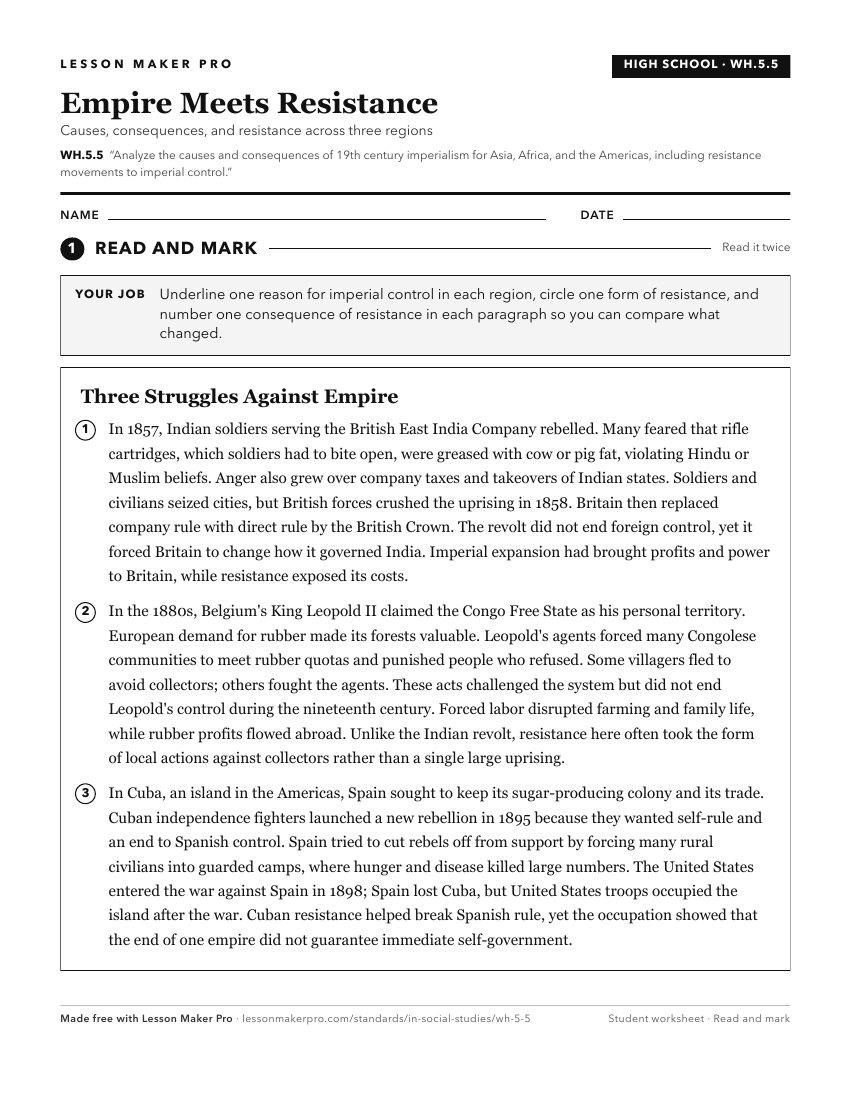
A ready-to-print activity worksheet aligned to WH.5.5, with an answer key for the teacher on its own page. No account needed.
PDF, US Letter, prints cleanly in black and white.
Download the worksheetKeep exploring
Related Standards
- 7.H.11
Explain the reasons for European colonization of Africa, Asia, and the Southwest Pacific and analyze the impact that colonization, imperialism, and slavery had ...
- 7.C.1
Compare, contrast, and evaluate the different routes to independence from colonial rule taken by countries in Asia, Africa, and the Southwest Pacific.
- WH.4.5
Examine the reactions against European Exploration including reactions in China, Japan, Africa, and the Americas.
- GHW.4.1
Analyze maps and assess ways that colonialism and imperialism have persisted and continue to evolve in the contemporary world.
Turn this exact standard into a lesson
Grade, subject, topic, and the complete standard are prefilled. Create one free, no account needed.
Also for this standard:Make a WorksheetMake a QuizMake a Sub Lesson