Indiana Social Studies 7.H.11
The Standard
Explain the reasons for European colonization of Africa, Asia, and the Southwest Pacific and analyze the impact that colonization, imperialism, and slavery had on the social, political, and economic development of these societies from both European and indigenous perspectives.
2026 Indiana Academic Standards: K-12 Social Studies
Teacher's field guide
What This Standard Means
What Students Need to Do
- Students identify European motives such as resources, trade, land, and power. They explain how colonial rule, slavery, and forced labor changed government, work, and daily life. They compare European accounts with accounts from people in Africa, Asia, and the Southwest Pacific.
What Mastery Looks Like
- A student links rubber extraction in Congo, trade in India, and settler land claims in Australia to European goals. They use European and local accounts to explain changes to leadership, labor, and land ownership. They can tell the Atlantic slave trade apart from later colonial forced labor.
Common Misconceptions
- Students may think these societies had no governments before European rule. They may treat the Atlantic slave trade and Congo rubber quotas as the same labor system. They may assume colonial railways mainly served local needs, not export trade.
How to Assess It
- Exit ticket: Choose two cases from different regions: Congo rubber quotas, British textile trade in India, or Aboriginal land loss in Australia. For each, name a European motive, a local effect, and one way European and local views might differ.
Lesson moves
Ways to Teach It
Give pairs a map of Congo, India, and Australia, then have them place resource, trade, and land motive cards beside each location.
Read short accounts of British rule from a British official and an Indian critic, then ask: Who gained power, and who lost it?
Sort cards for the Atlantic slave trade, Congo rubber quotas, Indian textile imports, and Aboriginal land seizures by who gained and who lost.
Show a rubber tire and locate its raw material on a map, then compare its supply chain with colonial Congo rubber extraction.
Free download
Printable 7.H.11 Worksheet
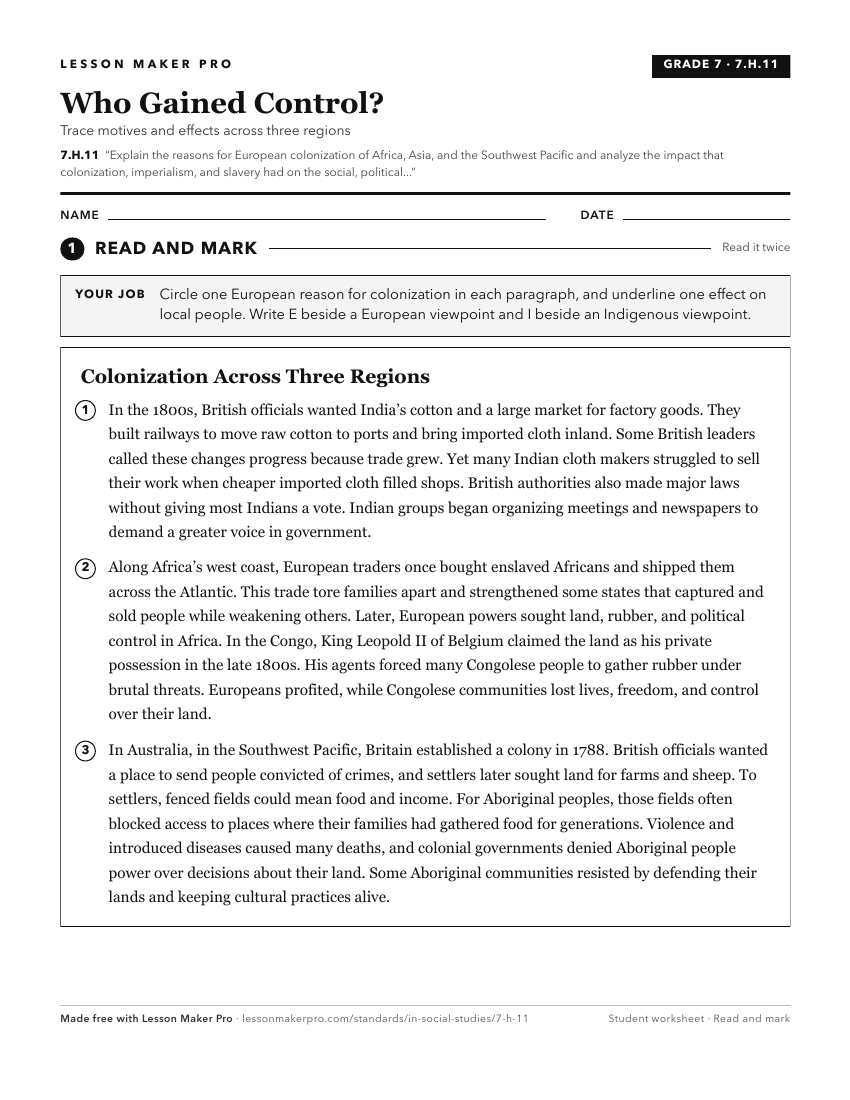
A ready-to-print activity worksheet aligned to 7.H.11, with an answer key for the teacher on its own page. No account needed.
PDF, US Letter, prints cleanly in black and white.
Download the worksheetKeep exploring
Related Standards
- WH.4.4
Explain the consequences of and resistance to the conquests and colonization as a result of the worldwide voyages of exploration, including the transatlantic sl...
- 8.H.2
Compare and contrast reasons for British, French, Spanish, and Dutch colonization in the New World.
- 7.H.6
Compare and contrast the institution of slavery in its various forms in Africa, Asia, and the Southwest Pacific, and analyze the impact slavery had on different...
- 5.H.5
Compare and contrast the religious, political, and economic reasons for the colonization of the Americas by Europe.
Turn this exact standard into a lesson
Grade, subject, topic, and the complete standard are prefilled. Create one free, no account needed.
Also for this standard:Make a WorksheetMake a QuizMake a Sub Lesson