Indiana Social Studies WH.4.5
The Standard
Examine the reactions against European Exploration including reactions in China, Japan, Africa, and the Americas.
2026 Indiana Academic Standards: K-12 Social Studies
Teacher's field guide
What This Standard Means
What Students Need to Do
- Students identify how people in China, Japan, Africa, and the Americas responded to European trade, missions, and conquest. They compare limits on contact, negotiation, and armed resistance using named examples.
What Mastery Looks Like
- A student can explain why Chinese officials regulated Portuguese trade at Macau and why Japanese rulers banned missionaries but allowed limited Dutch trade. They can link Queen Nzinga’s resistance to Portuguese expansion and the Pueblo Revolt to Spanish rule.
Common Misconceptions
- Some students think China and Japan ended all European contact, though both allowed limited trade. Others treat Africans or Indigenous Americans as a single group with one response. They may mistake the Pueblo Revolt for a response to first contact rather than decades of Spanish rule.
How to Assess It
- Give students this exit ticket: “Name one response to European expansion in China, Japan, Africa, and the Americas. Explain what prompted two of those responses.”
Lesson moves
Ways to Teach It
Give groups dated cards about Macau, Dejima, Queen Nzinga, and the Pueblo Revolt; have them arrange the cards on a timeline.
Ask students to write: Why did Japan ban missionaries but keep Dutch trade at Dejima?
Play four corners: read clues about Macau, Dejima, Queen Nzinga, and the Pueblo Revolt; students move to the matching region.
Find Taos Pueblo on a current map of New Mexico, then compare its location with a map of the 1680 revolt.
Free download
Printable WH.4.5 Worksheet
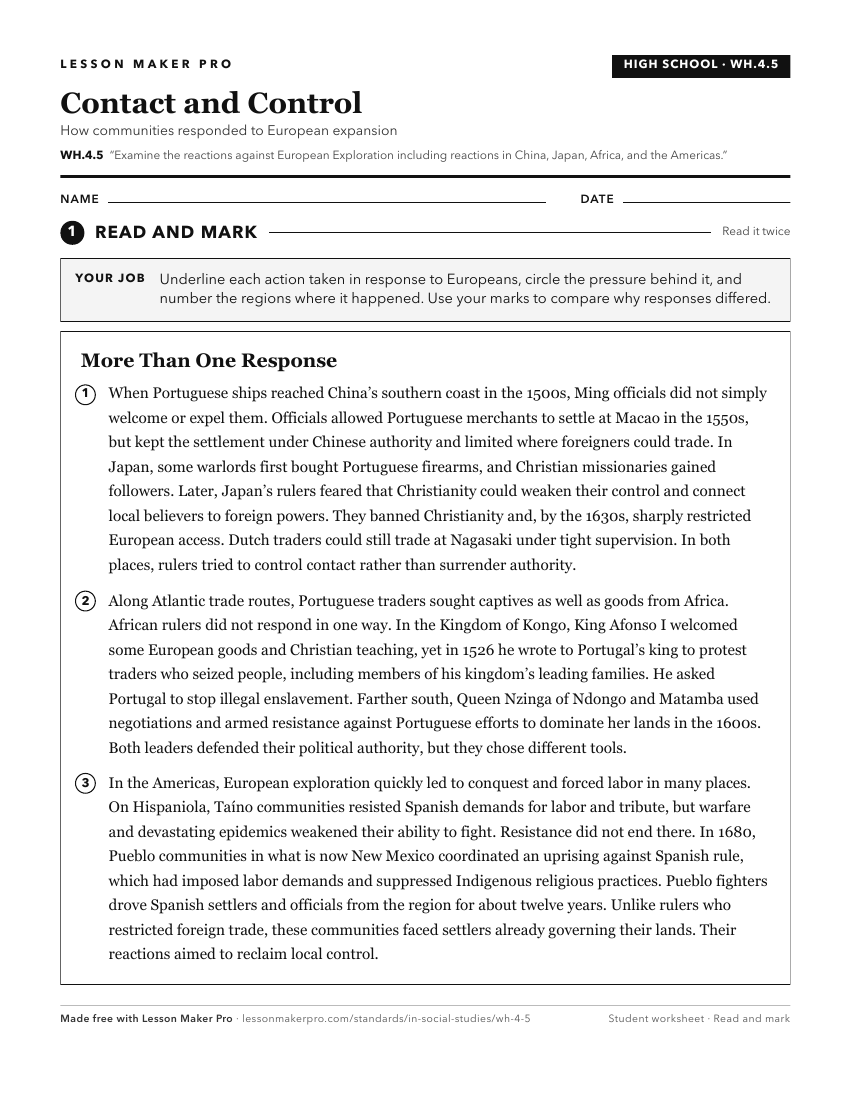
A ready-to-print activity worksheet aligned to WH.4.5, with an answer key for the teacher on its own page. No account needed.
PDF, US Letter, prints cleanly in black and white.
Download the worksheetKeep exploring
Related Standards
- 7.H.10
Analyze worldwide voyages of exploration and discovery by considering multiple perspectives of various people in the past by demonstrating their differing motiv...
- WH.5.5
Analyze the causes and consequences of 19th century imperialism for Asia, Africa, and the Americas, including resistance movements to imperial control.
- 5.H.2
Examine accounts of early European explorations of North America, including major land and water routes, reasons for exploration, and impacts of the exploration...
- WH.4.4
Explain the consequences of and resistance to the conquests and colonization as a result of the worldwide voyages of exploration, including the transatlantic sl...
Turn this exact standard into a lesson
Grade, subject, topic, and the complete standard are prefilled. Create one free, no account needed.
Also for this standard:Make a WorksheetMake a QuizMake a Sub Lesson