Indiana Social Studies USG.2.5
The Standard
Explain how a shared American civic identity is grounded in Founding Era principles and values such as liberty, equality, justice, popular sovereignty, individual rights, and representative democracy.
2026 Indiana Academic Standards: K-12 Social Studies · Students understand the nature of citizenship, politics, and governments, understanding the rights and responsibilities of citizens and how these are part of local, state, and national government. Students examine how the United States Constitution protects rights and provides the structure and functions of various levels of government. Students examine how the United States interacts with other nations as well as the government's role in world affairs will be examined.
Teacher's field guide
What This Standard Means
What Students Need to Do
- Students use founding documents to explain how shared political ideals, not shared ancestry, connect Americans. They link liberty, equality, justice, and individual rights to the people's power to choose representatives. They also identify where early practice fell short.
What Mastery Looks Like
- A student can use “consent of the governed” to explain popular sovereignty and House elections to explain representative democracy. They can explain that enslaved people and most women were denied political rights at the founding, despite promises of liberty and equality.
Common Misconceptions
- Students may think a shared civic identity means everyone has the same ancestry, religion, or views. They may confuse popular sovereignty with voting directly on every law, or assume everyone had equal rights at the founding.
How to Assess It
- Show students “all men are created equal” and “We the People.” Ask them to name an ideal in each excerpt, explain how elections put one ideal into practice, and identify one group excluded at the founding.
Lesson moves
Ways to Teach It
Give pairs printed strips from the Declaration, Constitution, and Bill of Rights; have them sort the strips by civic ideal and explain each choice.
Ask students to write: How could the Declaration promise equality while enslaved people were denied freedom and most women could not vote?
Play an evidence match game: students pair “consent of the governed,” House elections, and free speech with sovereignty, representation, and individual rights.
Use a local school board election flyer to trace how voters choose representatives who make decisions for the community.
Free download
Printable USG.2.5 Worksheet
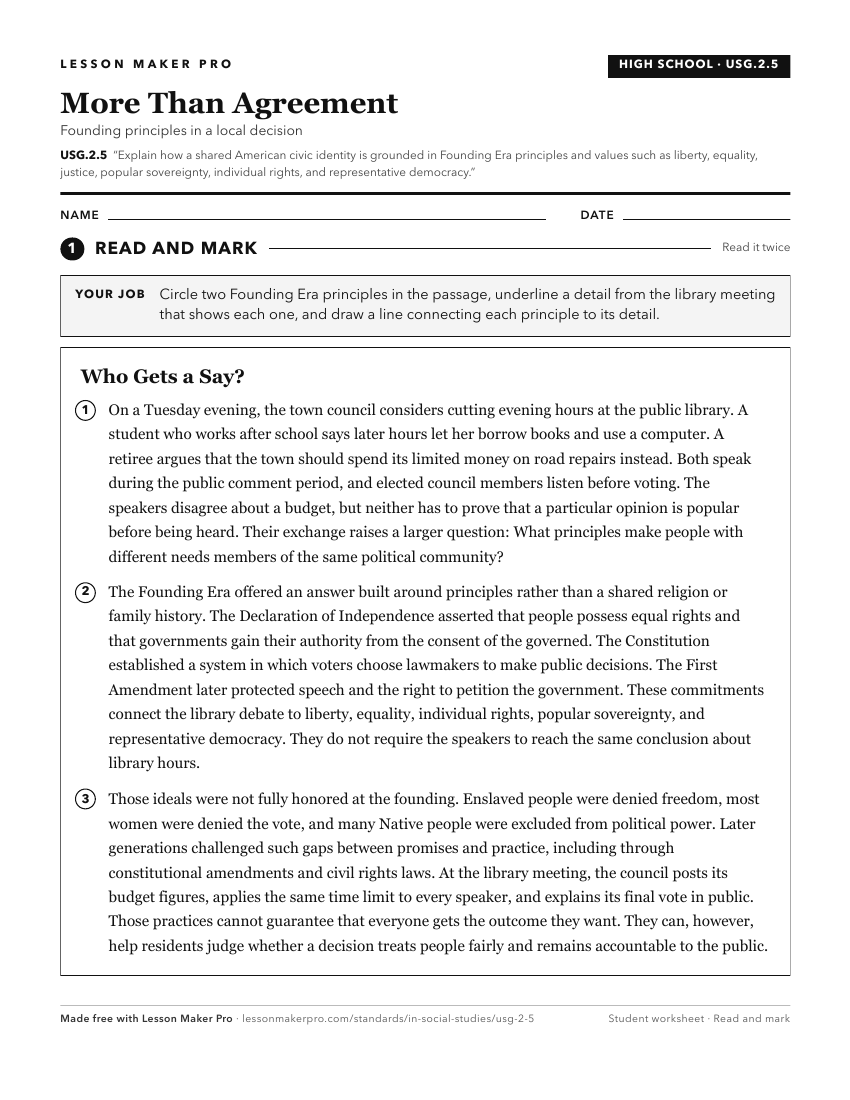
A ready-to-print activity worksheet aligned to USG.2.5, with an answer key for the teacher on its own page. No account needed.
PDF, US Letter, prints cleanly in black and white.
Download the worksheetKeep exploring
Related Standards
- 5.C.2
Identify and explain ideas about limited government, the rule of law, and individual rights in key colonial era documents.
- 8.C.1
Identify and explain essential ideas of constitutional government, which include limited government; rule of law; due process of law; separated and shared power...
- USG.1.6
Define and provide historical and contemporary examples of constitutionalism, rule of law, limited government, and popular sovereignty in the United States Cons...
- USG.2.4
Explain and analyze historical and contemporary examples of Founding Era principles of American government including natural rights, federalism, social contract...
Turn this exact standard into a lesson
Grade, subject, topic, and the complete standard are prefilled. Create one free, no account needed.
Also for this standard:Make a WorksheetMake a QuizMake a Sub Lesson