Indiana Social Studies USG.2.4
The Standard
Explain and analyze historical and contemporary examples of Founding Era principles of American government including natural rights, federalism, social contract, constitutionalism, representative democracy, political factions, liberty, security, justice, equality, the common good, and individual rights.
2026 Indiana Academic Standards: K-12 Social Studies · Students understand the nature of citizenship, politics, and governments, understanding the rights and responsibilities of citizens and how these are part of local, state, and national government. Students examine how the United States Constitution protects rights and provides the structure and functions of various levels of government. Students examine how the United States interacts with other nations as well as the government's role in world affairs will be examined.
Teacher's field guide
What This Standard Means
What Students Need to Do
- Students use founding debates and current policies to explain why government has power and where its limits lie. They show how voters, elected officials, and different levels of government make decisions. They explain whose rights and shared needs a decision serves.
What Mastery Looks Like
- A student explains why some people demanded a Bill of Rights before ratifying the Constitution. They connect that concern to a current rule about public protest and explain whose rights it affects. They can identify which level of government made the rule and support their answer with evidence.
Common Misconceptions
- Students may think the Bill of Rights created rights rather than placing limits on government. Some assume the federal government makes every rule, or that a majority vote can override any right. Others think the founders wanted to ban all political groups.
How to Assess It
- Exit ticket: Why did some people demand a Bill of Rights before ratification? How might their concern apply to a city rule limiting public protests? Name one right and one limit on government power.
Lesson moves
Ways to Teach It
Give pairs cards for the Bill of Rights, Federalist No. 10, a protest permit, and a party primary; match old concerns to new disputes.
Ask: Should a city deny a protest permit for safety? Write two sentences comparing that choice with debates over rights during ratification.
Run a four-corners game with school speech, state election, and city curfew scenarios; students choose the level of government responsible and defend it.
Post a sample town council proposal for an 8 p.m. park curfew; students draft a two-sentence public comment weighing safety against access.
Free download
Printable USG.2.4 Worksheet
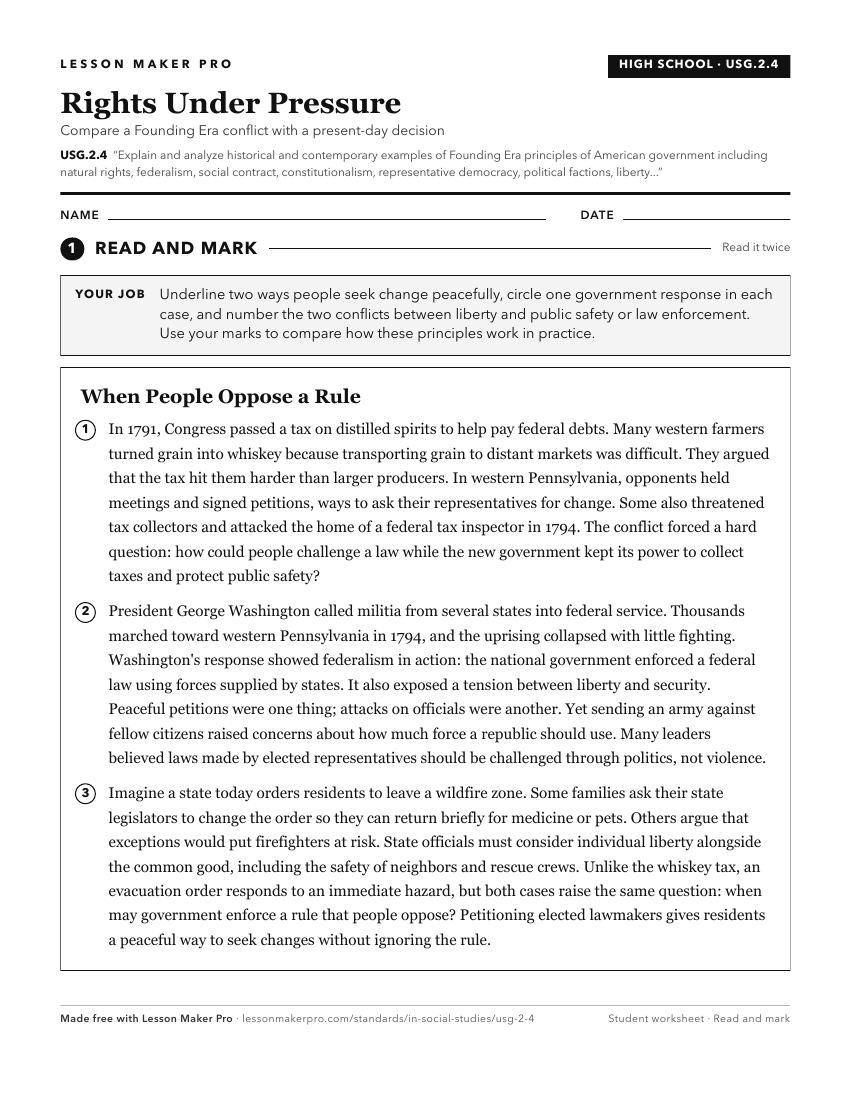
A ready-to-print activity worksheet aligned to USG.2.4, with an answer key for the teacher on its own page. No account needed.
PDF, US Letter, prints cleanly in black and white.
Download the worksheetKeep exploring
Related Standards
- USG.2.5
Explain how a shared American civic identity is grounded in Founding Era principles and values such as liberty, equality, justice, popular sovereignty, individu...
- USH.1.1
Analyze key documents from the Founding Era and major ideas about government, individual rights, and the general welfare embedded in these documents.
- USG.1.6
Define and provide historical and contemporary examples of constitutionalism, rule of law, limited government, and popular sovereignty in the United States Cons...
- USG.2.3
Analyze and interpret central ideas on government, individual rights, and the common good in founding documents of the United States.
Turn this exact standard into a lesson
Grade, subject, topic, and the complete standard are prefilled. Create one free, no account needed.
Also for this standard:Make a WorksheetMake a QuizMake a Sub Lesson