Indiana Social Studies USG.1.6
The Standard
Define and provide historical and contemporary examples of constitutionalism, rule of law, limited government, and popular sovereignty in the United States Constitution, and explain the relationship of these constitutional principles to the protection of the rights of individuals.
2026 Indiana Academic Standards: K-12 Social Studies · Students understand the nature of citizenship, politics, and governments, understanding the rights and responsibilities of citizens and how these are part of local, state, and national government. Students examine how the United States Constitution protects rights and provides the structure and functions of various levels of government. Students examine how the United States interacts with other nations as well as the government's role in world affairs will be examined.
Teacher's field guide
What This Standard Means
What Students Need to Do
- Students explain how the Constitution binds the government and limits its powers. They distinguish rule of law, which applies to officials too, from popular sovereignty, which gives people authority through elections. They use past and recent examples to show how these principles protect rights.
What Mastery Looks Like
- A student can explain why Nixon had to turn over tapes in 1974 and why a 2024 election gave voters a say, not unlimited power to winners. They can use the First Amendment and presidential term limits to show where government power stops.
Common Misconceptions
- Some students think a written constitution protects rights even if officials ignore it. Others think laws bind citizens but not leaders, or that an election win lets leaders silence critics. Limited government does not mean government cannot act.
How to Assess It
- Exit ticket: Newly elected council members ban criticism of the council. Name two principles that limit their action and explain which right protects critics.
Lesson moves
Ways to Teach It
Give pairs the Preamble, Article I, Section 1, and the First Amendment; have them highlight who grants power, who gets it, and where it stops.
Ask: If voters approve a law banning criticism of the mayor, can the city enforce it? Use the First Amendment to defend your answer.
Post four principle signs; read Nixon's tapes order, the 22nd Amendment, a recent election, and a court ruling against a speech ban; students choose.
Print your county's latest election results; students identify an elected official and explain why the First Amendment still limits that official's power.
Free download
Printable USG.1.6 Worksheet
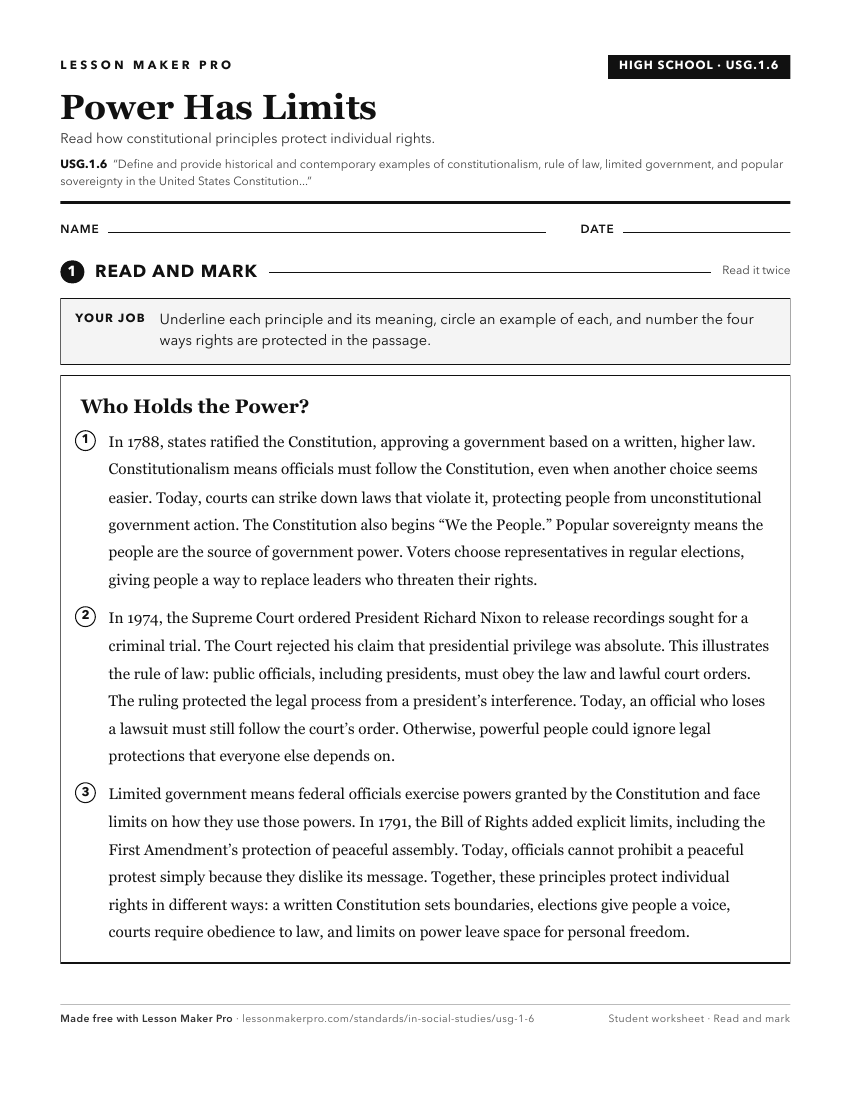
A ready-to-print activity worksheet aligned to USG.1.6, with an answer key for the teacher on its own page. No account needed.
PDF, US Letter, prints cleanly in black and white.
Download the worksheetKeep exploring
Related Standards
- USG.1.7
Evaluate how the United States Constitution establishes majority rule while protecting minority rights and balances the common good with individual liberties.
- 8.C.1
Identify and explain essential ideas of constitutional government, which include limited government; rule of law; due process of law; separated and shared power...
- USG.3.2
Explain the constitutional principles of federalism, separation of powers, the system of checks and balances, and republican government. Provide examples of the...
- USG.2.4
Explain and analyze historical and contemporary examples of Founding Era principles of American government including natural rights, federalism, social contract...
Turn this exact standard into a lesson
Grade, subject, topic, and the complete standard are prefilled. Create one free, no account needed.
Also for this standard:Make a WorksheetMake a QuizMake a Sub Lesson